What is ‘The Simple View of Reading’? and Why do we ask children to ‘read out aloud’?

The Simple View of Reading

The term ‘Simple View of Reading’ used by schools may seem strange as there is nothing simple about learning to read.

‘The Simple View of Reading’ was adopted by the Government in 2007 and now underpins the English National Curriculum’s programmes of study for reading at Key Stage 1 and 2.

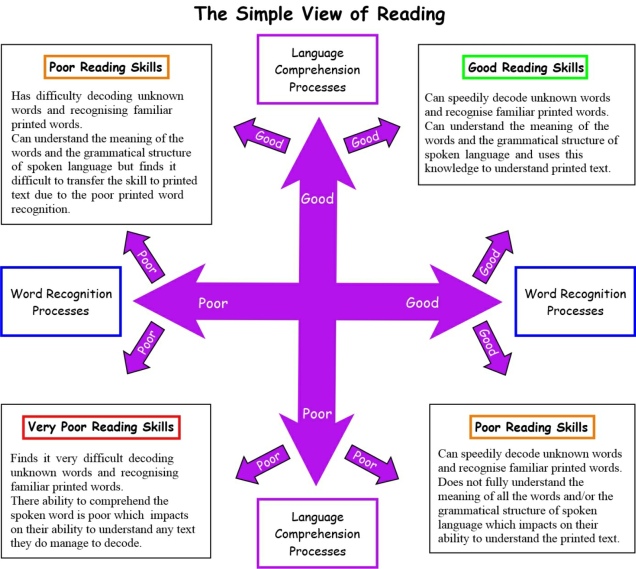
Even though reading, the ability to decode the word and extract the correct meaning of the words, is a complex set of skills; ‘the Simple View of Reading’ conceptual framework (Stuart et al. 2008, cited Hoover and Gough, 1986) reduces it down to two key components:

  • Word recognition – the ability to decode unknown words and recognise printed words.
  • Language comprehension – the ability to understand the spoken words and use this process to understand the written text.
Reading Comprehension = Decoding x Linguistic Comprehension

So in theory a child’s reading comprehension ability can be predicted by looking at their decoding and linguistic (spoken language) comprehension abilities (Johnston & Watson, 2007).

When using ‘the Simple View of Reading’ as the basis for teaching reading it becomes clearer as to why:

  • A high quality phonics scheme is required, which  the Rose Report (2006) explains ‘…is not a  ‘strategy’ so much as a body of knowledge, skills and understanding that has to be learned.’ (page 20) [This teaches children how to decode.]
  • A language rich environment to develop and encourage linguistic comprehension is vital.

[For a pdf copy of this diagram click here] PDF: https://www.teachphonics.co.uk/The%20simple%20view%20of%20Reading%20diagram.pdf

Why we ask children to read out aloud

Reading is the ability to first decode the letter sequence of the word (phonics) and then to place meaning to it in relation to the context in which it is being used.

Unfortunately, many children just decode, speak and do not actively listen to what they have said, so they do not gain meaning from the words they are reading (poor reading comprehension skills).

We ask children who are learning to read to ‘read out aloud’, but forget to tell them why. It is not just so we can hear they have decoded a word correctly. The important point is to encourage them to actively listen to what they are saying. The idea is that if they hear the words they will, if it is part of their vocabulary, understand their meaning and therefore fully comprehend the text they have read.

Bibliography

Johnston.R. and Watson.J. ‘Teaching Synthetic Phonics’, 2007, Pub: Learning Matters, Sage Publication Ltd.

Rose.J. ’Independent review of the teaching of early reading: final report March 2006’ Pub: DfES Publications

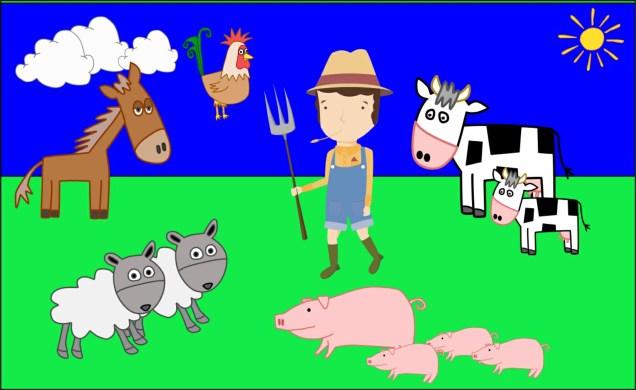
Developing Phoneme Knowledge Using the Power of ‘Old MacDonald’

Here at Teach Phonics we are always saying how important speaking, listening and vocabulary building is for all children. If a child does not hear or use a wide range of words they cannot develop their phonics skills. A child needs to experience a wide variety of word so they can learn how to make and use all the sounds required in the English language. This doesn’t happen by chance it has to be experienced and taught.

Spring and all that we often associate with this time of year is upon us: lambs, chicks and new life. This in turn prompted memories of singing ‘Old MacDonald had a Farm’, with my own children and grandchildren. A strange connection; maybe!

But, maybe not! Through the making of animal noises and the repetition of the ‘e i e i o’ refrain they were learning to play with sounds. Through the song they were learning how to make sounds through changing their mouth shape, the position of their tongue and controlling their breathing.

When they couldn’t make a particular animal noise we just moved to the next animal on the farm, because it is a fun song, so no pressure. Next time we sang the song, the animals were still all included and over time they learnt to make all the animal sounds. Which, by happy coincidence, are the same sounds (phonemes) needed in our everyday speech.

The great thing about Old MacDonald and his farm is that he also has tractors, a quad bike and depending on where he lives even a helicopter. The list of vehicles and additional animals is endless, especially if he opens up his own zoo next to the farm!

Old MacDonald and other nursery rhymes/songs all help to build and teach a child how to make the sounds required for pronouncing words. They offer a child the opportunity to practice making sounds which they may otherwise have no experience of in their normal everyday life. They will store this sound making information for later use as they mature and extend their vocabulary, which in turn supports their phonics knowledge, which impacts on their reading ability.

Homonyms & Homophones!

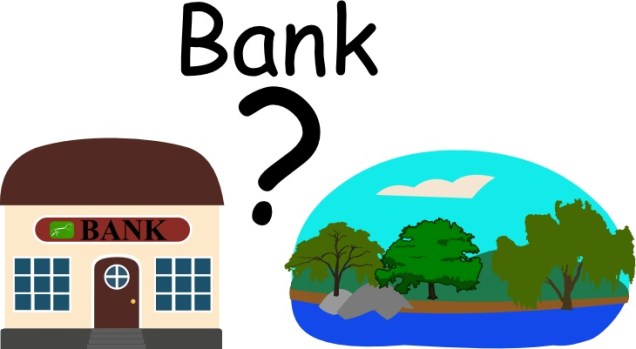
Homonyms and homophones need to be heard or read within a specific context if we are to understand what the word means, for instance, if I say the word ‘bank’ and do not give any other verbal or written clues what do I mean?

The word on its own could mean a couple of things the bank of a river or sand bank or a bank where I can collect money. If it is not put into a context its meaning is unclear. The word ‘bank’ is classed as a homonym.

Homonyms are words which are pronounced and spelt the same; therefore, their meaning can only be truly understood when the context in which the word is being used is made clear. For instance, the word ‘bark’ can be used to mean the bark on a tree or the noise a dog makes.

Homophones are words which are pronounced (sound) the same but have a different meaning and are spelt differently such as, ‘their’ and ‘there’, ‘one’ and ‘won’ or ‘two’, ‘to’ and ‘too’.