The Simple View of Reading
The term ‘Simple View of Reading’ used by schools may seem strange as there is nothing simple about learning to read.
‘The Simple View of Reading’ was adopted by the Government in 2007 and now underpins the English National Curriculum’s programmes of study for reading at Key Stage 1 and 2.
Even though reading, the ability to decode the word and extract the correct meaning of the words, is a complex set of skills; ‘the Simple View of Reading’ conceptual framework (Stuart et al. 2008, cited Hoover and Gough, 1986) reduces it down to two key components:
- Word recognition – the ability to decode unknown words and recognise printed words.
- Language comprehension – the ability to understand the spoken words and use this process to understand the written text.
| Reading Comprehension = Decoding x Linguistic Comprehension |
So in theory a child’s reading comprehension ability can be predicted by looking at their decoding and linguistic (spoken language) comprehension abilities (Johnston & Watson, 2007).
When using ‘the Simple View of Reading’ as the basis for teaching reading it becomes clearer as to why:
- A high quality phonics scheme is required, which the Rose Report (2006) explains ‘…is not a ‘strategy’ so much as a body of knowledge, skills and understanding that has to be learned.’ (page 20) [This teaches children how to decode.]
- A language rich environment to develop and encourage linguistic comprehension is vital.
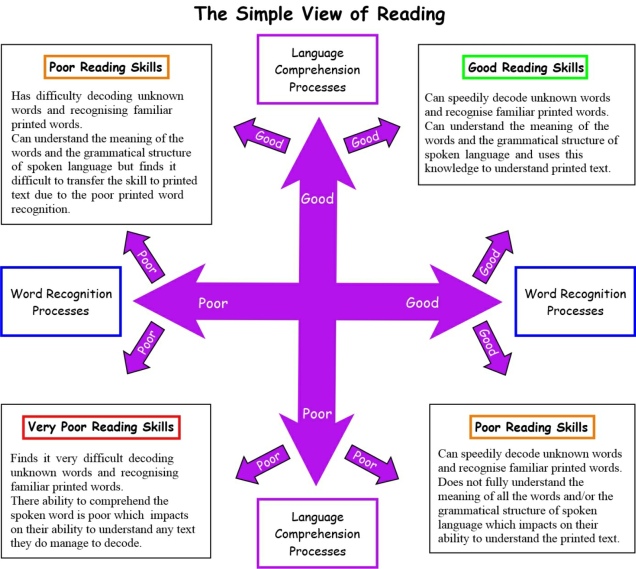
[For a pdf copy of this diagram click here] PDF: https://www.teachphonics.co.uk/The%20simple%20view%20of%20Reading%20diagram.pdf
Why we ask children to read out aloud

Reading is the ability to first decode the letter sequence of the word (phonics) and then to place meaning to it in relation to the context in which it is being used.
Unfortunately, many children just decode, speak and do not actively listen to what they have said, so they do not gain meaning from the words they are reading (poor reading comprehension skills).
We ask children who are learning to read to ‘read out aloud’, but forget to tell them why. It is not just so we can hear they have decoded a word correctly. The important point is to encourage them to actively listen to what they are saying. The idea is that if they hear the words they will, if it is part of their vocabulary, understand their meaning and therefore fully comprehend the text they have read.
Bibliography
Johnston.R. and Watson.J. ‘Teaching Synthetic Phonics’, 2007, Pub: Learning Matters, Sage Publication Ltd.
Rose.J. ’Independent review of the teaching of early reading: final report March 2006’ Pub: DfES Publications

