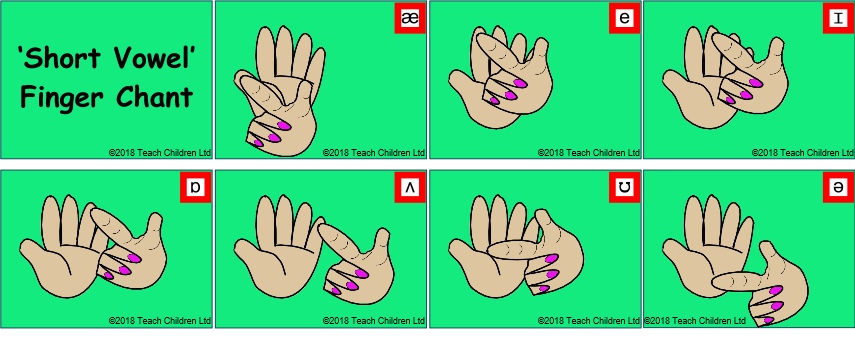
There are 7 ‘short’ vowel sounds, although children are usually only introduced to the 5 which are most commonly heard in simple CVC (consonant, vowel, consonant) words:
Learning to hear and differentiate the vowel sounds from consonant sounds is an important skill in understanding how words are formed. Every word in the English Language has to have a vowel sound in it and every syllable in a word also has to have a vowel sound within it. This knowledge is an important element in developing our phonemic awareness and phonics knowledge as we start to learn how to read and spell words.
There are 20 vowel sounds in the English (UK) Language, usually (in the UK Education System) split into two main categories based on sound quality:
‘Short’ vowel sounds, due to the short duration of the sound being made, the sound cannot be held onto without becoming distorted, such as the /e,(e)/ in me, pea and tree
‘Long’ vowel sounds, due to the length of their pronunciation, these can often be held without distorting their sound, such as the /oi,(ɔI)/ sound found in the words:boy, coin and buoy
Here at Teach Phonics we split the ‘long’ vowel sounds category into ‘long’ vowel sounds and ‘long ‘R’ controlled’ vowel sounds. The ‘long ’R’ controlled’ vowel sounds are so called because of the slight /r,(r)/ sound quality that can be heard in them for example the /or,(ɔː)/ sound found in the words: fork, door, walk and sauce.
The English Phoneme Chart, which uses the unique symbols of the International Phonetic Alphabet (IPA), splits the 20 vowel sounds into two groups based on mouth position:
Monophthongs which have one mouth position throughout the sound for example /e,(e)/ in me.
Diphthongs, where the mouth position changes, giving a 2 sounds quality to the phoneme for example, /oi,(ɔI)/ inboy.
Last week we started to explain some of the technical language associated with the teaching of phonics, which some new parents may have little or no knowledge of. So, we thought it would be a good idea to continue with this over next couple of weeks to further support you in helping your child.
Graphemes are the alphabet letters, or letter combinations, that represent a single sound (phoneme) in a written word.
An example of a single letter (grapheme) representing a single sound (a phoneme) can be seen in the following words: sat, pat and dog.
Some sounds are represented by two letters and are called digraphs such as the ‘ch’ in ‘chip’ or ‘sh’ in ‘shop’ or ‘ea’ in ‘head’ and the ‘ai’ in ‘rain’.
Other sounds can be represented by 3 (trigraphs) or 4 (quadgraphs) letter combinations such as ‘igh’ in ‘light’ and ‘eigh’ in ‘eight’.
Phonemes are the smallest units of sound of a language; which we blend together to form words.
The English Language has 44 phonemes, 24 consonants and 20 vowels, represented by the unique symbols of the International Phonetic Alphabet (IPA).
The 44 phonemes of English (UK) are represented by more than 280 letter or letter combinations. Most letters therefore never make just one sound and that sound can be made by more than one letter or letter combination.
We have created over 1,000 videos that split words into their individual phonemes, showing which letters are making which sound in each word. You can access these videos in two ways:
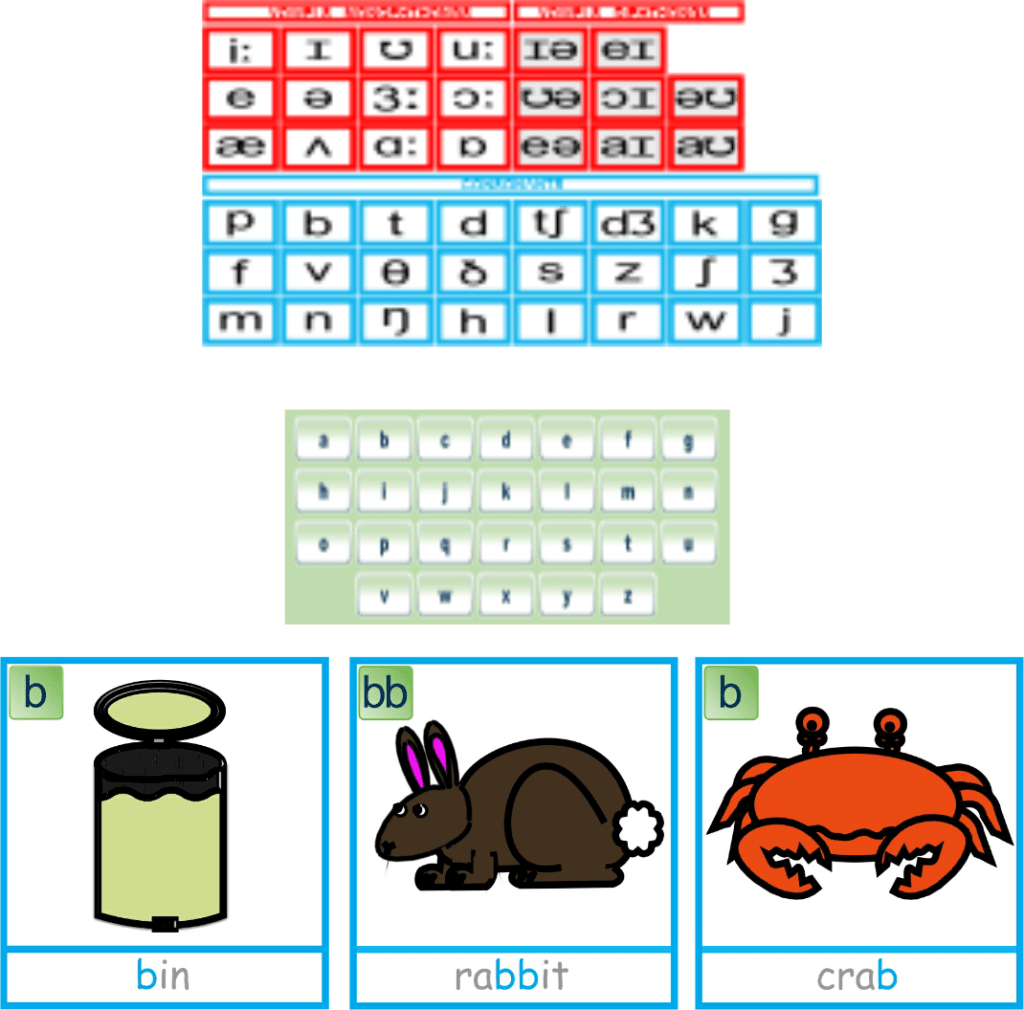
If you want to know which letter or letter combination represents a sound, click on the relevant phoneme button on the English Phoneme Chart;
If you want to know what sound a letter or letter combination makes and see supporting animations, click on the relevant letter or letter combination on the Alphabet Keyboard.
With the new school year well under way many new parents are being introduced to the world of phonics and the all the technical language associated with it. So we thought we would take this opportunity to demystify some of that technical language.
Phonics is the association of sounds (phonemes) to written alphabet letters (graphemes). For reading (decoding) the phonics coding system is used to convert the written word into sounds. For spelling (encoding) the same phonic coding system is used to covert sounds heard into letters to form written words.
Phonemic awareness is our ability to split words into their smallest sound units (individual phonemes) and to manipulate these sounds through segmentation, blending, substitution, re-ordering and deletion. This is based on what we hear and say, not the written word.
These are developed further later on when phonics is introduced, sound to letter association.
Segmentation – being able to split words into their individual sounds, for example ‘cat’ into c-a-t.
Blending – being able to blend individual sounds together to say a word, for example d-o-g into dog.
Substitution – being able to swap one sound/letter association for another in a word, for example swapping the /k,(k)/ sound in the word ‘cat’ with a /h,(h)/ sound to say the word ‘hat’.
Reordering – being able to swap the sounds/letter association around to create a new word, for example changing the order of the letters in the word ‘cat’ to form the new word ‘act’.
Deletion (omission) – being able to remove a sound/letter association from a word to create a new word, for example removing the /t,(t)/ sound from the word ‘cart’ to say the new word ‘car’.
Good phonemic awareness is the vital skill required before phonics can be introduced successfully as a tool for learning to read and spell.
Watch our ‘Single Word Reading’ animation to see these manipulation skills in action: bit.ly/20JAHSa
After such a long break from school it is good to take some time to check your child has not slipped back.
Playing some simple letter name and sound games can really help get your child (and you) back into school mode.
Some simple game ideas:
You can use words in books, cards, on labels or signs when out and about. Ask your child to point to a particular letter in the word using the letter name. Then ask your child to say the word, or you can say it. Then ask them to tell you what sound the letter is making in that word.
Pick a card at random, using lower-case and capital letter flash cards (you can make your own); show your child and ask them to tell you the name of the letter on the card, and to give you a sound the letter makes. Ask older children to give you the other sounds the letter can make. For older children you can also use cards that have common digraphs (two letters representing one sound) and trigraphs (three letters representing one sound) on.
Play Pelmanism (Memory Game). How to Play:
You will need two sets of flash cards. The cards are thoroughly mixed and spread face down on the table or floor. They can be arranged in a regular pattern or randomly, but they must not overlap.
One player turns over a card, leaving it in the same place, they say what it is (letter name and/or sound) and then turn over another saying what it is. If the two cards match then the player keeps them and has another go. If the cards do not match then the cards are turned back over in the same location as before and it is the next players turn.
The game is finished when all the cards have been matched and the winner is the one with the most pairs.
If you are not sure of all the sounds a letter, or combination of letters, can represent then use our Alphabet Keyboard to help you find the sounds (phonemes): bit.ly/2bUtZae
We are nearly through the summer holidays; six weeks may have seemed like a long time but it is amazing how quickly it passes.
The last thing you and your child probably want to think about right now is handwriting or phonics and getting ready for next term; and quite right too!
So, don’t think about it in the conventional way of practise, practise and practise.
Think more play, play and play!!!
Children learn so much through just playing; developing physical, mental, communication and vocabulary strengths and skills, which all support them at school and with learning.
Once introduced to a new game or activity children will very often take it and make it their own, making new rules and introducing extra characters or challenges.
The skill as a parent is remembering to let go of your preconceived ideas about how a game should be played and letting your child take the initiative.
If you provide the opportunities it is amazing how they will take on the challenge of inventing a new game or (in their eyes) improving an existing one.
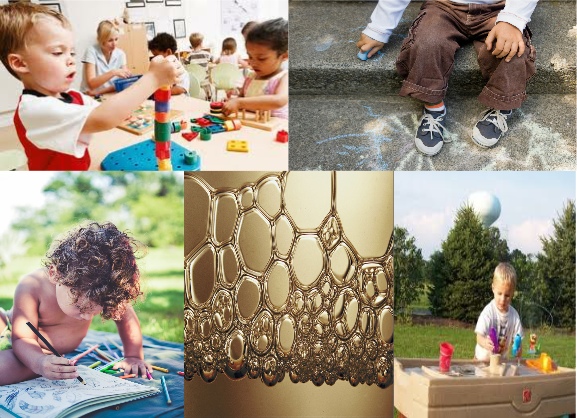
This does not have to cost a penny; use the toys they already have or make games using empty plastic bottles or cardboard tubes.
The following types of play can support and develop the key strengths and skills your child needs for handwriting and you have not had to mention school or homework.
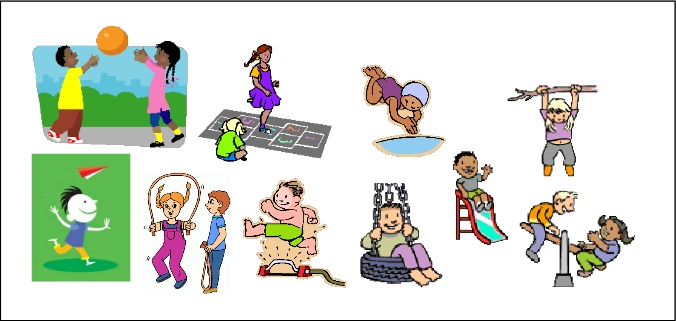
The local play park is a fantastic free resource; running, jumping, crawling and climbing can all be encouraged. If your child is a little reluctant then it may well be that they are unsure how to do some of these activities. Explain when jumping that they needed to land on their feet and bend their knees as they land. Start small and as their confidence grows so does the height or distance they jump. Climbing can be scary for some children so again explain how to climb, moving one hand or foot at a time so that there are always three other points of contact.
If you are lucky enough to have a garden then mud play is messy but so much fun, it can be contained in a small area and will not only make you a cool adult but, if you join in, it will knock years off you (have a go, it is a great free therapy session).
Skittle games are always fun, extend the activity by decorating the skittles (plastic bottles or cardboard tubes) using anything from crayons, paint or even dress them up as people or animals.
The SUN is out which makes it time for the water fights and games to begin.
It is August and for once, the weather is perfect, so why not set up water squirting games in the garden. The kids are waterproof and everything else will dry out, eventually!
How can water fights and games, where you can get wet, be handwriting and phonics homework?
You will be encouraging your child to develop their hand strength, co-ordination and eye tracking skills (all handwriting skills). However, these games are also fantastic for developing sound and word awareness skills.
Try mimicking the sounds that the water makes as it drips on to the floor or hits the targets; use directional language to support your child’s aiming skills; describe how the objects move when hit: bouncing, rolling or flying and talk through the emotions evoked through playing the games.
As well as supporting your child in developing a whole range of physical and language skills you will also increase your cool adult status.
Some fun water games:
Try setting up a target wall, using chalk to draw the targets.
How many of the targets can you hit with water squirted from a water pistol or squeeze bottle in a set time.
How many targets can be washed off.
Set up a skittles range.
Each skittle hit with water can be worth a certain number of points, or the distance of the skittles may affect their value.
A time trial game to hit all the skittles. If you are using plastic bottles as skittles try making some of them a little heavier by putting sand or dirt in them to make it a bit harder to knock them over.
Move the object race games.
A light toy/ball has to be moved by squirts of water over a distance.
A range of objects moved in to target areas to gain points.
The only limitation is you and your child’s imagination and trust me kids never tire of finding new ways to play with water (but then again neither do many adults)!
Phase 1 Phonics is the first phase of the Department of Education’s ‘Letter and Sounds’ program. This is designed to focus on developing a child’s speaking and listening skills (phonological awareness).
It focuses on developing their:
Ability to listen attentively
Vocabulary knowledge
Confidence in speaking to adults and other children
Ability to hear the difference between phonemes (sounds)
Ability to say/repeat clearly the phonemes they hear
To hear a word and then split that word up and say the individual sound (phonemes) that make up that word (segmentation)
This is all about developing their skills through what they hear and say only (phonemic awareness).
To be honest it is all about playing with sounds and words and having fun.
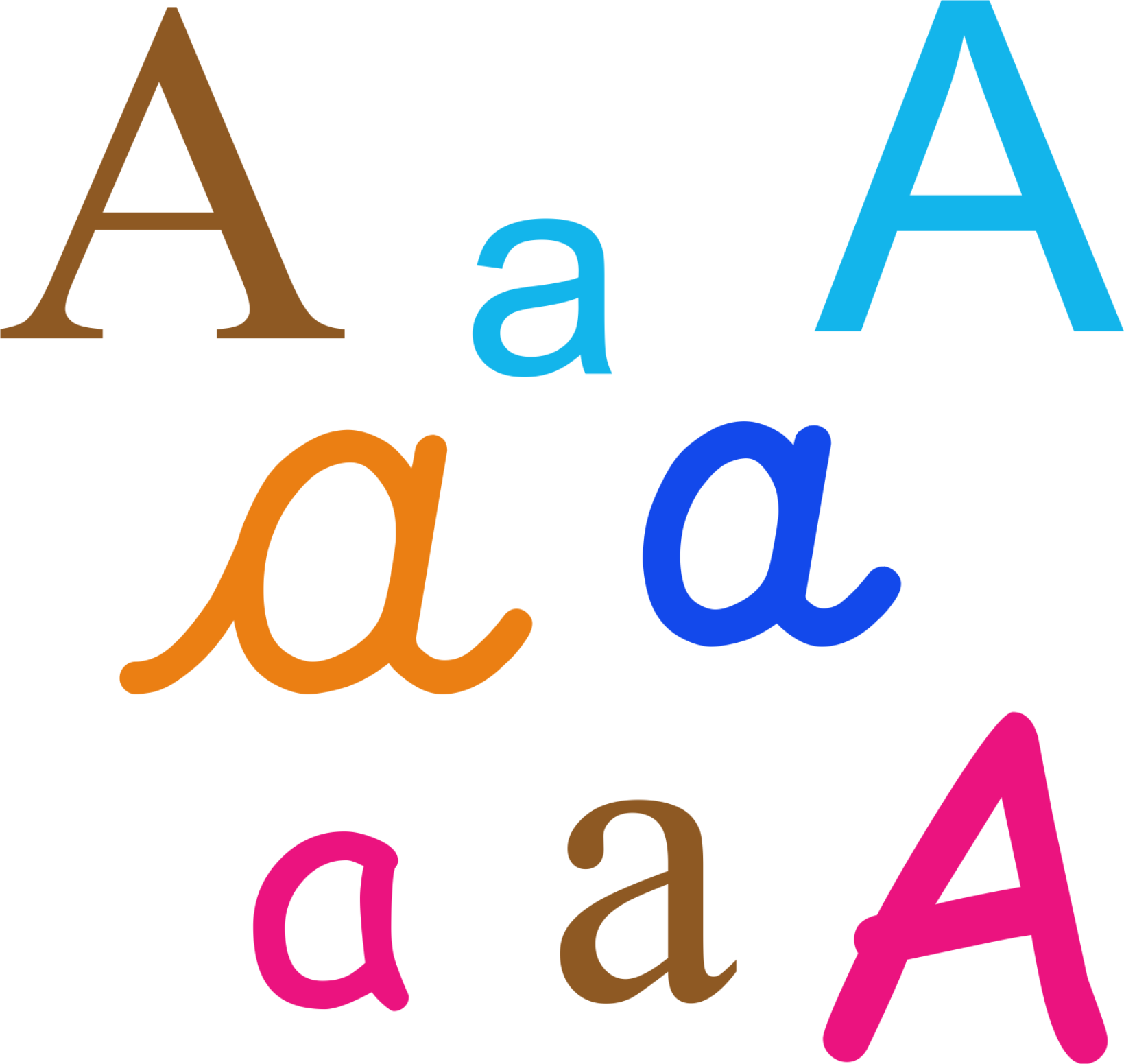
That the same letter can look different, for example, a lower-case letter ‘b’ looks different from a capital letter ‘B’. Letters will also look different depending on which font type is being used or if it is handwritten, for example, an Arial font letter ‘g’ looks different from a Calibri font ‘g’.
That letters have names and the same name is used for that letter even when they look different, so the lower-case letter ‘a’ and its capital letter form ‘A’ are both called ‘ay’.
That letters (graphemes) are used to represent sounds (phonemes) in words. Teaching the unique letter names of the alphabet is an important pre-phonics skill. A letter or combination of letters can represent more than one sound and so the only way of identifying alphabet letters when we talk about them is to use their unique names.
Developing Letter Knowledge:
Through Play:
Sorting and Matching Games – use plastic or wooden letters, alphabet letter flash cards; can they group all the lower-case letters together, or all the capital letters or all the different letter ‘ay’s’ together.
Kim’s Games – use plastic or wooden letters, alphabet letter flash cards. Using a few letters at a time, place 5 to 10 on a tray and let your child look at them and talk through which letters are there. Cover with a tea towel and ask your child to look away, then remove 1 or 2 of the letters. Then ask your child to look back and remove the tea towel. Can they spot which letters are missing.
Detective Games – focus on identifying individual letters of the alphabet and naming them, this can be played at home or when out and about.
Leap Frog – use the letters of the alphabet on home-made paper lily pads. Use the letter names to identify the target lily pad for your child to either jump onto or to throw a bean bag/soft toy on to.
Skittles and Throwing Games – use letters of the alphabet on the targets and use the letter names as a way of identifying which of the targets your child is aiming for.
Through Drawing/Writing:
Making lists of things to do or a shopping list. Their version of the list may be just squiggles and dots (so don’t rely on this for your shopping trip) but it is the beginning. I would keep the list and get them to tick off things done or items purchased as part of the experience so that it has a genuine purpose (children really like this).
Making and drawing their own story book.
Learning to write letters correctly (see our Teach Handwriting Website: http://bit.ly/2F9P7cI)
Through Songs/Nursery Rhymes:
Singing Alphabet Songs, try singing it to different tunes.
Make up Your Own Rap – point to the letters as the rap is said.
Through Talk:
Talk about letters as being shapes made up of straight, curves and diagonal lines.
Look at the letters in your child’s name, talk about the fact that the first letter in their name is always a capital letter and that normally the other letters are lower-case letters.
Point out, especially for slightly older children, that lower-case letters are about half the size of the capital letters.
Compare letters looking at what is the same and different about them.
When taking about letters use the letter name as well as the sound it is making in the word, remember a letter is often used to represent more than one sound. The letter ‘a’ can be used to represent different sounds in the following words: ant, apron, was, and any (just 4 of the eight sounds it is used to represent).
Through Book Sharing:
What books to choose?
Books with shapes
Books where you have to find things (like I spy)
Alphabet books
Books which use different font styles in the pictures and text.
Book Sharing Tips:
Alphabet books do not need to be read from cover to cover. Let your child choose which letters they want to look at.
Trace the letters with your finger or let your child trace it (make sure you trace the letter using the correct formation orientation, encourage your child to do the same).
Talk about the pictures in alphabet books before focusing on the letter, its name and the sound it can make.
Show your child the first letter in their name and then look for that letter in the book.
Show and talk about how some letters are in their capital form and others in their lower-case form. Can they find other examples of the letters?
Choose two letters to talk about: How do they look alike? How do they look different? What shapes/line styles are they made up of?
Vocabulary is knowing the meaning of words including names of things, feelings, concepts and ideas. The larger a child’s vocabulary (understanding what words mean not just being able to say them) the easier it is for them to understand what they are reading.
The more you talk and share words and their meaning with your child the greater their vocabulary will become.
Vocabulary building:
Through Play:
Introducing and playing sorting games helps your child to build a mental filing cabinet system of categories, this helps them to remember and learn the meaning of words. Start by introducing simple categories of everyday items like food or clothes as their vocabulary increases categories such as colour, size and texture become more appropriate.
As babies handle objects and toys describe how they feel, what they look like or the sound they make
When you are playing with your child add in new words (explain their meaning), descriptions or expand on words they use in play. For example, if you are playing cars with your child you may comment on the size difference or colours between the cars.
Remember children learn new words best when they are learned in context, that is, in a natural setting.
If they are trying to say a word let them finish and then say it back to them clearly and correctly. Do not make them repeat it back to you, they may choose to do so but make it their choice.
Through Drawing/Writing
When drawing or painting with your child, or they are sharing their pictures with you, talk about the shapes, colours types of lines (straight line or curves line), what you like best about the picture, and the objects you can see.
Through Songs and Nursery Rhymes
Listening of nursery rhymes and children’s song is a good way of helping your child make the distinction between the music and words (language used) in them. It is a good idea to practise this skill when there are no other noise distractions.
Try playing some action songs and rhymes to help your child learn the actions for the rhyme, then let them have a go on their own. Watch them to see if they can do some of the actions at the right time in the song, to see if they are listening for the right cue words. If they are struggling, explain they have to wait for certain words and show them what to do and when to do it.
Nursery and silly rhymes are great ways to introduce your child to rhyming sounds and increase sound play in words.
Singing often slows down our pronunciation of words, helping your child to pick out unusual or rhyming sound patterns. As with reading aloud it can introduce a wider vocabulary for your child.
Finger rhymes and action songs encourage your child to interact with words, the sounds within them and the rhythms they create. Finger rhymes such as ‘Round and Round the Garden’, ‘Pat-a-cake’ and ‘Incy Wincey Spider’. ‘Row, Row Your Boat’ is a lovely whole-body movement song that encourages a rhythmic whole-body motion, which babies and toddler enjoy (as well as the adults).
Through Talk
Speak in ‘parentese’ until a child is about 9 months old as they will listen to you longer and hear more words
Talk about feeling and situations throughout the day.
When your child points at something tell them the name of the object, for example if they point at an apple, say “Apple”.
Explain words or give synonyms
Avoid replacing unfamiliar words with familiar ones (explain the meaning). Remember to try to use the new word in context regularly as repetition of the word will help your child to remember it and reinforce the meaning of the word.
Repeat and expand on what your child says, so if they say “Dog!” you may say “A big dog!” This also helps them to develop an understanding of sentence structure.
Through Book Sharing
What books to choose?
Books with words not used in everyday conversation.
Non-fiction books (informational, instructional, true stories) -as they use different words to fiction (story) books.
Any book really. The language of books in much richer and varied than that of everyday conversation.
Book Sharing Tips
Sharing and talking about the books you are reading helps to build word knowledge, as you point to the pictures, picking out different objects.
Reading out aloud helps to introduce your child to words that they may not experience in their everyday talk. This helps to expose them to new vocabulary and the sounds to be found in those words.
Reading aloud poems and story books with strong rhyme elements, like those found in Dr.Seuss books, helps introduce the new words and rhyming sounds in words.
Try exaggerating the rhyming words to help highlight the sound patterns, making it easier for your child to tune into them.
Explain unfamiliar words; don’t replace them with familiar ones.
When a word has more than one meaning. Talk about the different meanings.
Add descriptive words or more information than in the book.
Encourage your child to talk about the pictures. Add information and ideas to what they have said.
Use words to describe how characters in the book might have felt at a point in the story.
Use words to describe ideas in the story even if they are not used in the book.
Remember children learn new words and their meaning through repetition, so you will need to be patient as you re-read the same story over and over again or answer the same questions over and over again.





 teachphonics.blog