Why Placement (Preposition) and Directional Vocabulary is Important!

Teaching your child the vocabulary related to placement (preposition) and direction is import in supporting them to understand and follow instructions, as well as sharing information themselves, such as; ‘put your cup on the table’ or to say ‘teddy in car’.

We also use this placement (preposition) and directional language to explain how to draw shapes, patterns and write letters and numbers.

We have created three sets of picture cards and games to help you support your child in developing and using positional (preposition) and directional vocabulary.

You can find these free resources on our Phonics website by following this link: https://www.teachphonics.co.uk/phonics-resources.html

You can find these free resources in Parent section of the Teach Handwriting website by following this link: https://teachhandwriting.co.uk/more-activities.html

What are prepositions?

A word used with a noun or pronoun to show place, position, time or means, e.g. at home, in the hall, on Sunday, by train.” Definition from Oxford School Dictionary, third edition 2002.

Here are just some preposition and directional phrases you might like to use:

On the … On top of the … Above the … Over the…

Under the… Below the … Beneath … Underneath …

Behind the …

In front of the…

Next to …Beside the … On the right of … To the right of … On the right-hand side … On the left of … To the left of … On the left-hand side… Before the … After the …

In the…  Inside the …

Out of the … Outside of the …

Between the … In between the … In the middle … In the center …

Going up the ….  Going down the … Going towards the… Going away from …

Why Vocabulary Building with your Child is so Important! 

Building your child’s vocabulary is a vital pre-reading skill. This is because schools teach what is referred to as the ‘The Simple View of Reading’.

This means that a child decodes the words using their phonics skills and their own vocabulary knowledge to help them understand the text they are reading.

So, for a child to have good reading skills they need to be able to speedily decode unknown words and recognize familiar printed words. And, understand the meaning and grammatical structure of the spoken language and then use this knowledge to understand the printed text.

This means that a child:

• Who does not fully understand the meaning of all the words and/or the grammatical structure of the spoken language (age appropriate) will also be unable to fully understand the printed text; even if they decoded it correctly.

• Whose ability to understand the spoken word is poor will also be unable to understand the printed text; even if they have managed to decode a few words.

Helping your child build their vocabulary is also vital, if they are to continue to develop good communication skills. Talking, explaining, sharing and playing are all important in developing your child’s vocabulary, their understanding of the words meaning in the context of the conversation and the grammatical conventions of our spoken language.

The Importance of Using Letter Names for Developing Handwriting, Phonics and Reading Skills

Here at Teach Children we have always promoted the importance and power of teaching the correct letter names to begin with; through our Teach Handwriting website, Schemes and Teach Phonics website. Unfortunately, some schools, teacher and parents still seem to be concerned that this is not consistent with the teaching of phonics, which is just not correct.

A myth which became popular, in the early years of introducing synthetic phonics into schools, is that children should not be taught the alphabet letter names as they find it too confusing. However, in recent years this has started to change as phonics schemes have adjusted some of their approaches to teaching phonics to include the use of letter names.

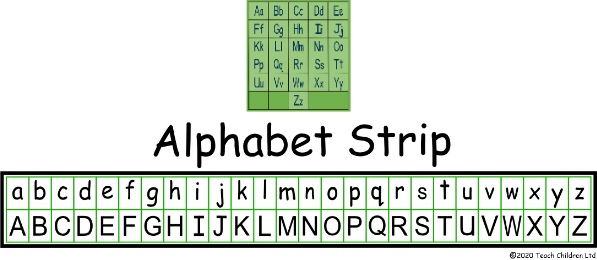
Learning the unique letter names of the alphabet is a pre-phonics skill; as well as an early learning goal. It has to be remembered that a letter is a shape which only represents a sound when it is placed within a word or sentence (has a context). Also, a letter or combination of letters can represent more than one sound and so the only unique way of identifying alphabet letters when we talk about them is to use their names.

It is important to remember that just because a child can correctly recite the ‘Alphabet’ song it does not mean they know the letters of the alphabet. It is surprising how many children can do this but when shown letters from the alphabet cannot name them at all. They may be able to tell you the sound the letter makes but have no idea of the letters name.

Learning the correct letter names helps to reinforce that when talking about the letter ‘a’ (ay) for example it has a set shape regardless of the sound that it will be representing in the word. This further supports children’s handwriting development as the communication of your requirements is unambiguous.

Teaching the correct letter names is important when supporting handwriting as this can in turn affect a child’s phonics understanding later on. For example, it can seem very easy when explaining to a child which letter to write when they ask which one is making a ‘kuh’ sound in a word such as cat to say a ‘curly kuh’. There is no such letter in the alphabet called ‘curly kuh’ it is the letter ‘c’ (cee). By adding the ‘kuh’ sound to the letter it reinforces incorrect phonics knowledge. The letter ‘c’ does not make a ‘kuh’ sound in words such as: city, circle, cycle and centre.

Some children will then only ever refer to the letter ‘c’ as ‘curly kuh’ and the letter ‘k’ as’ kicking kuh’. As I say these are not letter names of the alphabet and also devalue the power of phonics at the same time.

How can the education establishment get hot under the collar about not using the correct terminology in the teaching of English in schools such as: phonemes, graphemes, digraphs, modal verbs etc… yet still refer to the letter’s ‘c’ and ‘k’ as ‘curly or kicking kuh’!

Phonics is a powerful decoding and encoding tool. However, so is the alphabet letter naming system. Both need to working side by side to support our children, especially in those early years of their educational journey.

The English phonic system is very complex but this is why our language is so rich. Young children need to use letter names as an additional tool, as it takes many years for them to be introduced to the more complex phonics coding system.

Alphabet Name animation (scroll to the bottom of the page): https://www.teachphonics.co.uk/phonics-graphemes.html

What is Phonics?

With the new school year under way some of you will have been introduced to phonics for the first time. Phonics is a very useful decoding tool used for developing reading skills and as an encoding tool for spelling.

Phonics is the simple process of linking sounds to letters, its complexity comes from how many sounds (phoneme) to letter (grapheme) combinations there are. So, to be good at phonics a child needs to know the 44 sounds and numerous letter and letter combinations of English and then learn the associations between the two.

Children can communicate orally from an early age; it is when they move to the written word that they need to learn how to decode text, to turn the letters into words they already know.  

Using phonics knowledge for reading entails:

  1. Identify the letter or letter combination, in a word, that represent a sound
  2. Associate the letter or letter combination to one of the 44 sounds
  3. Blend each of the sounds together to form the word
  4. Recognise the now oral word to extract its meaning

The theory supporting the teaching of reading using phonics, especially synthetic phonics, is that if a child can decode a word by associating individual sounds to a letter or combination of letters, they will then be able to blend those sounds together to form and say the word.

Once a word has been spoken, they will extract its meaning by using their far more extensive spoken language comprehension. Children are therefore using the same mental processes to understand written text and speech.

The Key to Good Phonics Skills – Part 14

Developing #Listening & #Speaking Skills – Directional and Positional Language (Word Play)

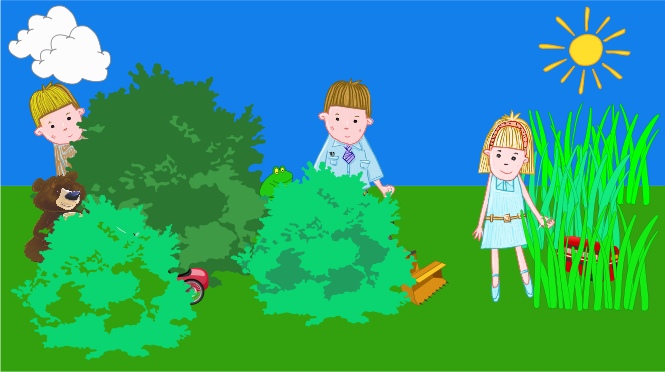
Treasure hunt and hide & seek games are a great way to teach a child directional and placement (prepositions) language. It is important for a child to learn directional and placement vocabulary so that they can both understand instructions given and share information themselves, such as; ‘put your cup on the table’ or to say ‘teddy in car’.

Through treasure hunts and hide & seek games you can introduce new directional and placement language in a fun and exciting way. There are a number of different ways to approach this:

  • You can give verbal instructions to the hidden treasure.
  • You could create a map for them to follow and ask them to talk through the map, supporting with new language as necessary.
  • You could use a mixture of verbal and map clues.
  • For older children get them to hide the treasure and give you instructions, or draw a map.
  • If you have more than one treasure to find, make the most exciting piece more difficult to find.

The important thing is the language shared. Words and phrases to use are: left, right, straight on, forward, backwards, about turn, turn around, up, down, higher, lower, stop, next to, in front, beside, underneath, on top of, behind, on the left of, on the right of, outside, and inside.

Treasure hunts and hide & seek games are a great whole class or family activity and you are never too young or too old to join in!

The Key to Good Phonics Skills – Part 13

Developing #Listening & #Speaking Skills – Syllable Awareness & Counting (Word Play)

At about the age of 4 years old children start to develop an understanding that words can be split into sound parts (syllables) and that these parts give the word its rhythm.  A syllable is the largest phonological unit (one or a group of sounds) of a word and is like the rhythmic beat of the word.

They should be able to orally blend syllables together to form words and segment words into syllables (https://www.teachphonics.co.uk/phonological-awareness-stage-4.html).

A fun activity to help develop syllable understanding:

How Many Syllables?     

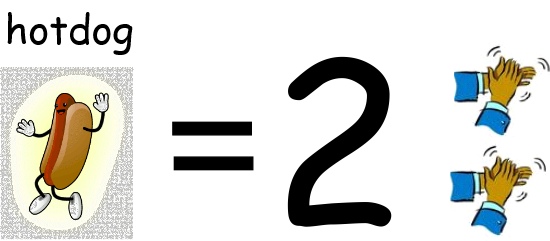
Children love to clap out the number of syllables in a word. It is important to say the word at a normal speed rather than really slowly as this can distort the word and make it difficult to hear the syllables. To start with a child just needs to be able to recognize them by clapping, stamping or jumping for each syllable of a word; they don’t need to be able to count them. It is thought that only about 50% of children can count out the syllables by the age of 4, so you can do the counting for them.

Spoken syllables are organised around the vowel sounds, making counting them easy; as the jaw drops when the vowel sound is spoken in the syllable. Try placing your hand under your jaw with your mouth closed before you say a word. Start with ‘cat’ you will notice the jaw drops once; this is because it is a one syllable (monosyllabic) word.

Most children will find it easier to identify syllables in compound words to start with. A compound word is formed by two words (root words) put together such as: sunset, hotdog, snowman and postman. They find it easier because the jaw tends to drop quite distinctly as we say the vowel sound in each of the root words and because we tend to say these words slowly.

The Key to Good Phonics Skills – Part 10

Developing #Listening & #Speaking Skills – Developing Word Awareness

A good word awareness (receptive and expressive language) is a key phonics skill.

Helping a child build their vocabulary (word awareness – receptive & expressive language) is vital if they are to continue to develop good communication skills. Talking, explaining, sharing and playing are all important as well as making sure that you pronounce words clearly and correctly for a child to hear. A child may not have developed all the skills needed to copy you accurately but they will store the sound pattern information for later use. The more they hear the correct sound patterns the sooner they will start to use them themselves.

Click the link for ‘Tips to Help Develop Word Awareness (Receptive & Expressive Language)’:

https://teachphonics.co.uk/word-awareness.html

The Key to Good Phonics Skills – Part 9

Developing #Listening & #Speaking Skills – How to encourage your child to keep talking!

Learning to the conventions of conversation start from birth, as parents we do not really think about it in this way but it is what we tend to do naturally.

Sometime though we all need a few pointers to help us, so here are some ideas to help you develop and encourage your child’s talking skills:

From Birth to 1 Years Old

  • To encourage cooing and babbling. Get yourselves comfortable in a face-to-face interaction position, babies often like lying on their back or on your lap looking up at you.
  • Start by talking to your child while gently tickling their tummy or neck.
  • Anytime they make a sound you imitate or match the sound as best you can. It is best to wait until they have finished before you try (one of the conventions of conversation).
  • Try changing or adding a new sound to the one your child has made, so if they say ‘ah’ you might say ‘ah-ooh’, this will help to keep the game interesting.
  • Show that you are excited by the sound they make – smile and laugh, if you are enjoying the interaction, they will be excited by it too.
  • Vocal play works best when it occurs naturally, such as playing with farm animals, for instance sheep go baa, baa or cows make a moo, moo sound.

1 to 2 Years Old

  • Talk directly to your baby/toddler so they can see your facial expressions and how your lips move, as this is the beginnings of learning the conventions of communicating, listening and responding (something they cannot get from the TV, iPad or overheard conversations – indirect talk).
  • Talk through everyday events, such as getting dressed; what is happening, where you are going and what the plan is for the day.
  • Use your body language, expressions and gestures to help reinforce and develop your child’s neurological pathways to support understanding and comprehension.
  • Share books with your baby/toddler, they may not understand what you are saying to begin with but they will be listening to the different sounds that the words make. By reading aloud you are probably using words that will introduce new sounds that your child may not be picking up from your normal day to day conversations. As they get older you are developing and increasing the range of their vocabulary.
  • Babies and young children love to hear you singing and saying rhymes, this is because the language is slowed down, allowing them to hear the small units of sounds and patterns which are often repeated several times in a short time lapse. Again, the language used is often different from your day-to-day talk.
  • To encourage and help your child to generate and play with sound, repeat the sounds that they make.
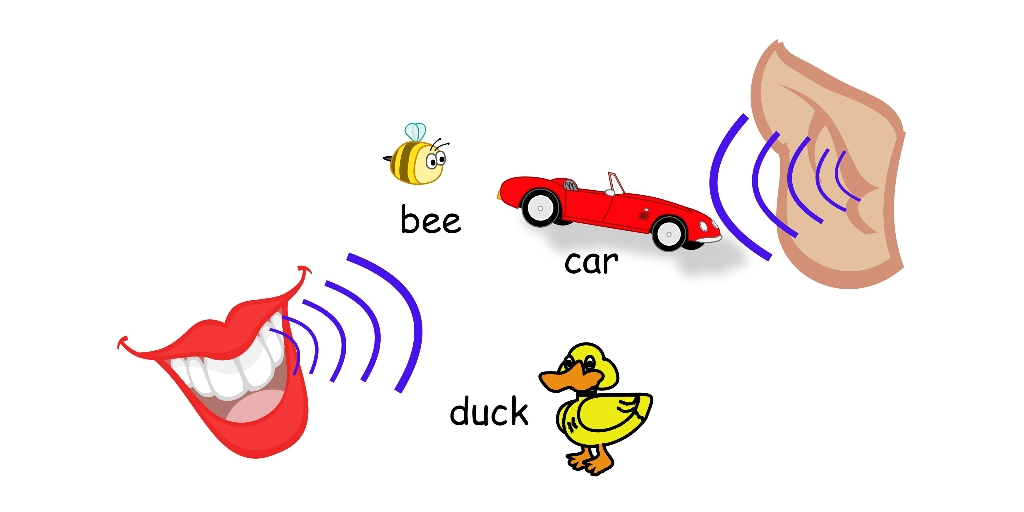
  • Using familiar objects and toys make the noises associated with them for example a toy car, broom, broom or a toy bumble bee buzz, buzz.
  • When you are out and about talk about what you can see and about the sounds they make, a cat goes meow or a train Choo, Choo, for example.
  • You can use other onomatopoeic words to describe sounds, such as wooden spoons on saucepans could be bang, bang or blocks being knocked together could be click, clack.

2 to 5 Years Old

  • When playing, talking and sharing new words it is important to get down to your child’s level so they can see your face and how your mouth and lips move to form the words or sounds being explored.
  • Remember toddlers learn to listen best when they are taking an active role in what they are doing, especially when you or others join in eagerly with them to play the games.
  • Give your child thinking and response time, this may seem like a long pause but it is worth waiting, be sure your child has finished what they wanted to say before you respond.
  • Try not to finish off your child’s sentence, yes sometimes it may be quicker but just give them a little moment longer and they will get there. If it is clear they cannot think of the word they want then that is of course different.
  • Before a child can really take part in meaningful interactions with others, they need to learn how to take turns. It is one of the basic elements of communication, when we are talking to someone, we leave a gap/pause so that the other person has the opportunity to respond, taking turns. Turn taking skills need to be modelled and taught to help your child develop and understand this element of communicating with others.
  • To encourage your child to keep talking try nodding, smiling and using comments such as; wow, really or acknowledging something they have said by repeating rather than always asking them questions.
  • We are all guilty of half-listening, especially when we are busy trying to cook dinner for example. If it is obvious that what your child wants to tell you is really important then make it clear that you are interested by saying “Just let me finish this and then I can listen to you more carefully.”

The Key to Good Phonics Skills – Part 8

Developing #Listening & #Speaking Skills – The Importance of Small Talk!

Don’t underestimate the importance of everyday chatter or conversation (‘Small Talk’), children develop and learn a great deal through ‘Small Talk’ with adults and other children.

What do we mean by ‘Small Talk’?

With babies it is the kind of talk that explains what we are doing, what they are doing, where we are going and what we can see.  As they get older our verbal exchanges increase as we support their receptive and expressive vocabulary development. Through these exchanges we also support their general language development and understanding of how words are pronounced, basic sentence structure and using the correct tense.

When we talk with a child we demonstrate and model the use of language in real time so that it has meaning. For instance, a child may point and say “cat” and we would respond with “Yes, the cat is sleeping.” Or we may correct the child and say “That is a dog.” If we could we would point to a cat and explain the difference. We also correct mispronunciation of words and correct tense issues in the same way; repeating the word or sentence using the correct pronunciation or tense back to the child. The Communication Trust is now part of the I Can organisation and has a great range of information and guidance for parents and professionals: https://www.icancharity.org.uk/

The Key to Good Phonics Skills – Part 1

What is listening?

Listening is a complicated skill that requires children to learn how to pay attention – being able to focus on a particular voice or sound by filtering out other voices and ambient noises. They then have to concentrate on the voice or sounds to take in the information, building the stamina needed to listen for extended periods of time. Then they have to interpret that information to gain meaning – comprehension.

The usual approach to teaching children to listen is based on three behaviours:

  1. Sitting or standing still
  2. Looking at the person who is speaking
  3. Thinking about what the person is saying or said

However just because your child is replicating these behaviours doesn’t mean they are listening.

It is also surprising how often children are happy to follow steps 1 and 2 but completely miss step 3.

This is not surprising really as listening is not a set of behaviours but a set of skills that need to be taught and developed, starting from birth.

A child with poor listening skills will find it difficult to complete tasks, as they have not taken in all the information and so not understood the full extent of the task, or what was required of them. This can lead to a child flitting from one activity to another and never finishing anything, slowing down their learning. They also miss out on the sense of achievement and feeling of pride when a task is completed. This helps to build a child’s confidence, self-esteem and self-motivation to try again or attempt a more challenging task.

For many children good listening skills do not develop naturally, they have to be taught!