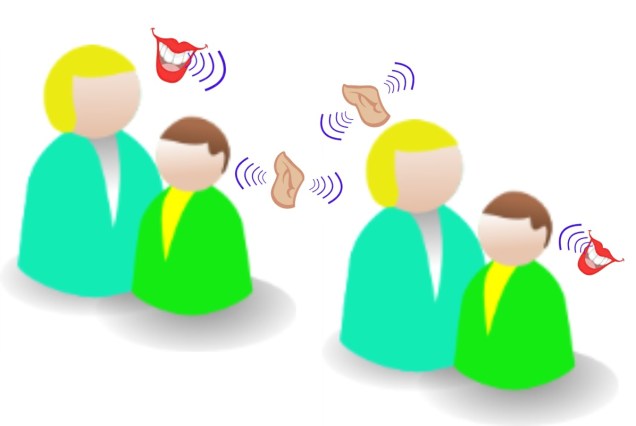
This week we will look at turn taking in conversation a skill children need to learn to take part in meaningful interaction with others. These interactions are a vital part of children’s physical, emotional, social and intellectual growth and wellbeing.
Children need to learn that in conversation they need to take turns listening and speaking.
This is more complex process than we often give it credit for as often we, especially in our busy lives, can be guilty of only listening to reply rather than listening to understand.
Children need to learn when to talk and when to listen; for this to happen they need to do the following:
- Actively Listen to the other person. This means:
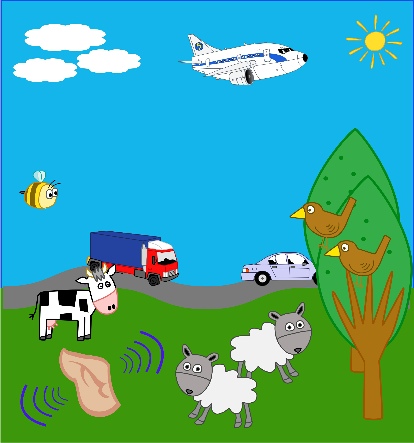
- Concentrate on the words being said, by blocking out other environmental noises and voices.
- For most children and adults this also means looking at the person, watching their facial expression and body language.
- Listening for the verbal cues and/or changes in the tone of voice that signifies that the person has finished speaking.
- Recognising that it is either your turn to respond by formulating a reply or not.
- Formulate a Response. This means:
- Extracting meaning – taking understanding from the words that have been spoken.
- Mentally searching for words to compile a grammatically correct set of sentences.
In young children this can take time, not because they do not have the answer, because they just take longer to recall and formulate their responses. This is due to the constant acquisition of new language and understanding of the grammatical conventions that need to be applied.
- Communicate Response. This means
- Speaking clearly, pronouncing words correctly in coherent sentences.
- Using socially appropriate facial expressions and body language to accompany the response.
- Using the appropriate verbal cues and/or changes in the tone of voice that allow the other person to understand it is now their turn.
- Wait. This means giving time for the other person to formulate their response.
- Actively Listen to the other person.
Learning these skills takes time and needs to be taught as well as modelled by those around the children. It begins very early on for instance, when we talk to a baby, as if expecting an answer. As a baby starts to make cooing and babbling sounds, they begin to respond to you in those gaps, their first conversations.
Something that is worth remembering:
“When you talk, you are only repeating what you already know. But if you listen, you may learn something new.” (Dalai Lama)