Back to School – What is Phonics?

Blog Phonics

With the new school year under way some of you will have been introduced to phonics for the first time. Phonics is a very useful decoding tool used for developing reading skills and as an encoding tool for spelling.

Phonics is the simple process of linking sounds to letters, its complexity comes from how many sound (phoneme) to letter (grapheme) combinations there are. So, to be good at phonics a child needs to know the 44 sounds and numerous letter and letter combinations of English and then learn the associations between the two.

Children can communicate orally from an early age; it is when they move to the written word that they need to learn how to decode text, to turn the letters into words they already know.

Using phonics knowledge for reading entails:

  1. Identify the letter or letter combination, in a word, that represent a sound
  2. Associate the letter or letter combination to one of the 44 sounds
  3. Blend each of the sounds together to form the word
  4. Recognise the now oral word to extract its meaning

The theory supporting the teaching of reading using phonics, especially synthetic phonics, is that if a child can decode a word by associating individual sounds to a letter or combination of letters they will then be able to blend those sounds together to form and say the word.

Once a word has been spoken they will extract its meaning by using their far more extensive spoken language comprehension. Children are therefore using the same mental processes to understand written text and speech.
Developing and Supporting Your Child’s Reading Journey – Week 6

Phonics Assessment Pages

Letter Knowledge

Letter knowledge is understanding;

  • That the same letter can look different, for example, a lower case letter ‘b’ looks different from a capital letter ‘B’. Letters will also look different depending on which font type is being used or if it is handwritten, for example, an Arial font letter ‘g’ looks different from a Calibri font ‘g’.
  • That letters have names and the same name is used for that letter even when they look different, so the lower case letter ‘a’ and its capital letter form ‘A’ are both called ‘ay’.
  • That letters (graphemes) are used to represent sounds (phonemes) in words. Teaching the unique letter names of the alphabet is an important pre-phonics skill. A letter or combination of letters can represent more than one sound and so the only way of identifying alphabet letters when we talk about them is to use their unique names.

Developing Letter Knowledge:

Through Play:

  • Sorting and Matching Games – use plastic or wooden letters, alphabet letter flash cards; can they group all the lower case letters together, or all the capital letters or all the different letter ‘ay’s together.
  • Kim’s Games – use plastic or wooden letters, alphabet letter flash cards use a few letters at a time, place 5 to 10 on a tray and let your child look at them and talk through which letters are there. Cover with a tea towel and ask your child to look away, then remove 1 or 2 of the letters. Then ask your child to look back and remove the tea towel. Can they spot which letters are missing.
  • Detective Games – focus on identifying individual letters of the alphabet and naming them, this can be played at home or when out and about.
  • Leap Frog – use the letters of the alphabet on home-made paper lily pads. Use the letter names to identify the target lily pad for your child to either jump onto or to throw a bean bag/soft toy on to.
  • Skittles and Throwing Games – use letters of the alphabet on the targets and use the letter names as a way of identifying which of the targets your child is aiming for.

Through Drawing/Writing:

  • Making lists of things to do, or a shopping list. Their version of the list may be just squiggles and dots (so don’t rely on this for your shopping trip) but it is the beginning. I would keep the list and get them to tick off things done or items purchased as part of the experience so that it has a genuine purpose (children really like this).
  • Making and drawing their own story book.
  • Learning to writing letters correctly – see our Teach handwriting Website: http://bit.ly/1dqBYFm

 Through Songs/Nursery Rhymes:

  • Singing Alphabet Song, try singing it to different tunes.
  • Make up Your Own Rap – point to the letters as the rap is said.

Through Talk:

  • Talk about letters as being shapes made up of straight, curves and diagonal lines.
  • Look at the letters in your child’s name, talk about the fact that the first letter in their name is always a capital letter and that normally the other letters are lower case letters.
  • Point out especially for slightly older children that lower case letters are about half the size of the capital letters.
  • Compare letters looking at what is the same and different about them.
  • When taking about letters use the letter name as well as the sound it is making in the word, remember a letter is often used to represent more than one sound. The letter ‘a’ can be used to represent different sounds in the following words: ant, apron, was, and any (just 4 of the eight sounds it is used to represent).

Through Book Sharing:

What Books to choose?

  • Books with shapes
  • Books where you have to find things (like I spy)
  • Alphabet books
  • Books which use different font styles in the pictures and text.

Book Sharing Tips:

  • Alphabet books do not need to be read from cover to cover. Let your child choose which letters they want to look at.
  • Trace the letters with your finger or let your child trace it (make sure you trace the letter using the correct formation orientation, encourage your child to do the same).
  • Talk about the pictures in alphabet books before focusing on the letter, its name and the sound it can make.
  • Show your child the first letter in their name and then look for that letter in the book.
  • Show and talk about how some letters are in their capital form and others in their lower case form. Can they find other examples of the letters?
  • Choose two letters to talk about: How do they look alike? How do they look different? What shapes/line styles are they made up of?

Letter & Sound Relationships That Break the Phonics Rules

Back in September we explained that Phonics is a very useful decoding tool used for developing reading skills and as an encoding tool for spelling. It is the simple process of linking sounds to letters, its complexity comes from how many sound (phonemes) to letter combinations (graphemes) there are.

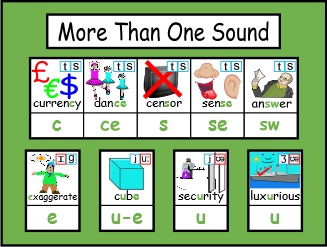
Some letter and sound associations just don’t follow the normal phonics rule of a single sound being associated to a letter or letter combination. A few letters represent two sounds, such as the letter ‘u’ which in the word ‘cupid’ represents the two sounds /y,(j)/ and /oo,(uː)/.

A more common one letter two sound relation is that of the letter ‘x’ representing the two sounds /k,(k)/ and /s,(s)/ as in the words: six and box.

Here are some other examples of single letters and split digraphs making two sounds instead of the usual phonics rule of only making one sound:

Level 1 More Than 1 soundLevel 2 More Than 1 sound

The ‘Long Vowel’ Sounds

Tree animation   Toy animation

There are 13 ‘long vowel’ sounds in total; 7 ‘long vowel’ sounds and 6 ‘long ‘R’ controlled vowel’ sounds.

The 7 ‘long vowel’ sounds are so called due to the length of their pronunciation; these can often be held without distorting their sound.

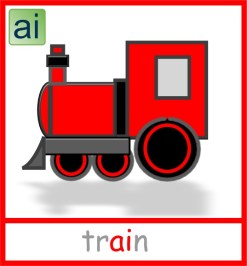
 The /ai,(eI)/ sound found in the words: train, tray, cake and break.

The /oa,(ǝƱ)/ sound found in the words: boat, hotel, toe and bone.

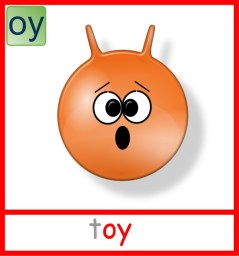
The /oi,(ɔI)/ sound found in the words: boy, coin and buoy.

The /ow,(aƱ)/ sound found in the words: owl, house, drought and hour.

The /ee,(іː)/ sound found in the words: tree, pea, me, and pony.

The /I,(aI)/ sound found in the words :iron, fly, pie and light.

The /oo,(uː)/ sound found in the words: spoon, blue, screw and you.

The 6 ‘long ‘R’ controlled vowel’ sounds are so called because of the slight /r,(r)/ sound quality that can be heard in them along with the length of their pronunciation; these can often be held without distorting their sound.

The /ar,(ɑː)/ sound found in the words: car, father (southern UK accent) and art.

The /or,(ɔː)/ sound found in the words: fork, door, walk and sauce.

The /ear,(Iǝ)/ sound found in the words: ear, here, deer and pier.

The /er,(ɜː)/ sound found in the words: bird, kerb, nurse and worm.

The /re,(Ʊǝ)/ sound found in the words: manure, tour and mature.

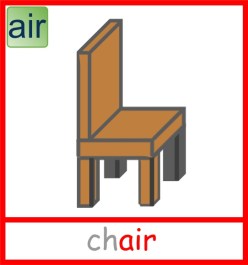
The /air,(eǝ)/ sound found in the words: chair, pear, square and where.


What are Graphemes?

Train picture card    Chair picture card

Date Originally Posted: 19/10/17

Graphemes are the alphabet letters, or letter combinations, that represent a single sound in a written word.

An example of a single letter representing a single sound (a grapheme) can be seen in the following words: sat, pat and dog.

Some sounds are represented by two letters and are called digraphs such as the ‘ch’ in ‘chip’ or ‘sh’ in ‘shop’ or ‘ea’ in ‘head’ and the ‘ai’ in ‘rain’.

Other sounds can be represented by 3 (trigraphs) or 4 (quadgraph) letter combinations such as ‘igh’ in ‘light’ and ‘eigh’ in ‘eight’.

What are Phonemes?

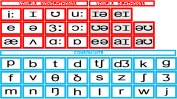
Phonics Chart with Phonemes

Date Originally Posted: 12/10/17

Phonemes are the smallest units of sound of a language; which we blend together to form words.

The English Language has 44 phonemes, 24 consonants and 20 vowels, represented by the unique symbols of the International Phonetic Alphabet (IPA).

The 44 phonemes of English are represented by more than 280 letter or letter combinations. Most letters therefore never make just one sound and that sound can be made by more than one letter or letter combination.

We have created over 1,000 videos that split words into their individual phonemes, showing which letters are making which sound in each word. You can access these videos in two ways:

  • If you want to know which letter or letter combination represents a sound, click on the relevant phoneme button on the English Phoneme Chart;
  • If you want to know what sound a letter or letter combination makes, click on the relevant letter or letter combination on the Alphabet Keyboard.

We hope you find these useful.

The Difference between Phonemic Awareness and Phonics

Single word reading

Date Originally Posted: 28/09/17

With the new school year well under way many new parents are being introduced to the world of phonics and the all the technical language associated with it. So we thought we would take this opportunity to demystify some of that technical language.

Phonemic awareness is our ability to split words into their smallest sound units (individual phonemes) and to manipulate these sounds through segmentation, blending, substitution and deletion. This is based on what we hear and say, not the written word.

The phonemic awareness sound manipulation skills; segmentation, blending, substitution and deletion are developed further through phonics, as letter associations are introduced.

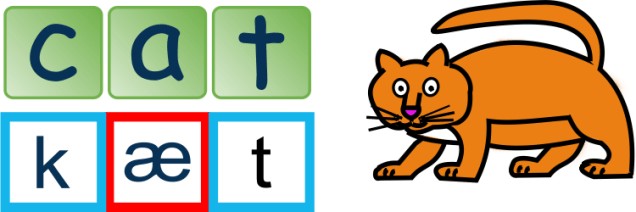
  • Segmentation – being able to split words into their individual sounds, for example ‘cat’ into c-a-t.
  • Blending – being able to blend individual sounds together to say a word, for example d-o-g into dog.
  • Substitution – being able to swap one sound/letter association for another in a word, for example swapping the /k,(k)/ sound in the word ‘cat’ with a /h,(h)/ sound to say the word ‘hat’.
  • Reordering – being able to swap the sounds/letter association around to create a new word, for example changing the order of the letters in the word ‘cat’ to form the new word ‘act’.
  • Deletion – being able to remove a sound/letter association from a word to create a new word, for example removing the /t,(t)/ sound from the word ‘cart’ to say the new word ‘car’.

Good phonemic awareness is the vital skill required before phonics can be introduced successfully as a tool for learning to read and spell.

Phonics is the association of sounds (phonemes) to written alphabet letters (graphemes). For reading (decoding) the phonics coding system is used to convert the written word into sounds. For spelling (encoding) the same phonic coding system is used to covert sounds heard into letters to form written words.

Watch our ‘Single Word Reading’ animation to see these manipulation skills in action: bit.ly/20JAHSa

Back to School – What is Phonics?

Blog Phonics

Date Originally Posted: 07/09/17

With the new school year under way some of you will have been introduced to phonics for the first time. Phonics is a very useful decoding tool used for developing reading skills and as an encoding tool for spelling.

Phonics is the simple process of linking sounds to letters, its complexity comes from how many sound (phoneme) to letter (grapheme) combinations there are. So to be good at phonics a child needs to know the 44 sounds and numerous letter and letter combinations of English and then learn the associations between the two.

Children can communicate orally from an early age; it is when they move to the written word that they need to learn how to decode text, to turn the letters into words they already know.

Using phonics knowledge for reading entails:

  1. Identify the letter or letter combination, in a word, that represent a sound
  2. Associate the letter or letter combination to one of the 44 sounds
  3. Blend each of the sounds together to form the word
  4. Recognise the now oral word to extract its meaning

The theory supporting the teaching of reading using phonics, especially synthetic phonics, is that if a child can decode a word by associating individual sounds to a letter or combination of letters they will then be able to blend those sounds together to form and say the word.

Once a word has been spoken they will extract its meaning by using their far more extensive spoken language comprehension. Children are therefore using the same mental processes to understand written text and speech.