Word Play – Syllable Awareness & Counting

syllables 1

At about the age of 4 years old children start to develop an understanding that words can be split into sound parts (syllables) and that these parts give the word its rhythm.  A syllable is the largest phonological unit (one or a group of sounds) of a word and is like the rhythmic beat of the word.

They should be able to orally blend syllables together to form words and segment words into syllables.

A fun activity to help develop syllable understanding:

How Many Syllables?     

Children love to clap out the number of syllables in a word. It is important to say the word at a normal speed rather than really slowly as this can distort the word and make it difficult to hear the syllables. To start with a child just needs to be able to recognize them by clapping, stamping or jumping for each syllable of a word; they don’t need to be able to count them. It is thought that only about 50% of children can count out the syllables by the age of 4, so you can do the counting for them.

Spoken syllables are organised around the vowel sounds, making counting them easy; as the jaw drops when the vowel sound is spoken in the syllable. Try placing your hand under your jaw with your mouth closed before you say a word. Start with ‘cat’ you will notice the jaw drops once, this is because it is a one syllable (monosyllabic) word.

Most children will find it easier to identify syllables in compound words to start with. A compound word is formed by two words (root words) put together such as: sunset, hotdog, snowman and postman. They find it easier because the jaw tends to drop quite distinctly as we say the vowel sound in each of the root words and because we tend to say these words slowly.

Word Play – Rhyme & Alliteration

Nursery Rhymes

Young children develop their vocabulary and understanding of sound patterns within words through word play.

Rhyme awareness and the enjoyment of alliteration begins early, usually between the ages of 2 and 3 years old (Stage 3 of phonological awareness). This develops in to an important tool, supporting a child in developing an understanding of how words are formed and the sound patterns within them. These are important pre-phonics skills a child needs to develop to support their future ability to succeed with phonics, reading and writing.

This Rhyme awareness is supported and developed through the singing of songs and nursery rhymes and finger chants. Alliteration (words that begin with the same sounds) such as ‘Sammy snake slithers silently’, which children love to hear in rhymes and stories, also supports their word knowledge and understanding of sounds in words.

Being able to repeat, and join in with, short phrases they have anticipated in a story or rhyme, is another important step in a child beginning to understand the use of words in stories and story structure; such as, “I’ll huff and puff and blow your house down!” in the story of The Three Little Pigs.

For more information on this, and other pre-phonics skills (Phonological Awareness) your child develops through from birth to 7 +years old, check out the Pre-phonics section of our website: https://www.teachphonics.co.uk/phonological-development.html 

A good vocabulary is a key phonics skill

Word Awareness

Helping a child build their vocabulary (word awareness – receptive & expressive language) is vital if they are to continue to develop good communication skills. Talking, explaining, sharing and playing are all important as well as making sure that you pronounce words clearly and correctly for a child to hear. A child may not have developed all the skills needed to copy you accurately but they will store the sound pattern information for later use. The more they hear the correct sound patterns the sooner they will start to use them themselves.

Click the link for ideas & activities to support a child’s vocabulary development: http://bit.ly/29LajVk

Receptive & Expressive Language

Receptive language is how we take in and understand language; it is what we hear, see and read. This also includes body language and environmental clues. All these elements help us to interpret a situation and give it its meaning, so that we can understand what is being communicated. We do not need to be able to produce language to receive and understand it, so infants and toddlers understand far more than they can express (expressive language).

Expressive language is our ability to put our thoughts, needs and wants into words and sentences in a way that makes sense and is grammatically correct. A baby’s expressive language to begin with is based on cries and gestures and then moves to sound making, gestures and body language signals. We use this expressive language when we speak and write. Even when babies and toddlers move to speaking words they have a limited vocabulary which is why they can get frustrated when we do not understand them.

The Importance of Speaking & Listening

Speaking & Listening Icon 2

Phonological awareness development incorporates the understanding of, and the learning of how to, communicate through speech, body language and written forms. It relates to our sensitivity and understanding of the sound structures of our oral language. It enables us to progress from our awareness of large sound units (words in sentences) to smaller sound units (phonemes in words).

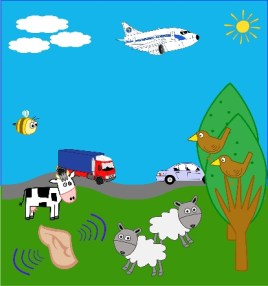
Speaking and listening skills play a vital role in helping children to develop their awareness of the sounds around them. The more they hear, the more associations they can make to those sounds (what they see, feel and experience), the greater their ability to distinguish between them.

Our tips and ideas help you to support your child’s speaking and listening skills: https://www.teachphonics.co.uk/how-to-talk-to-your-child.html

Don’t underestimate the importance of everyday chatter or conversation (‘Small Talk’), children develop and learn a great deal through ‘Small Talk’ with adults and other children.

What do we mean by ‘Small Talk’? With babies it is the kind of talk that explains what we are doing, what they are doing, where we are going and what we can see.  As they get older our verbal exchanges increase as we support their receptive and expressive vocabulary development. Through these exchanges we also support their general language development and understanding of how words are pronounced, basic sentence structure and using the correct tense.

When we talk with a child we demonstrate and model the use of language in real time so that it has meaning. For instance, a child may point and say “cat” and we would respond with “Yes, the cat is sleeping.” Or we may correct the child and say “That is a dog.” If we could we would point to a cat and explain the difference. We also correct mispronunciation of words and correct tense issues in the same way; repeating the word or sentence using the correct pronunciation or tense back to the child.

The Communication Trust has a link to a free downloadable booklet called Small Talk which is a very useful guide for understanding how your child learns to talk from birth to age 5: https://www.thecommunicationtrust.org.uk/resources/resources/resources-for-parents/small-talk.aspx

The Skills a Child Needs to Achieve Phonics Success

Phonological Awareness Chart

Phonics is actually stage 8 of the 10 distinct and progressive stages of phonological awareness development.

Pre-phonics skills are those a child learns as they develop through the phonological awareness stages 1 to 7. Throughout this time they are continually developing their understanding and knowledge of our spoken language as well as other communication forms such as gestures, facial expressions, body language and social conventions.

Speaking and listening skills play a vital role in helping children develop their phonics knowledge as they need to be exposed to a wide and varied vocabulary that allows them to hear and use the range of sounds that form our language.

Being exposed to a greater range of sound experiences helps children to develop their awareness of the sounds around them. The more they hear, the more associations they can make to those sounds (what they see, feel, experience), the greater their ability to distinguish between them. This skill becomes important later on as they begin to isolate individual words in sentences, being able to distinguish between words that sound similar such as dog and hog.

Through listening and speaking games and activities children are exposed to new vocabulary as well as learning to play with the sounds in their language. This helps them to remember how the sounds feel when they make them as well as how they sound in isolation and when combined with other sounds.

Scientists believe a child’s sound awareness begins before they are born; at about 24 weeks, which highlights the importance of sound awareness, including environmental and speech sounds, as part of our instinctive natural development.

The Phonological Awareness Stages on our website (http://bit.ly/2FMnYsS) are set in a developmental order from one to ten. Against each stage we have provided an age range guide based on research, which shows when most children develop the various phonological awareness skills. Clicking on a stage will take you to another page which gives more in-depth information and links to help you support children through the stage.

Accents and Phonics

Bath - phonics section

Because the English language is so rich and diverse it is very difficult to create a phonics system that caters for all. Every region that speaks the English language has its own accent which means there are always variations in the way that a word is pronounced.

Across England we all spell words the same but we certainly do not say them all the same, even though we all use the same 44 sounds. In the English language the 44 sounds can be represented by over 280 letter combinations.

So accents have arisen from regions applying different phonemes (sounds) to graphemes (letters) when they pronounce words. The regions still use the same sounds and letters, they just associate them differently.

For example, in the South of England the letter ‘a’ can be pronounced as the ‘long ’R’ controlled’ vowel sound /ar,(ɑː)/ in words such as ‘grass’ and ‘bath’ whereas in the North of England it will be pronounced as the ‘short’ vowel /a,(æ)/ sound in these two words.

Click here scroll down the page to see the animations of the different pronunciations of the word ‘bath’.

Both pronunciations are correct, which can make teaching phonics a little tricky; the key is to teach the sound to letter relationships which best suit the children being taught in relation to their regional accent. It is important to remember that children’s knowledge of the sounds that make words is based on how you speak to them naturally and not a strict standardized set of sounds.

However, for general educational and learning purposes the English language’s phonics system has been standardized, this is known as the ‘Received Pronounced’ (RP) English, and is used in comprehensive English dictionaries and translation dictionaries. The RP is based on a southern accent sound to letter relationship basis.

The ‘Long Vowel’ Sounds

Long Vowel Sounds

There are 13 ‘long vowel’ sounds in total; 7 ‘long vowel’ sounds and 6 ‘long ‘R’ controlled vowel’ sounds.

The 7 ‘long vowel’ sounds are so called due to the length of their pronunciation; these can often be held without distorting their sound.

 The /ai,(eI)/ sound found in the words: train, tray, cake and break.

The /oa,(ǝƱ)/ sound found in the words: boat, hotel, toe and bone.

The /oi,(ɔI)/ sound found in the words: boy, coin and buoy.

The /ow,(aƱ)/ sound found in the words: owl, house, drought and hour.

The /ee,(іː)/ sound found in the words: tree, pea, me, and pony.

The /I,(aI)/ sound found in the words: iron, fly, pie and light.

The /oo,(uː)/ sound found in the words: spoon, blue, screw and you.

The 6 ‘long ‘R’ controlled vowel’ sounds are so called because of the slight /r,(r)/ sound quality that can be heard in them along with the length of their pronunciation; these can often be held without distorting their sound.

The /ar,(ɑː)/ sound found in the words: car, father (southern UK accent) and art.

The /or,(ɔː)/ sound found in the words: fork, door, walk and sauce.

The /ear,(Iǝ)/ sound found in the words: ear, here, deer and pier.

The /er,(ɜː)/ sound found in the words: bird, kerb, nurse and worm.

The /re,(Ʊǝ)/ sound found in the words: manure, tour and mature.

The /air,(eǝ)/ sound found in the words: chair, pear, square and where.

How Many ‘Short Vowel’ Sounds Do You Know?

Short Vowel song Pictures

There are 7 ‘short vowel’ sounds, although children are usually only introduced to the 5 which are most commonly heard in simple CVC (consonant, vowel, consonant) words: /a,(æ)/ in cat, /e,(e)/ in peg, /i,(I)/ in pin, /o,(ɒ)/ in hot, /u,(ʌ)/ in bus.

The other two ‘short vowel’ sounds are: /oo(u),(Ʊ)/ in bull or could and /uh,(ǝ or schwa)/ heard  as the final sound in the words: zebra, doctor and corner.

Our ‘Short Vowel’ Finger Chant can help you, and your child, to learn and remember the 7 ‘short vowel’ sounds: https://www.teachphonics.co.uk/free-resources-phonics.html

English (UK) Vowel Sounds

Learning to hear and differentiate the vowel sounds from consonant sounds is an important skill in understanding how words are formed. Every word in the English Language has to have a vowel sound in it and every syllable in a word also has to have a vowel sound within it. This knowledge is an important element in developing our phonemic awareness and phonics knowledge as we start to learn how to read and spell words.

There are 20 vowel sounds in the English (UK) Language, usually (in the UK Education System) split into two main categories based on sound quality:

  • ‘Short’ vowel sounds, due to the short duration of the sound being made, the sound cannot be held onto without becoming distorted
  • ‘Long’ vowel sounds, due to the length of their pronunciation, these can often be held without distorting their sound.

Here at Teach Phonics we split the ‘long’ vowel sounds category into ‘long’ vowel sounds and ‘long ‘R’ controlled’ vowel sounds. The ‘long ’R’ controlled’ vowel sounds are so called because of the slight /r,(r)/ sound quality that can be heard in them.

The English Phoneme Chart, which uses the unique symbols of the International Phonetic Alphabet (IPA), splits the 20 vowel sound into two groups based on mouth position:

  • Monophthongs which have one mouth position throughout the sound
  • Diphthongs, where the mouth position changes, giving a 2 sound quality to the phoneme.

The Consonant Sounds with their Most Common Letter and Letter Combinations

There are 24 consonant sounds in the English language. A consonant sound is made (produced) when the air flow is being restricted in some way, which means that the mouth doesn’t open as wide and so the jaw doesn’t drop noticeably, which is different from vowel sounds.

Here is a list of just some of the most commonly seen letter and letter combinations used to represent the 24 consonant sounds. For a more comprehensive lists check out our English Phoneme Chart or Alphabet Keyboard which can be found on our ‘Phonemes’ page: bit.ly/1Qgc9dA

  • /b,(b)/ bin, rabbit
  • /k,(k)/ cat, key, duck, queen, anchor, broccoli
  • /ch,(ʧ)/ church, watch
  • /d,(d)/ dog, ladder, towed
  • /f,(f)/  fish, puffin, phone, laugh
  • /g,(g)/ girl, digger, ghost
  • /h,(h)/ hen, who
  • /j,(ʤ)/  jigsaw, giant, bridge
  • /l,(l)/   lion, llama
  • /m,(m)/  man, hammer, lamb
  • /n,(n)/   nest, penny, knife, gnome
  • /ng,(ŋ)/ king, sink
  • /p,(p)/    panda, hippo
  • /r,(r)/   robin, lorry, wrist
  • /s,(s)/  sun, dress, city, geese, castle
  • /sh,(ʃ)/  ship, chef, delicious, initials, sugar
  • /t,(t)/   tent, butterfly, jumped
  • /th,(θ)/  thumb
  • /th,(ð)/ feather, breathe
  • /v,(v)/ van, sleeve, of
  • /w,(w)/ well, whale, penguin
  • /y,(j)/ yo-yo, euro
  • /z,(z)/  zero, puzzle, sneeze, cheese, is
  • /zh,(Ʒ)/ measure, television