Developing and Supporting Your Child’s Reading Journey – Week 4

Reading

Print Awareness to Develop Understanding of Reading Conventions

Print Awareness is knowing that print (words) has meaning, including noticing print around them in the environment (posters & street signs) and understanding how to handle the conventions for reading a book. We can often assume that all young children or pre-readers (as not always young children) will develop print awareness naturally. However, research suggests that 95% of their visual attention is directed towards pictures, which in themselves hold a great deal of meaning and often tell the story very effectively.

Pictures/ illustrations in story books and pure picture books are powerful ways to engage children and adult with books, storytelling and reading. This is not to say that pictures are any easy way to interpret a storyline as they can hold a great deal of meaning, from simple obvious interpretation to more sophisticated symbolic representation.

Young children and pre-readers need opportunities to explore print and be helped to understand that the written word (print) has meaning. Once they start to see print they will begin to notice it everywhere not just in books but on posters, food packets, menus and street signs.

Again we can often assume that a child or pre-reader knows how to handle a book, however this is not always the case and can be due to a lack of experience with books or different cultural reading conventions. So it is important to check and teach these reading conventions for reading English:

  • Front cover opens to the left and we read it from the front to the back.
  • Print on a page is read left to right.
  • Usually print is read from the top of the page across and down (this may differ slightly in some children’s books)

Supporting Print Awareness:

Through Play:

  • Use takeaway menus or create your own as part of role playtime, they could have their own café serving up all sorts of interesting dishes for you. A blackboard can be very useful for this, allowing you or your child to write up their own menu for the day.
  • Travel brochures or leaflets from your local tourist information office are great for roleplay encouraging new language as well as a different way to explore print as they often have maps and timetables.
  • Use sticky labels or post it notes to label items or furniture as part of a ‘can you see or find’ game.

Through Drawing/Writing:

  • Making lists of things to do, or a shopping list. Their version of the list may be just squiggles and dots (so don’t rely on this for your shopping trip) but it is the beginning. I would keep the list and get them to tick off things done or items purchased as part of the experience so that it has a genuine purpose (children really like this).
  • For slightly older children making simple invitations and thank you cards can be fun. Ttry not to make the messages too long or to write too many as they will get bored and see it as a chore not as fun.
  • Making and drawing their own story book.

Through Songs/Nursery Rhymes:

  • Showing the printed words to songs and rhymes

Through Talk:

  • Point out signs, logos and labels when out and about as well as at home.
  • A lot of print awareness skills is developed through the sharing of books and appropriate on-line material.

Through Book Sharing:

What Books to choose?

  • Books that have writing as part of the story
  • Books that have writing as part of the picture
  • Story books; all types
  • Factual (non-fiction) books; all types
  • Comics
  • Children’s magazines and newspapers

Book Sharing Tips

  • Remember babies will chew and bash the pages of the book as you read. This is normal and part of their learning experience so go with it.
  • Encourage and let your child turn the pages.
  • Point to the words of the title as you say them
  • Explain what the author and illustrator do as you say their names.
  • Point to words or repeated phrases as you say them and or as your child says them. This will also help your to develop the skill of reading from left to right and from the top of the page down (English).
  • Point to words of interest and explain how words have spaces between them and why.
  • To help your child understand how to handle a book use the word ‘front’ and ‘back’ of the book. If you are handed a book upside down or with the ‘back’ cover facing you explain that you have to turn it around or over so that you can read it.
  • Explain that page numbers help you to find things in the book as well as to help make sure you do not miss any part of the story.
  • Explain that content pages in story books show the chapters and in factual (non-fiction) they show different subject areas, as well as giving the page numbers on which to find them.
  • Explain how the index page in non-fiction books work
  • Explain what a glossary is in a book.
Developing and Supporting Your Child’s Reading Journey – Week 3

Talking Icon

Vocabulary Development for Comprehension

Vocabulary is knowing the meaning of words including names of things, feelings, concepts and ideas. The larger a child’s vocabulary (understanding what words mean not just being able to say them) the easier it is for them to understand what they are reading.

The more you talk and share words and their meaning with your child the greater their vocabulary will become.

Vocabulary building:

Through Play

  • Introducing and playing sorting games helps your child to build a mental filing cabinet system of categories, this helps them to remember and learn the meaning of words. Start by introducing simple categories of everyday items like food or clothes as their vocabulary increases categories such as colour, size and texture become more appropriate.
  • As babies handle objects and toys describe how they feel, what they look like or the sound they make
  • When you are playing with your child add in new words and descriptions to the words as well as descriptions or expand on words they use in play. For example, if you are playing cars with your child you may comment on the size difference or colours between the cars.
  • Remember children learn new words best when they are learned in context, that is, in a natural setting.
  • If they are trying to say a word, let them finish and then say it back to them clearly and correctly. Do not make them repeat it back to you, they may choose to do so but make it their choice.

Through Drawing/Writing

  • When drawing or painting with your child or they are sharing their pictures with you talk about the shapes, colours types of lines (straight line or curves line), what you like best about the picture, and the objects you can see.

Through Songs and Nursery Rhymes

  • Listening of nursery rhymes and children’s song is a good way of helping your child make the distinction between the music and words (language used) in them. It is a good idea to practise this skill when there are no other noise distractions.
  • Try playing some action songs and rhymes to help your child learn the actions for the rhyme, then let them have a go on their own. Watch them to see if they can do some of the actions at the right time in the song, to see if they are listening for the right cue words. If they are struggling, explain they have to wait for certain words and show them what to do and when to do it.
  • Nursery and silly rhymes are great ways to introduce your child to rhyming sounds and increase sound play in words.
  • Singing often slows down our pronunciation of words, helping your child to pick out unusual or rhyming sound patterns. As with reading aloud it can introduce a wider vocabulary for your child.
  • Finger rhymes and action songs encourage your child to interact with words, the sounds within them and the rhythms they create. Finger rhymes such as ‘Round and Round the Garden’, ‘Pat-a-cake’ and ‘Incy Wincey Spider’. ‘Row, Row Your Boat’ is a lovely whole body movement song that encourages a rhythmic whole body motion, which babies and toddler enjoy (as well as the adults).

Through Talk

  • Speak in ‘parentese’ until a child is about 9 months old as they will listen to you longer and hear more words
  • Talk about feeling and situations throughout the day.
  • When your child points at something tell them the name of the object, for example if they point at an apple, say “Apple”.
  • Explain words or give synonyms
  • Avoid replacing unfamiliar words with familiar ones (explain the meaning). Remember to try to use the new word in context regularly as repetition of the word will help your child to remember it and reinforce the meaning of the word.
  • Repeat and expand on what your child says, so if they say “Dog!” you may say “A big dog!” This also helps them to develop an understanding of sentence structure.

Through Book Sharing

What books to choose?

  • Books with word not used in everyday conversation.
  • Non-fiction books (informational, instructional, true stories) -as they use different words to friction (story) books.
  • Any book really. The language of books in much richer and varied than that of everyday conversation.

Book Sharing Tips

  • Sharing and talking about the books you are reading helps to build word knowledge, as you point to the pictures, picking out different objects.
  • Reading out aloud helps to introduce your child to words that they may not experience in their everyday talk. This helps to expose them to new vocabulary and the sounds to be found in those words.
  • Reading aloud poems and story books with strong rhyme elements, like those found in Dr.Seuss books, helps introduce the new words and rhyming sounds in words.
  • Try exaggerating the rhyming words to help highlight the sound patterns, making it easier for your child to tune into them.
  • Explain unfamiliar words; don’t replace it with a familiar one.
  • When a word has more than one meaning. Talk about the different meanings.
  • Add descriptive words or more information than in the book.
  • Encourage your child to talk about the pictures. Add information and ideas to what they have said.
  • Use words to describe how characters in the book might have felt at a point in the story.
  • Use words to describe ideas in the story even if they are not used in the book.
  • Remember children learn new words and their meaning through repetition, so you will need to be patient as you re-read the same story over and over again or answering the same questions over and over again.

Developing and Supporting Your Child’s Reading Journey – Week 2

Word Awareness

Phonological Awareness Games and Book Sharing Ideas

Phonological awareness relates to our sensitivity and understanding of the sound structures of our oral language. It enables us to progress from our awareness of large sound units (words in sentences) to smaller sound units (phonemes in words).

Our phonological awareness develops over time and the depth of that awareness is based on the range of experiences we have. Research suggests that our phonological awareness begins in the womb at about 24 weeks and is continually built upon throughout our lives. We tend to think of children going through ten distinct phonological stages; the later stages being related to phonics.

Children are taught to read in schools through phonics; the association between sounds (phonemes) to written alphabet letters (graphemes).

Phonics reading is the process of firstly segmenting the written word into letters, or letter combinations, then associating known sounds to those letters and finally blending the sounds together to form words (decoding). If a child is weak in any of the phonological awareness stages before those relating to phonics then they will struggle with learning to read.

Because of the nature of how we develop our phonological awareness games and activities cannot easily be split into categories. Playing, drawing, writing, singing and book sharing all require you to talk with your child highlighting sounds, words and rhythms of language.

Here are some games and activities to help you:

  • Singing and sharing nursery rhymes is a great way to help children hear sounds in words because the words are drawn out and the sounds highlighted or exaggerated.
  • Clapping, bouncing or tapping to songs and rhymes helps to highlight the syllables of the words. A syllable is the largest phonological unit (one or a group of sounds) of a word and is like the rhythmic beat of the word.
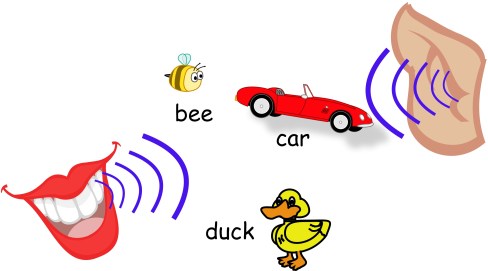
  • Point out the sounds you hear such as animal or environmental noises and explain what is making that noise.
  • Play games or sing songs where you and your child can make noises such as animal sounds (Old MacDonald had a farm) or vehicle noises (The Wheels on the Bus).
  • Draw animal or other every day objects that have a distinct sound, name them and make the sound they produce.

Book Sharing

What books should you choose?

  • Books with sounds of animals and other things
  • Nursery Rhymes
  • Book formatted from songs
  • Books with rhyme and alliteration
  • Poetry books
  • Any book really, remember your local library can help you to chose a good range of books to share with your child if you are not sure.

Book Sharing Tips

  • Don’t be shy, make animal and object noises. If you are self-conscious about it your child will pick up on this. No one thinks twice about an adult making what may appear to be strange noise if they are sharing them with a child (its when you forget they are not with you and you do it that they tend to look at a you a bit funny).
  • Talk about whether a book rhymes or not. Point out the rhyming words, make up other rhyming words for any of the words in the book. Remember they do not have to be real words they can be silly funny words that pick up the rhyming sounds in the original word.
  • It is important to remember for some children saying a word that rhymes with one you have given can be very difficult if not impossible. So, don’t stress them out with this, it is often easier for them to recognise a rhyme than to make one. You could ask them to tell you if two words you give rhyme or not. If they find this easy try giving them three words with only two that rhyme and ask them to identify the rhyming words.
  • After sharing the book pick out words that you can clap out the syllables for. You could make this into a jumping or hopping game instead. With older children ask then to tell you how many syllables the word has and then to check their answer by counting the number of claps or jumps they make.
  • Play an ‘I Spy’ game using the pictures in the book looking for rhyming words for instance by giving clues such as; “It is red and rhymes with the word sock.” The answer is clock.

Developing and Supporting Your Child’s Reading Journey – Week 1

Reading with boy 4506329-1801x2700 (2)

How to Develop a Child’s Interest in Books and Reading

Research suggests that children who enjoy books are more likely to want to learn to read and will keep trying even when they find it hard. Therefore, it is important to keep their interaction around books a positive one.

Through Play

Books come in all shapes and sizes and are made from various materials.

  • Have a few bath books, even if most of the time your baby or toddler just chews on them they will be handling a book, possibly turning the pages. Giving you the opportunity to talk about the pictures with them.
  • Try to have a range of cloth, hard books and suitable picture books around the house and in your child’s play area so they can pick them up at any time. This way they can explore them for themselves (even if it is to give them a quick chew on) not always as an adult sharing activity.

Through Drawing & Writing

Drawing and making your own simple story book can be a great way of getting your child interested in books and reading. Children love to hear stories about them. Simple homemade books about them can be a great way of introducing children to books and reading. This can be a very effective approach to encourage reluctant readers.

  • Draw simple pictures with, or for your child, and talk through what you are drawing for example; a picture of house with matchstick people. The pictures could be telling the events of the day for example going to the park or walking the dog.
  • If drawing is not your thing (like me) use fuzzy felt instead to make a picture to share the story of their day.

Through Songs and Nursery Rhymes

Children’s songs and nursery rhymes cover a wide range of concepts from going through every day sequences such as in nursery rhyme ‘Here we go Round the Mulberry Bush’ which uses the phrase ‘This is the way we…’ to order the event of getting up in the morning. Some introduce concept such as size, numbers, colours and shapes. While others tell stories for example ‘Baa Baa Black Sheep’ or ‘We’re going on a Bear Hunt’ by Michael Rosen & Helen Oxenbury.

Sharing books that enable you and your child to sing along (retell) their favourite songs and nursery rhymes means that the child knows what to expect and that they are going to have fun and enjoy the experience. Over time you will then be able to introduce books with new songs and nursery rhymes, building on your child’s positive experience of other book sharing sessions with you. Remember you may have to revert back to the old favourite time and time again but stick with it.

Through Book Sharing

What books should you choose?

  • Pick children’s books you enjoy
  • Pick books your child enjoys
  • Give your child time to choose and look at books (your local library is a great place for this).
  • Follow your child’s interests
  • Use ‘true’ books and stories (not those specifically written for developing phonics knowledge or rigidly structured reading scheme books for teaching and learning to read, these will come from school and serve a different purpose).

Book Sharing Tips

  • Remember that a child’s age personality, mood and stage of development will affect how they interact with the book.
  • Keep the interaction around the book positive and fun, if you are not enjoying it your child will pick up on this.
  • Keep your child involved, remember you do not have to read the book word for word, it is the positive sharing experience that is important.
  • If your child does not seem interested in reading or sharing books, start slowly by sharing /reading one or two pages at a time. Keep the interaction positive and over time their interest will grow.
  • If your child is showing no interest then try again another time.
  • When reading a book with your child that you really like then tell them that you like the book or story. Your child may not agree with you and insist on their favourite book which after reading for the 500th time you may be bored with but keep with it, there will be another favourite book!
  • Try to share books throughout the day not just at nap and bed times. I found having a couple of books in my bag really useful as I could then share a book with one of my girl’s while the other was swimming or with them both while waiting for the bus or sharing tea and cake in a café.
  • Read with your child every day. There are some days where this just seems impossible to manage. Remember one minute is better than no minutes and it does not have to be a book you are reading, there are lots of environment reading matter you could use such as painting/pictures, posters, advertisement, road signs and maps.


Bring the Fun Back into Reading with your Child

Kids Playing

The importance of reading to, and with, your child can’t be overemphasized. The more your child gets exposed to words and enjoys the reading experience the quicker they will learn to read for themselves.

From next week, we will be starting a six-week series on ‘Developing and Supporting Your Child’s Reading Journey’. Each week we will look at a different reading skill element, giving example games and activities you can use to support and develop your child through:

  • Play
  • Drawing/Writing
  • Book Sharing
  • Talk & Song

‘Developing and Supporting Your Child’s Reading Journey’ Series:

  • Week 1. How to develop a child’s interest in books and reading.
  • Week 2. Phonological awareness skills required for reading.
  • Week 3. Vocabulary development for comprehension.
  • Week 4. Print awareness to develop understanding of reading conventions.
  • Week 5. Narrative skills to support the understanding of different writing styles.
  • Week 6. Letter knowledge

Word Play – Rhyme & Alliteration

Nursery Rhymes

Rhyme awareness and the enjoyment of alliteration begins early, usually between the ages of 2 and 3 years old (Stage 3 of phonological awareness). This develops in to an important tool, supporting a child in developing an understanding of how words are formed and the sound patterns within them. These are important pre-phonics skills a child needs to develop to support their future ability to succeed with phonics, reading and writing.

This Rhyme awareness is supported and developed through the singing of songs and nursery rhymes and finger chants. Alliteration (words that begin with the same sounds) such as ‘Sammy snake slithers silently’, which children love to hear in rhymes and stories, also supports their word knowledge and understanding of sounds in words.

Being able to repeat, and join in with, short phrases they have anticipated in a story or rhyme, is another important step in a child beginning to understand the use of words in stories and story structure; such as, “I’ll huff and puff and blow your house down!” in the story of The Three Little Pigs.

For more information on this, and other pre-phonics skills (Phonological Awareness) your child develops through from birth to 7 +years old, check out the Pre-phonics section of our website: bit.ly/1KRi6YX

Some Words Lose Their Meaning Without a Context

Some words, such as homophones and homonyms, need to be heard or read within a specific context if we are to understand what the word means.

Homonyms are words which are pronounced and spelt the same, however; their meaning can only be truly understood when the context in which the word is being used is made clear. For instance, the word ‘bark’ can be used to mean the bark on a tree or the noise a dog makes.

Homophones are words which are pronounced (sound) the same but have a different meaning and are spelt differently such as ‘pair’ and ‘pear’, ‘their’ and ‘there’ or ‘two’, ‘to’ and ‘too’.

To view more examples, follow this link:  http://bit.ly/2BcUa8N

The Difference between Phonemic Awareness and Phonics

Single word reading

Date Originally Posted: 28/09/17

With the new school year well under way many new parents are being introduced to the world of phonics and the all the technical language associated with it. So we thought we would take this opportunity to demystify some of that technical language.

Phonemic awareness is our ability to split words into their smallest sound units (individual phonemes) and to manipulate these sounds through segmentation, blending, substitution and deletion. This is based on what we hear and say, not the written word.

The phonemic awareness sound manipulation skills; segmentation, blending, substitution and deletion are developed further through phonics, as letter associations are introduced.

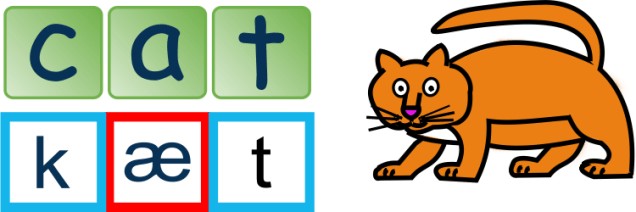
  • Segmentation – being able to split words into their individual sounds, for example ‘cat’ into c-a-t.
  • Blending – being able to blend individual sounds together to say a word, for example d-o-g into dog.
  • Substitution – being able to swap one sound/letter association for another in a word, for example swapping the /k,(k)/ sound in the word ‘cat’ with a /h,(h)/ sound to say the word ‘hat’.
  • Reordering – being able to swap the sounds/letter association around to create a new word, for example changing the order of the letters in the word ‘cat’ to form the new word ‘act’.
  • Deletion – being able to remove a sound/letter association from a word to create a new word, for example removing the /t,(t)/ sound from the word ‘cart’ to say the new word ‘car’.

Good phonemic awareness is the vital skill required before phonics can be introduced successfully as a tool for learning to read and spell.

Phonics is the association of sounds (phonemes) to written alphabet letters (graphemes). For reading (decoding) the phonics coding system is used to convert the written word into sounds. For spelling (encoding) the same phonic coding system is used to covert sounds heard into letters to form written words.

Watch our ‘Single Word Reading’ animation to see these manipulation skills in action: bit.ly/20JAHSa

Back to School – What is Phonics?

Blog Phonics

Date Originally Posted: 07/09/17

With the new school year under way some of you will have been introduced to phonics for the first time. Phonics is a very useful decoding tool used for developing reading skills and as an encoding tool for spelling.

Phonics is the simple process of linking sounds to letters, its complexity comes from how many sound (phoneme) to letter (grapheme) combinations there are. So to be good at phonics a child needs to know the 44 sounds and numerous letter and letter combinations of English and then learn the associations between the two.

Children can communicate orally from an early age; it is when they move to the written word that they need to learn how to decode text, to turn the letters into words they already know.

Using phonics knowledge for reading entails:

  1. Identify the letter or letter combination, in a word, that represent a sound
  2. Associate the letter or letter combination to one of the 44 sounds
  3. Blend each of the sounds together to form the word
  4. Recognise the now oral word to extract its meaning

The theory supporting the teaching of reading using phonics, especially synthetic phonics, is that if a child can decode a word by associating individual sounds to a letter or combination of letters they will then be able to blend those sounds together to form and say the word.

Once a word has been spoken they will extract its meaning by using their far more extensive spoken language comprehension. Children are therefore using the same mental processes to understand written text and speech.