Conversational Turn Taking Skills – Part 2

Dad & Girl 1

Children need to learn that in conversation they need to take turns listening and speaking.

This is more complex process than we often give it credit for as often we, especially in our busy lives, can be guilty of only listening to reply rather than listening to understand.

Children need to learn when to talk and when to listen; for this to happen they need to do the following:

  • Actively Listen to the other person. This means:
    • Concentrate on the words being said, by blocking out other environmental noises and voices.
    • For most children and adults this also means looking at the person, watching their facial expression and body language.
    • Listening for the verbal cues and/or changes in the tone of voice that signifies that the person has finished speaking.
    • Recognising that it is either your turn to respond by formulating a reply or not.
  • Formulate a Response. This means:
    • Extracting meaning – taking understanding from the words that have been spoken.
    • Mentally searching for words to compile a grammatically correct set of sentences.

In young children this can take time, not because they do not have the answer, because they just take longer to recall and formulate their responses. This is due to the constant acquisition of new language and understanding of the grammatical conventions that need to be applied.

  • Communicate Response. This means
    • Speaking clearly, pronouncing words correctly in coherent sentences.
    • Using socially appropriate facial expressions and body language to accompany the response.
    • Using the appropriate verbal cues and/or changes in the tone of voice that allow the other person to understand it is now their turn.
  • Wait. This means giving time for the other person to formulate their response.
  • Actively Listen to the other person.

Learning these skills takes time and needs to be taught as well as modelled by those around the children. It begins very early on for instance, when we talk to a baby, as if expecting an answer. As a baby starts to make cooing and babbling sounds, they begin to respond to you in those gaps, their first conversations.

Something that is worth remembering:

“When you talk, you are only repeating what you already know. But if you listen, you may learn something new.” (Dalai Lama)

The Importance of Small Talk – Week 1

Dad & kids 2

Don’t underestimate the importance of everyday chatter or conversation (‘Small Talk’), children develop and learn a great deal through ‘Small Talk’ with adults and other children.

What do we mean by ‘Small Talk’?

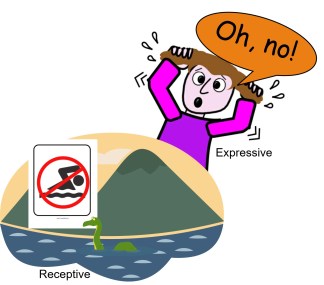
With babies it is the kind of talk that explains what we are doing, what they are doing, where we are going and what we can see.  As they get older our verbal exchanges increase as we support their receptive and expressive vocabulary development. Through these exchanges we also support their general language development and understanding of how words are pronounced, basic sentence structure and using the correct tense.

When we talk with a child we demonstrate and model the use of language in real time so that it has meaning. For instance, a child may point and say “cat” and we would respond with “Yes, the cat is sleeping.” Or we may correct the child and say “That is a dog.” If we could we would point to a cat and explain the difference. We also correct mispronunciation of words and correct tense issues in the same way; repeating the word or sentence using the correct pronunciation or tense back to the child.

The Communication Trust has a link to a free downloadable booklet called Small Talk which is a very useful guide for understanding how your child learns to talk from birth to age 5:

https://www.thecommunicationtrust.org.uk/resources/resources/resources-for-parents/small-talk.aspx

Speaking & Listening Skills

Listening & Speaking 2

Supporting a child to develop their speaking and listening skills is vital!

It is not just the key to literacy success but an essential social communication skill.

Sadly, schools are still reporting huge gaps in young children’s speaking and listening skills. So, over the next 6 weeks, we are re-running our popular blogs that look at different developmental elements of speaking and listening; providing practical games and activities to help build your child’s skills.

Week 1. The Importance of Small Talk

Week 2. Conversational Turn Taking Skills

Week 3. What is Listening?

Week 4. Games to Develop Listening Skills – Sound Screen Games

Week 5. Games to Develop Listening Skills – Sound Scanning Games

Week 6. Games to develop Listening Skills – Music Fun

Half-term Fun – Clothes Peg Games

Clothes peg games 2

Some fun indoor activities may be the order of the day if the half term weather proves not to be so hot.

This is a very simple idea which children love because they can take greater ownership of it. The aim of the activity is to help build up hand and finger strength through using the pegs; however it can have a dual purpose, helping to keep track of the week by using it as a timetable or for learning spellings or maths activities, as well as supporting the development of language skills.

You do not need anything fancy, just some string (for the washing line), clothes pegs and pieces of paper or card to peg onto the washing line. The washing line can be a permanent fixture or you can just pop it up when you need to use it.

The clothes line needs to be at a height suitable for your child to peg things on to (placed against a wall is a safe option so that no-one can walk into it by accident and hurt themselves).

There are a whole range of games that can be played using this simple washing line and pegs concept:

  1. Memory games – Get your child to peg up 5 to 10 different pictures or items on the line. Then give them 1 minute to remember the items. Once the time is up ask them to look away, or close their eyes, and then you remove one or more of the items. Get them to look back at the line. Can they work out what is missing?
  • You could try just moving one or two of the items around. Can they figure out which ones are in the wrong place and put them back in their correct place?
  • Try swapping an item for something new, which your child did not hang up on the line. Can they work out which is the new item on the line?
  1. Odd One Out – Hang pictures on the line that belong together. Can they pick out the odd item on the line and explain why it is the odd one out.
  • They could all be pictures of fruit with a picture of some clothing
  • They could be shapes with straight sides and one with curves
  • They could all be animals but all are wild with only one being domestic
  1. Sorting – Ask your child to sort all the pictures or items from a selection and to hang all the identical things on the washing line. They could all be the same;
  • Colour
  • Shape
  • Type
  1. Pattern Work – Using pictures, different colour and shaped paper or items create different patterns. The patterns can be based on colour, size or type of object. You can create a pattern sequence on the washing line and then ask your child to try and copy the sequence. Can they explain the pattern and create their own for you to copy and explain?
  2. Pairing or What is the Same? – Hang a range of pictures or items on the line, making sure that some of the items can be paired together because they are exactly the same. They could match because;
  • They are exactly the same e.g. a pair of socks
  • Match numbers to a picture with the same number of items on
  • Match capital to lower-case letters
  • Or have items that can be put together because they are both from the same set, for example they are types of fruit or are the same colour.

Phonics Half-term Fun!

Water fun 2

Next week is half-term for many of us and The SUN should be out which makes it time for the water fights and games to begin.

It will soon be June, the weather should be perfect, so why not set up water squirting games in the garden. The kids are waterproof and everything else will dry out, eventually!

This week on our Teach Handwriting Blog we have encouraged water fights and games for developing a child’s hand strength, co-ordination and eye tracking skills (all handwriting skills). However these games are also fantastic for developing sound and word awareness skills.

Try mimicking the sounds that the water makes as it drips on to the floor or hits the targets; use directional language to support your child’s aiming skills; describe how the objects move when hit: bouncing, rolling or flying and talk through the emotions evoked through playing the games.

As well as supporting your child in developing a whole range of physical and language skills you will also increase your cool adult status.

Some fun water games:

  • Try setting up a target wall, using chalk to draw the targets.
    • How many of the targets can you hit with water squirted from a water pistol or squeeze bottle in a set time.
    • How many targets can be washed off.
  • Set up a skittles range.
    • Each skittle hit with water can be worth a certain number of points, or the distance of the skittles may affect their value.
    • A time trial game to hit all the skittles. If you are using plastic bottles as skittles try making some of them a little heavier by putting sand or dirt in them to make it a bit harder to knock them over.
  • Move the object race games.
    • A light toy/ball has to be moved by squirts of water over a distance.
    • A range of objects moved in to target areas to gain points.

The only limitation is you and your child’s imagination and trust me kids never tire of finding new ways to play with water (but then again neither do many adults)!

Have FUN!

Letter & Sound Relationships That Break the Phonics Rules

Back in September we explained that Phonics is very useful as a decoding tool used for developing reading skills and an encoding tool for spelling. It is the simple process of linking sounds to letters, its complexity comes from how many sound (phonemes) to letter combinations (graphemes) there are.

Some letter and sound associations just don’t follow the normal phonics rule of a single sound being associated to a letter or letter combination. A few letters represent two sounds, such as the letter ‘u’ which in the word ‘cupid’ represents the two sounds /y,(j)/ and /oo,(uː)/.

A more common one letter two sound relation is that of the letter ‘x’ representing the two sounds /k,(k)/ and /s,(s)/ as in the words: six and box.

Here are some other examples of single letters and split digraphs making two sounds instead of the usual phonics rule of only making one sound:

More than 1 sound 1

Some Words Lose Their Meaning Without a Context

Some words, such as homonyms and homophones, need to be heard or read within a specific context if we are to understand what the word means.

Homonyms are words which are pronounced and spelt the same; therefore, their meaning can only be truly understood when the context in which the word is being used is made clear. For instance, the word ‘bark’ can be used to mean the bark on a tree or the noise a dog makes.

Homophones are words which are pronounced (sound) the same but have a different meaning and are spelt differently such as ‘pair’ and ‘pear’, ‘their’ and ‘there’ or ‘two’, ‘to’ and ‘too’.

To view more examples, follow this link:  http://bit.ly/2BcUa8N

Developing Phoneme Knowledge Using the Power of ‘Old MacDonald’

Sound PlayOld Mac farm 2

Yesterday I shared a link to an article “Language unlocks reading: supporting early language and reading for every child” (https://literacytrust.org.uk/…/al…/language-unlocks-reading/) which highlights the importance of developing a child’s vocabulary.

Here at Teach Phonics we are always saying how important speaking, listening and vocabulary building is for all children. As I commented yesterday if a child does not hear or use a wide range of words they cannot develop their phonics skills. A child needs to experience a wide variety of word so they can learn how to make and use all the sounds required in the English language. This doesn’t happen by chance it has to be experienced and taught.

Spring and all that we often associate with this time of year is upon us: lambs, chicks and new life. This in turn prompted memories of singing ‘Old MacDonald had a Farm’, with my own children. A strange connection; maybe!

But, maybe not! Through the making of animal noises and the repetition of the ‘e i e i o’ refrain the girls were learning to play with sounds. Through the song they were learning how to make sounds through changing their mouth shape, the position of their tongue and controlling their breathing.

When they couldn’t make a particular animal noise we just moved to the next animal on the farm, because it is a fun song, so no pressure. Next time we sang the song, the animals were still all included and over time they learnt to make all the animal sounds. Which, by happy coincidence, are the same sounds (phonemes) needed in our everyday speech.

The great thing about Old MacDonald and his farm is that he also has tractors, a quad bike and depending on where he lives even a helicopter. The list of vehicles and additional animals is endless, especially if he opens up his own zoo next to the farm!

Old MacDonald and other nursery rhymes/songs all help to build and teach a child how to make the sounds required for pronouncing words. They offer a child the opportunity to practice making sounds which they may otherwise have no experience of in their normal everyday life. They will store this sound making information for later use as they mature and extend their vocabulary, which in turn supports their phonics knowledge, which impacts on their reading ability.

The Impact of Poor Visual Memory Skills on Reading

Visual Memory 2

Good visual memory skills enable us to recall information that has been previously visually presented.

Visual memory difficulties can hinder a child’s ability to read fluently and with ease due to the fact that they cannot always remember what the word looks like, even though it may be a very common sight word which has been taught to them many times before.

Typical problems due to poor visual memory skills:

  • Difficulty in recognising some letters and numbers, especially those they may not use very often, for example some of the capital letters.
  • Have problems learning sight words, or remembering what a word is, from one page to another.
  • Reading is slow and stilted, making comprehension difficult.

For more information on how to identify visual memory difficulties see our Other Physical Skills Assessment from our Teach Handwriting website: http://bit.ly/2P5jS44

For games and activities to help support and develop visual memory skills use this links: http://bit.ly/2M350S1


Why Poor Eye Tracking and Spatial Awareness Skills Affect Reading

Eyes

Eye tracking is the ability to control and coordinate the fine eye movements that allows us to:

  • Read a line of print by moving our eyes from left to right, without moving the head.
  • To focus and move the eyes to follow an object, without moving the head, in all directions.
  • To track/follow objects near and far.
  • To focus on one object without moving the eyes.

Eye tracking difficulties can have a dramatic effect on a child’s ability to read fluently and with ease due to the fact that they do not see the print in the same way as people with good eye tracking skills.

Typical problems due to poor eye tracking skills:

  • They lose their place, skip words or transposes them.
  • They use a finger to help keep their place.
  • Some will turn their head sideways to read or write.
  • Others may cover one eye to read.
  • They hold their head close to the table when looking at things, reading, writing and drawing.

Good spatial awareness enables us to be aware of the space around us and our position in that space, as well the relationship between ourselves and objects. This also includes our ability to see and understand the spacing of text and pictures on a page, to distinguish between paragraphs, sentences, words and individual letters.

Spatial awareness difficulties can have a dramatic effect on a child’s ability to read fluently and with ease due to the fact that they do not see the print in the same way as people with good spatial awareness skills.

Typical problems due to poor spatial awareness skills:

  • They lose their place, skip lines and words or transpose them.
  • They use a finger to help keep their place.
  • Comprehension can be difficult as text is mis-read.

For more information on how to identify eye tracking and spatial awareness difficulties as well as activities to help support and develop these skills use these links (they will take you to the relevant pages on our Teach Handwriting website):