The Impact of Poor Visual Memory Skills on #Reading

Visual Memory 2

Good visual memory skills enable us to recall information that has been previously visually presented.

Visual memory difficulties can hinder a child’s ability to read fluently and with ease due to the fact that they cannot always remember what the word looks like, even though it may be a very common sight word which has been taught to them many times before.


Typical problems due to poor visual memory skills:

  • Difficulty in recognising some letters and numbers, especially those they may not use very often, for example some of the capital letters.
  • Have problems learning sight words, or remembering what a word is, from one page to another.
  • Reading is slow and stilted, making comprehension difficult.

For more information on how to identify visual memory difficulties see our Other Physical Skills Assessment from our Teach Handwriting website: http://bit.ly/2P5jS44

For games and activities to help support and develop visual memory skills use this links: http://bit.ly/2M350S1

Why do we ask children to #read out aloud?

Other reading stuff 1

We ask children who are learning to read to ‘read out aloud’, but forget to tell them why. It is not just so we can hear they have decoded a word correctly. The important point is to encourage them to actively listen to what they are saying. The idea is that if they hear the words they will, if it is part of their vocabulary, understand their meaning and therefore fully comprehend the text they have read.

Many children, and grown-ups for that matter, do not enjoy or find reading difficult.

So, keep it short, simple and practical. We read all sorts of things as part of our daily activities but do not always ask our children to do the same or read them out aloud. If getting your child to read from their school reading books is proving to be a battle every day then don’t do it. Try getting them to read other things instead, such as:

  • Packets/tins food labels and the cooking instructions;
  • Simple recipes for meals you might cook (these can be from a book, magazine, phone, notepad or laptop),
  • Ask family and friends to write a text or what’s App message to your child//children every day or two and get them to read them out aloud to you.
  • 1 or 2 paragraphs from a suitable article about something they are interested in or enjoy, football, ballet, computer game reviews etc… (these can be from a book, magazine, phone, notepad or laptop). We all like to share information about things that are important to us.

Remember it is not about the number of pages they read but that they are understanding what they are reading and hopefully get an enjoyment from the experience. Who doesn’t like to read a message or letter from family or friends!

What is ‘The Simple View of Reading’?

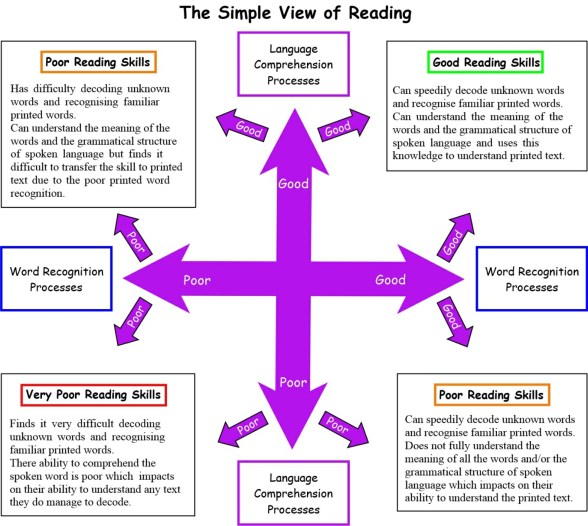
Simple view of reading 1.jpg

The term ‘Simple View of Reading’ used by schools may seem strange as there is nothing simple about learning to read.

‘The Simple View of Reading’ was adopted by the Government in 2007 and now underpins the English National Curriculum’s programmes of study for reading at Key Stage 1 and 2.

Even though reading, the ability to decode the word and extract the correct meaning of the words, is a complex set of skills; ‘the Simple View of Reading’ conceptual framework (Stuart et al. 2008, cited Hoover and Gough, 1986) reduces it down to two key components:

  • Word recognition – the ability to decode unknown words and recognise printed words.
  • Language comprehension – the ability to understand the spoken words and use this process to understand the written text.

Reading Comprehension = Decoding x Linguistic Comprehension

So in theory a child’s reading comprehension ability can be predicted by looking at their decoding and linguistic (spoken language) comprehension abilities (Johnston & Watson, 2007).

When using ‘the Simple View of Reading’ as the basis for teaching reading it becomes clearer as to why:

  • A high quality phonics scheme is required, which the Rose Report (2006) explains ‘…is not a  ‘strategy’ so much as a body of knowledge, skills and understanding that has to be learned.’ (page 20) [This teaches children how to decode.]
  • A language rich environment to develop and encourage linguistic comprehension is vital.

Bibliography

Johnston.R. and Watson.J. ‘Teaching Synthetic Phonics’, 2007, Pub: Learning Matters, Sage Publication Ltd.

Rose.J. ’Independent review of the teaching of early reading: final report March 2006’ Pub: DfES Publications

 The simple view of reading and evidence based practice’ Rhona Stainthorp Institute of Education, Reading University, Morag Stuart, Institute of Education, University of London (2008) Pdf downloaded from internet

Why do we ask children to ‘read out aloud’?

Reading with boy 4506329-1801x2700 (2)

Reading is the ability to first decode the letter sequence of the word (phonics) and then to place meaning to it in relation to the context in which it is being used.

Unfortunately, many children just decode, speak and do not actively listen to what they have said, so they do not gain meaning from the words they are reading (poor reading comprehension skills).

We ask children who are learning to read to ‘read out aloud’, but forget to tell them why. It is not just so we can hear they have decoded a word correctly. The important point is to encourage them to actively listen to what they are saying. The idea is that if they hear the words they will, if it is part of their vocabulary, understand their meaning and therefore fully comprehend the text they have read.

Poor reading comprehension skills may also occur because a child has a limited vocabulary usage and/or understanding. A language rich environment is vital to help support and develop a child’s vocabulary and linguistic comprehension, which in turn, will support their reading comprehension skills.

Some Words Lose Their Meaning Without a Context

Some words, such as homonyms and homophones, need to be heard or read within a specific context if we are to understand what the word means.

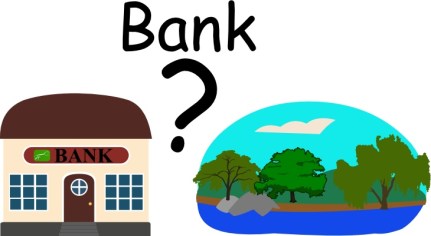
Homonyms are words which are pronounced and spelt the same; therefore, their meaning can only be truly understood when the context in which the word is being used is made clear. For instance, the word ‘bark’ can be used to mean the bark on a tree or the noise a dog makes.

Homophones are words which are pronounced (sound) the same but have a different meaning and are spelt differently such as ‘pair’ and ‘pear’, ‘their’ and ‘there’ or ‘two’, ‘to’ and ‘too’.

To view more examples, follow this link:  http://bit.ly/2BcUa8N

Developing Phoneme Knowledge Using the Power of ‘Old MacDonald’

Sound PlayOld Mac farm 2

Yesterday I shared a link to an article “Language unlocks reading: supporting early language and reading for every child” (https://literacytrust.org.uk/…/al…/language-unlocks-reading/) which highlights the importance of developing a child’s vocabulary.

Here at Teach Phonics we are always saying how important speaking, listening and vocabulary building is for all children. As I commented yesterday if a child does not hear or use a wide range of words they cannot develop their phonics skills. A child needs to experience a wide variety of word so they can learn how to make and use all the sounds required in the English language. This doesn’t happen by chance it has to be experienced and taught.

Spring and all that we often associate with this time of year is upon us: lambs, chicks and new life. This in turn prompted memories of singing ‘Old MacDonald had a Farm’, with my own children. A strange connection; maybe!

But, maybe not! Through the making of animal noises and the repetition of the ‘e i e i o’ refrain the girls were learning to play with sounds. Through the song they were learning how to make sounds through changing their mouth shape, the position of their tongue and controlling their breathing.

When they couldn’t make a particular animal noise we just moved to the next animal on the farm, because it is a fun song, so no pressure. Next time we sang the song, the animals were still all included and over time they learnt to make all the animal sounds. Which, by happy coincidence, are the same sounds (phonemes) needed in our everyday speech.

The great thing about Old MacDonald and his farm is that he also has tractors, a quad bike and depending on where he lives even a helicopter. The list of vehicles and additional animals is endless, especially if he opens up his own zoo next to the farm!

Old MacDonald and other nursery rhymes/songs all help to build and teach a child how to make the sounds required for pronouncing words. They offer a child the opportunity to practice making sounds which they may otherwise have no experience of in their normal everyday life. They will store this sound making information for later use as they mature and extend their vocabulary, which in turn supports their phonics knowledge, which impacts on their reading ability.

The Impact of Poor Visual Memory Skills on Reading

Visual Memory 2

Good visual memory skills enable us to recall information that has been previously visually presented.

Visual memory difficulties can hinder a child’s ability to read fluently and with ease due to the fact that they cannot always remember what the word looks like, even though it may be a very common sight word which has been taught to them many times before.

Typical problems due to poor visual memory skills:

  • Difficulty in recognising some letters and numbers, especially those they may not use very often, for example some of the capital letters.
  • Have problems learning sight words, or remembering what a word is, from one page to another.
  • Reading is slow and stilted, making comprehension difficult.

For more information on how to identify visual memory difficulties see our Other Physical Skills Assessment from our Teach Handwriting website: http://bit.ly/2P5jS44

For games and activities to help support and develop visual memory skills use this links: http://bit.ly/2M350S1


Why Poor Eye Tracking and Spatial Awareness Skills Affect Reading

Eyes

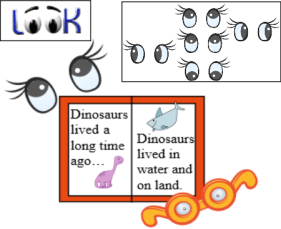
Eye tracking is the ability to control and coordinate the fine eye movements that allows us to:

  • Read a line of print by moving our eyes from left to right, without moving the head.
  • To focus and move the eyes to follow an object, without moving the head, in all directions.
  • To track/follow objects near and far.
  • To focus on one object without moving the eyes.

Eye tracking difficulties can have a dramatic effect on a child’s ability to read fluently and with ease due to the fact that they do not see the print in the same way as people with good eye tracking skills.

Typical problems due to poor eye tracking skills:

  • They lose their place, skip words or transposes them.
  • They use a finger to help keep their place.
  • Some will turn their head sideways to read or write.
  • Others may cover one eye to read.
  • They hold their head close to the table when looking at things, reading, writing and drawing.

Good spatial awareness enables us to be aware of the space around us and our position in that space, as well the relationship between ourselves and objects. This also includes our ability to see and understand the spacing of text and pictures on a page, to distinguish between paragraphs, sentences, words and individual letters.

Spatial awareness difficulties can have a dramatic effect on a child’s ability to read fluently and with ease due to the fact that they do not see the print in the same way as people with good spatial awareness skills.

Typical problems due to poor spatial awareness skills:

  • They lose their place, skip lines and words or transpose them.
  • They use a finger to help keep their place.
  • Comprehension can be difficult as text is mis-read.

For more information on how to identify eye tracking and spatial awareness difficulties as well as activities to help support and develop these skills use these links (they will take you to the relevant pages on our Teach Handwriting website):

Eyesight Difficulties

Eye test 1

Children will often be unaware that what they see and experience may be different to what we or their friends are seeing. As parents it can be a real shock when your child says “isn’t that what you see?”, as unless the difference is extreme and has an obvious impact on them we can think everything is ok.

Visual difficulties not only affect a child’s ability to read but also their handwriting skills.

If you are not sure about your child’s vision then book an eyesight test, it could be your child is struggling because they need glasses, and they are now cool and don’t carry the stigma they used to.

Some children may not have a problem with their eyesight but find reading print difficult because it seems to move around on the page as they try to read.

When reading a book with your child it is worth talking to them about what they see. Try to be matter of fact, so that they do not feel you are looking for a particular answer. Using a book with a good print size and not too crammed with words (so a school reading book is a good idea) you are looking to find out:

  • Can they identify each row of text (try asking them to count how many lines on the page or to point to each line of print) or do they jump or miss out lines.
  • Can they identify words in the line of text or do they sometimes blur together.
  • Can they see each letter in words or do they sometimes swap them around so “was” becomes “saw” for instance (this does happen occasionally when a child is first learning to read but is more of a concern if it becomes a regular reading error for a number of words).
  • Does the print do funny things, such as move or wiggle about?

Book an eye test for your child if they are having some, or all, of these difficulties. Also try placing different coloured overlays (coloured plastic wallets are good) over the text to see if your child finds it easier to read or see the print. For many children, struggling with the issues above, coloured overlays or specially tinted glasses can make an amazing difference. We found the impact for our two dyslexic daughters quite dramatic, improving their skills, confidence and self-esteem. It does not work for all children but it is really worth trying.

Some opticians, who have an Optometrist or Orthoptist, can perform a coloured overlay test (http://www.eyecaretrust.org.uk/view.php?item_id=125) for your child to assess whether coloured lenses would be beneficial. The test can be difficult for children under the age of 8 as they may choose their preferred fashion colour rather than the one best suited for them.

Developing and Supporting Your Child’s Reading Journey – Week 6

Letter Knowledge

Phonics Assessment Pages

Letter knowledge is understanding;

  • That the same letter can look different, for example, a lower-case letter ‘b’ looks different from a capital letter ‘B’. Letters will also look different depending on which font type is being used or if it is handwritten, for example, an Arial font letter ‘g’ looks different from a Calibri font ‘g’.
  • That letters have names and the same name is used for that letter even when they look different, so the lower-case letter ‘a’ and its capital letter form ‘A’ are both called ‘ay’.
  • That letters (graphemes) are used to represent sounds (phonemes) in words. Teaching the unique letter names of the alphabet is an important pre-phonics skill. A letter or combination of letters can represent more than one sound and so the only way of identifying alphabet letters when we talk about them is to use their unique names.

Developing Letter Knowledge:

Through Play:

  • Sorting and Matching Games – use plastic or wooden letters, alphabet letter flash cards; can they group all the lower-case letters together, or all the capital letters or all the different letter ‘ay’s’ together.
  • Kim’s Games – use plastic or wooden letters, alphabet letter flash cards. Using a few letters at a time, place 5 to 10 on a tray and let your child look at them and talk through which letters are there. Cover with a tea towel and ask your child to look away, then remove 1 or 2 of the letters. Then ask your child to look back and remove the tea towel. Can they spot which letters are missing.
  • Detective Games – focus on identifying individual letters of the alphabet and naming them, this can be played at home or when out and about.
  • Leap Frog – use the letters of the alphabet on home-made paper lily pads. Use the letter names to identify the target lily pad for your child to either jump onto or to throw a bean bag/soft toy on to.
  • Skittles and Throwing Games – use letters of the alphabet on the targets and use the letter names as a way of identifying which of the targets your child is aiming for.

Through Drawing/Writing:

  • Making lists of things to do, or a shopping list. Their version of the list may be just squiggles and dots (so don’t rely on this for your shopping trip) but it is the beginning. I would keep the list and get them to tick off things done or items purchased as part of the experience so that it has a genuine purpose (children really like this).
  • Making and drawing their own story book.
  • Learning to write letters correctly (see our Teach handwriting Website: http://bit.ly/2F9P7cI)

Through Songs/Nursery Rhymes:

  • Singing Alphabet Song, try singing it to different tunes.
  • Make up Your Own Rap – point to the letters as the rap is said.

Through Talk:

  • Talk about letters as being shapes made up of straight, curves and diagonal lines.
  • Look at the letters in your child’s name, talk about the fact that the first letter in their name is always a capital letter and that normally the other letters are lower-case letters.
  • Point out, especially for slightly older children, that lower-case letters are about half the size of the capital letters.
  • Compare letters looking at what is the same and different about them.
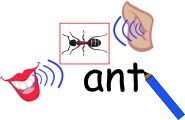
  • When taking about letters use the letter name as well as the sound it is making in the word, remember a letter is often used to represent more than one sound. The letter ‘a’ can be used to represent different sounds in the following words: ant, apron, was, and any (just 4 of the eight sounds it is used to represent).

Through Book Sharing:

What Books to choose?

  • Books with shapes
  • Books where you have to find things (like I spy)
  • Alphabet books
  • Books which use different font styles in the pictures and text.

Book Sharing Tips:

  • Alphabet books do not need to be read from cover to cover. Let your child choose which letters they want to look at.
  • Trace the letters with your finger or let your child trace it (make sure you trace the letter using the correct formation orientation, encourage your child to do the same).
  • Talk about the pictures in alphabet books before focusing on the letter, its name and the sound it can make.
  • Show your child the first letter in their name and then look for that letter in the book.
  • Show and talk about how some letters are in their capital form and others in their lower-case form. Can they find other examples of the letters?
  • Choose two letters to talk about: How do they look alike? How do they look different? What shapes/line styles are they made up of?