Games to Develop Listening Skills – Part 3

Musical Bottles

These games are designed to help a child learn about the different levels of sound, pitch, tone and volume.

Music Fun

  • Skittle Band – Use or make a drum stick (wooden spoons are good for this) and explore with your child the different sounds the drum stick makes against different objects made of different materials, such as steel saucepan, another wooden spoon, plastic bottles etc. Choose items that are safe and you are happy for them to play with. You could photograph the object and record the sounds they make or video (on your phone), to play back and talk about later on. Try moving the activity outside for a different sound quality experience.
  • Orchestral Conductor – Once your child is happy and enjoys playing and making sounds, with different objects and instruments, try the conductor game. You can use your hands or a baton to point and encourage them to play certain sounds just like an orchestral conductor does, but make sure you have a clear stop gesture which your child will understand (you may need to say stop at the same time as the gesture to begin with, but they will soon get the idea). Then swap places and you become the musician and they the conductor; it may not be a classic you create but it is great fun. As your child develops their skills you can add new elements and hand gestures to make the sound louder or softer.
  • Musical Bottles – Use plastic bottles with different amounts of water/sand in them and different things as a beater. Talk about how:
    • Low/deep or high pitched a sound is compared with another.
    • Using different beaters can change the quality of the sound when used on the same bottle.
    • Using different amounts of pressure to hit the bottle makes the sound louder (harsher) or quieter (softer).

Try organizing the bottles in order of pitch to create a musical instrument and using this as part of the Orchestral Conductor game. You could number each bottle or use a different picture on the bottle as a way of encouraging your child to play the bottles in different orders (making music).

Enjoy!

Games to Develop Listening Skills – Part 2

Listening Games Scanning

These games are designed to help a child learn how to block out ambient noises so that they focus and concentrate on one particular sound.

Sound Scanning Games

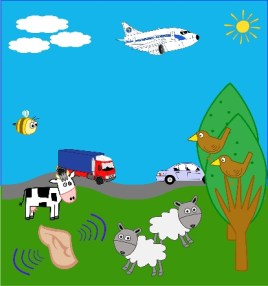
The idea is to identify and talk about different sounds in different locations; in the park or at home in different rooms. Ask the child to listen for a moment (timed activity 30 seconds to start with then increase) and to pick out different sounds they can hear. Some will be close and easier to identify, other sounds may be further away and require more focused concentration to work out what they may be.

  • Sound Scanning Questions to help:
      • What can you hear that is far away?
      • What can you hear that is close by?
      • What can you hear that is loud?
      • What can you hear that is quiet?
      • What can you hear that makes a high pitched sound?
      • What can you hear that makes a low pitched sound?
      • What can you hear that sounds big?
      • What can you hear that sounds small?
  • Listening Walk Activities- You could record some of the sounds heard and talked about on the walk. Try changing the ‘What can you …?’ questions to ‘What did you…?’ Depending on your child’s age they may be able to draw a sound scape picture showing all the things they heard on the walk.
  • Where is the Sound? – The aim of the game is find out where the sound is coming from. Start by using something that makes a good clear sound. Ask your child to cover their eyes (can use a blindfold) and have them sit or stand in the middle of the room. Move around the room, starting not too far away from them and make the sound. Pause between each sound to give your child time to settle and focus on it before you make the next sound. Try to keep an even, slow pace. The aim is for your child to point in the direction they believe the sound is coming from. Gradually move further away, maintaining the same sound level. Swap places with your child, so you have to guess where the sound is coming from.

To make it more challenging:

  • Change the volume of the noise.
  • Change the object that is making the noise.
  • Change the speed (rhythm), as well as the location, at which the sounds are made.

Have Fun!

Games to Develop Listening Skills – Part 1

Listening Games

Last week we explained the three things required for good listening skills:

  • To pay attention – being able to focus on a particular voice or sound by filtering out other voices and ambient noises.
  • To concentrate on the voice or sounds to take in the information, building the stamina needed to listen for extended periods of time.
  • To interpret that information to gain meaning – comprehension.

Here are some games to help build these skills.

These games are designed to help a child learn how to block out ambient noises so that they focus and concentrate on one particular sound.

Sound Screen Games

Create a barrier between you and your child so they cannot see the object you are going to use to make noises with and see if they can guess the object. Try to use objects that make sounds that occur around them a lot of the time, for example keys rattling together or wooden blocks being knocked together. There are many variations of the game that can be played but you need to make sure your child has the opportunity to experience the sounds with the relevant object beforehand, if they are not to be frustrated by the game.

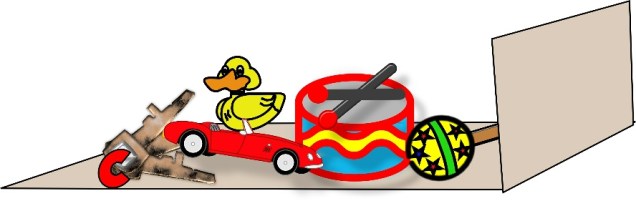
  • Mrs Blog has a box… To the tune of Old Macdonald changing the name as best fits the situation. Place a box, on its side with a number of objects inside that make a noise (choose items your child is familiar with the sound of) between you and your child so they can’t see what is in the box. Start singing “My mummy has a box ee, i, ee, i, o and in that box she has…” Stop and gesture to encourage your child to listen (maybe a cupped hand to your ear) then pick one of the objects and make a sound; your child then tries to guess what it is. Continue to sing but imitating the sound of the object you played, which your child can now see. If it was a bunch of keys for example; “with a jingle, jangle here and a jingle jangle there, my mummy has a box ee, i, ee, i, o.” Swap places so your child can choose an object in the box, change the song so you are using their name, for example “My James has a box…”
  • Same or Different? Place a barrier between you and your child so they cannot see which object you will use to make a sound and that you duck behind so they cannot see your face when you make vocal sounds.  This can be played at different levels. At the basic level using animal noises such as baa , moo, woof etc. A more complex level would be to use shakers with different size things inside to make different shaking sounds. Plastic containers or bags of the same size and type can be used to make the shakers with different small items in such as dried pea, rice, sand or small coins, pebbles or small lego bricks. Make the noise once and then repeat either with the same noise or a different one. The child then says if they a were the same or different.
  • Copy Cat! Place a barrier between you and your child so they cannot see which object you will use to make a sound and that you duck behind so they cannot see your face when you make vocal sounds.  You will need two set of the same objects, a set for you and one for your child. The aim of the game is for you to make a noise with either an object or your voice and for your child to copy that sound choosing the correct object in front of them or using their voice as you did. The game can become more complicated as you mix a number of sounds using objects and your voice. Swap roles so that your child becomes the leader of the game and you have to copy them.

Have Fun!

N.B. Be careful of small objects escaping from shakers etc. as these can be a choke hazard.

What is listening?

Listening

Listening is a complicated skill that requires children to learn how to pay attention – being able to focus on a particular voice or sound by filtering out other voices and ambient noises. They then have to concentrate on the voice or sounds to take in the information, building the stamina needed to listen for extended periods of time. Then they have to interpret that information to gain meaning – comprehension.

The usual approach to teaching children to listen is based on three behaviours:

  • Sitting or standing still
  • Looking at the person who is speaking
  • Thinking about what the person is saying or said

However just because your child is replicating these behaviours doesn’t mean they are listening.

It is also surprising how often children are happy to follow steps 1 and 2 but completely miss step 3.

This is not surprising really as listening is not a set of behaviours but a set of skills that need to be taught and developed, starting from birth.

A child with poor listening skills will find it difficult to complete tasks, as they have not taken in all the information and so not understood the full extent of the task, or what was required of them. This can lead to a child flitting from one activity to another and never finishing anything, slowing down their learning. They also miss out on the sense of achievement and feeling of pride when a task is completed. This helps to build a child’s confidence, self-esteem and self-motivation to try again or attempt a more challenging task.

For many children good listening skills do not develop naturally, they have to be taught!

Over the next few weeks we will introduce games and activities to support listening skills.

Conversational Turn Taking Skills

Children need to learn that in conversation they need to take turns listening and speaking.

This a more complex process then we often give it credit for as often we, especially in our busy lives, can be guilty of only listening to reply rather than listening to understand.

Children need to learn when to talk and when to listen; for this to happen they need to do the following:

  • Actively listen to the other person. This means:
    • Concentrate on the words being said, by blocking out other environmental noises and voices.
    • For most children and adults this also means looking at the person, watching their facial expression and body language.
    • Listening for the verbal cues and/or changes in the tone of voice that signifies that the person has finish speaking.
    • Recognising that it is either your turn to respond by formulating a reply or not.
  • Formulate a response. This means:
    • Extracting meaning – taking understanding from the words that have been spoken.
    • Mentally searching for words to compile a grammatically correct set of sentences.

In young children this can take time, not because they do not have the answer, because they just take longer to recall and formulate their responses. This is due to the constant acquisition of new language and understanding of the grammatical conventions that need to be applied.

  • Communicate Response. This means
    • Speaking clearly, pronouncing words correctly in coherent sentences.
    • Using socially appropriate facial expressions and body language to accompany the response.
    • Using the appropriate verbal cues and/or changes in the tone of voice that allow the other person to understand it is now their turn.
  • Wait. This means giving time for the other person to formulate their response.
  • Actively Listen to the other person.

Learning these skills takes time and needs to be taught as well as modelled by those around the children. It begins very early on for instance, when we talk to a baby, as if expecting an answer. As a baby starts to make cooing and babbling sounds they begin to respond to you in those gaps, their first conversations.

Something that is worth remembering:

“When you talk, you are only repeating what you already know. But if you listen, you may learn something new.” (Dalai Lama)

The Importance Speaking & Listening

Speaking & Listening Icon 2Speaking and listening skills play a vital role in helping children to develop their awareness of the sounds around them. The more they hear, the more associations they can make to those sounds (what they see, feel and experience), the greater their ability to distinguish between them.

Click here to link to our tips and ideas page on how to support a child’s speaking and listening skills. http://bit.ly/2ncjzYn

The Power of ‘Old MacDonald’

Old MacDonold Farm

The Easter break is upon us, bringing with it thoughts of Spring and all that we often associate with this time of year, lambs, chicks and new life. This in turn prompted memories of singing ‘Old MacDonald had a Farm’, with my own children. A strange connection; maybe!

But, maybe not! Through the making of animal noises and the repetition of the ‘e i e i o’ refrain the girls were learning to play with sounds. Through the song they were learning how to make sounds through changing their mouth shape, the position of their tongue and controlling their breathing.

When they couldn’t make a particular animal noise we just moved to the next animal on the farm, because it is a fun song, so no pressure. Next time we sang the song, the animals were still all included and over time they learnt to make all the animal sounds. Which, by happy coincidence, are the same sounds (phonemes) needed in our everyday speech.

The great thing about Old MacDonald and his farm is that he also has tractors, a quad bike and depending on where he lives even a helicopter. The list of vehicles and additional animals is endless, especially if he opens up his own zoo next to the farm!

Syllable Awareness & Counting

Syllables snowman

At about the age of 4 years old children start to develop an understanding that words can be split into parts (syllables) and that these parts give the word its rhythm.  A syllable is the largest phonological unit (one or a group of sounds) of a word and is like the rhythmic beat of the word.

They should be able to orally blend syllables together to form words and segment words into syllables.

A fun activity to help develop syllable understanding:

How Many Syllables?     

Children love to clap out the number of syllables in a word. It is important to say the word at a normal speed rather than really slowly as this can distort the word and make it difficult to hear the syllables. To start with your child just needs to be able to recognize them by clapping, stamping or jumping for each syllable of a word; they don’t need to be able to count them. It is thought that only about 50% of children can count out the syllables by the age of 4, so you can do the counting for them.

Spoken syllables are organised around the vowel sounds, making counting them easy; as the jaw drops when the vowel sound is spoken in the syllable. Try placing your hand under your jaw with your mouth closed before you say a word. Start with ‘cat’ you will notice the jaw drops once, this is because it is a one syllable (monosyllabic) word.

Most children will find it easier to identify syllables in compound words to start with. A compound word is formed by two words (root words) put together such as: sunset, hotbed, snowman and postman. They find it easier because the jaw tends to drop quite distinctly. As we say the vowel sound in each of the root words and because we tend to say these words slowly.

Vocabulary Building Ideas & Activities

Word Awareness

Helping your child build their vocabulary (word awareness – receptive & expressive language) is vital if your child is to continue to develop good communication skills. Talking, explaining, sharing and playing are all important as well as making sure that you pronounce words clearly and correctly for your child to hear. Your child will not have developed all the skills needed yet to copy you accurately but they will store the sound pattern information for later use.

Click the link for ideas & activities to support your child’s vocabulary development: http://bit.ly/29LajVk

Receptive & Expressive Language

Receptive language is how we take in and understand language; it is what we hear, see and read. This also includes body language and environmental clues. All these elements help us to interpret a situation and give it its meaning, so that we can understand what is being communicated. We do not need to be able to produce language to receive and understand it, so infants and toddlers understand far more than they can express (expressive language).

Expressive language is our ability to put our thoughts, needs and wants into words and sentences in a way that makes sense and is grammatically correct. A baby’s expressive language to begin with is based on cries and gestures and then moves to sound making, gestures and body language signals. We use this expressive language when we speak and write. Even when babies and toddlers move to speaking words they have a limited vocabulary which is why they can get frustrated when we do not understand them.

The Importance of Speaking & Listening

Speaking & Listening Icon 2

Phonological awareness development incorporates the understanding of, and the learning of how to, communicate through speech, body language and written forms. It relates to our sensitivity and understanding of the sound structures of our oral language. It enables us to progress from our awareness of large sound units (words in sentences) to smaller sound units (phonemes in words).

Speaking and listening skills play a vital role in helping children to develop their awareness of the sounds around them. The more they hear, the more associations they can make to those sounds (what they see, feel and experience), the greater their ability to distinguish between them.

Our tips and ideas help you to support your child’s speaking and listening skills.

https://www.teachphonics.co.uk/how-to-talk-to-your-child.html

Don’t underestimate the importance of everyday chatter or conversation (‘Small Talk), children develop and learn a great deal through ‘Small Talk’ with adults and other children.

What do we mean by ‘Small Talk’? With babies it is the kind of talk that explains what we are doing, what they are doing, where we are going and what we can see.  As they get older our verbal exchanges increase as we support their receptive and expressive vocabulary development. Through these exchanges we also support their general language development and understanding of how words are pronounced, basic sentence structure and using the correct tense.

When we talk with a child we demonstrate and model the use of language in real time so that it has meaning. For instance, a child may point and say “cat” and we would respond with “Yes, the cat is sleeping.” Or we may correct the child and say “That is a dog.” If we could we would point to a cat and explain the difference. We also correct mispronunciation of words and correct tense issues in the same way; repeating the word or sentence using the correct pronunciation or tense back to the child.

The Communication Trust has a link to a free downloadable booklet called Small Talk which is a very useful guide for understanding how your child learns to talk from birth to age 5:

https://www.thecommunicationtrust.org.uk/resources/resources/resources-for-parents/small-talk.aspx