English (UK) Vowel Sounds

Learning to hear and differentiate the vowel sounds from consonant sounds is an important skill in understanding how words are formed. Every word in the English Language has to have a vowel sound in it and every syllable in a word also has to have a vowel sound within it. This knowledge is an important element in developing our phonemic awareness and phonics knowledge as we start to learn how to read and spell words.

There are 20 vowel sounds in the English (UK) Language, usually (in the UK Education System) split into two main categories based on sound quality:

  • ‘Short’ vowel sounds, due to the short duration of the sound being made, the sound cannot be held onto without becoming distorted, such as the /e,(e)/ in me, pea and tree
  • ‘Long’ vowel sounds, due to the length of their pronunciation, these can often be held without distorting their sound, such as the /oi,(ɔI)/ sound found in the words:boy, coin and buoy

Here at Teach Phonics we split the ‘long’ vowel sounds category into ‘long’ vowel sounds and ‘long ‘R’ controlled’ vowel sounds. The ‘long ’R’ controlled’ vowel sounds are so called because of the slight /r,(r)/ sound quality that can be heard in them for example the /or,(ɔː)/ sound found in the words: fork, door, walk and sauce.

The English Phoneme Chart (https://www.teachphonics.co.uk/phonics-phoneme-chart.html), which uses the unique symbols of the International Phonetic Alphabet (IPA), splits the 20 vowel sounds into two groups based on mouth position:

  • Monophthongs which have one mouth position throughout the sound for example /e,(e)/ in me.
  • Diphthongs, where the mouth position changes, giving a 2 sounds quality to the phoneme for example, /oi,(ɔI)/ inboy.

The Consonant Sounds with their Most Common Letter and Letter Combinations

There are 24 consonant sounds in the English language. A consonant sound is made (produced) when the air flow is being restricted in some way, which means that the mouth doesn’t open as wide and so the jaw doesn’t drop noticeably, which is different from vowel sounds.

Here is a list of just some of the most commonly seen letter and letter combinations used to represent the 24 consonant sounds. For a more comprehensive lists check out our English Phoneme Chart or Alphabet Keyboard which can be found on our ‘Phonemes’ page: https://www.teachphonics.co.uk/phonics.html            

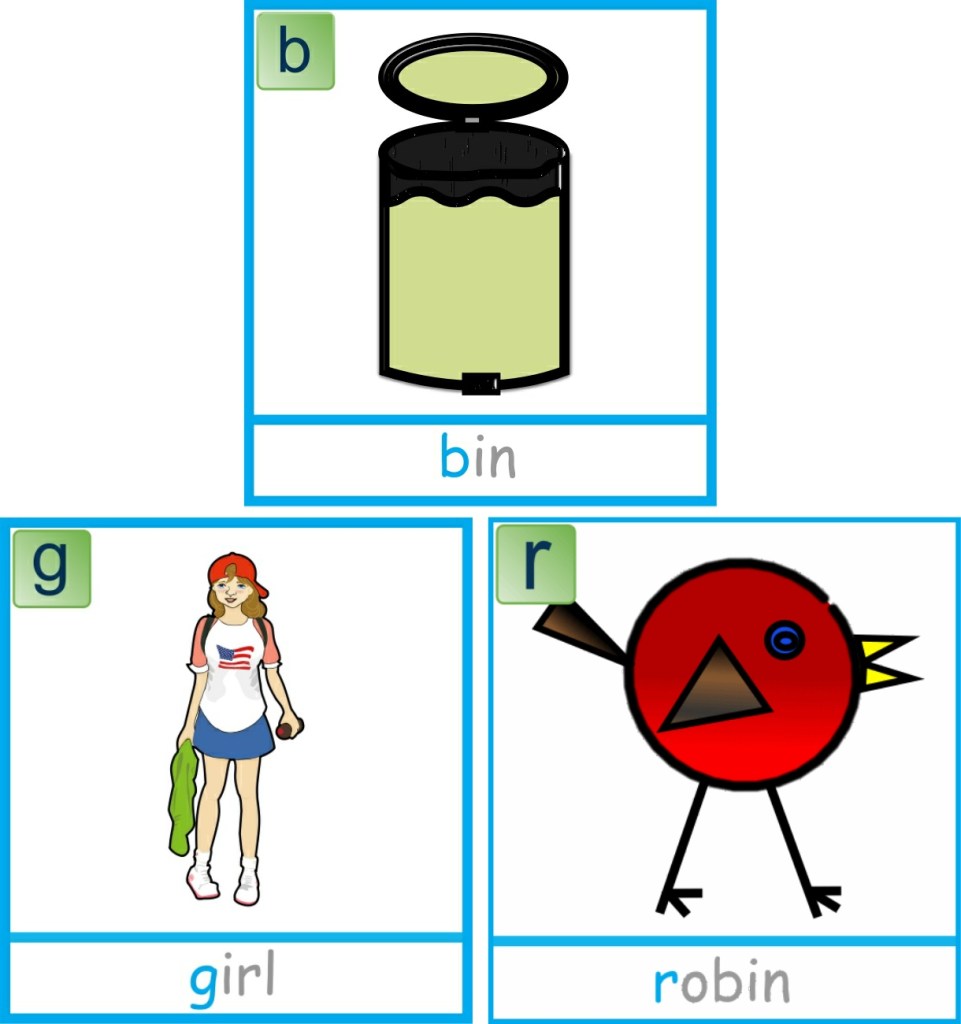
  • /b,(b)/      bin, rabbit
  • /k,(k)/      cat, key, duck, queen, anchor, broccoli
  • /ch,(ʧ)/    church, watch
  • /d,(d)/      dog, ladder, towed
  • /f,(f)/        fish, puffin, phone, laugh
  • /g,(g)/     girl, digger, ghost
  • /h,(h)/     hen, who
  • /j,(ʤ)/      jigsaw, giant, bridge
  • /l,(l)/        lion, llama
  • /m,(m)/   man, hammer, lamb
  • /n,(n)/     nest, penny, knife, gnome
  • /ng,(ŋ)/   king, sink
  • /p,(p)/     panda, hippo
  • /r,(r)/      robin, lorry, wrist
  • /s,(s)/    sun, dress, city, geese, castle
  • /sh,(ʃ)/   ship, chef, delicious, initials, sugar
  • /t,(t)/      tent, butterfly, jumped
  • /th,(θ)/   thumb
  • /th,(ð)feather, breathe
  • /v,(v)/   van, sleeve, of
  • /w,(w)well, whale, penguin
  • /y,(j)/    yo-yo, euro
  • /z,(z)/    zero, puzzle, sneeze, cheese, is
  • /zh,(Ʒ)measure, television

What are Vowels and Consonants?

The English Language is created through the different combinations of 44 sounds (phonemes), 20 vowels and 24 consonants. In our written language we refer to the letters of the alphabet as being consonant or vowel letters depending on which type of sound they are representing.

Vowel sounds allow the air to flow freely, causing the chin to drop noticeably, whilst consonant sounds are produced by restricting the air flow.

Vowel sounds are usually (in the UK Education System) split into two main categories based on sound quality:

  • ‘Short’ vowel sounds, due to the short duration of the sound being made. The sound cannot be held onto without becoming distorted
  • ‘Long’ vowel sounds, due to the length of their pronunciation. These can often be held without distorting their sound.

The letters of the alphabet that we normally associate as being the vowel letters are: a, e, i, o and u. The letter ‘y’ is sometimes referred to as an honorary or semi vowel as it is used to replace one of the other vowel letters in words such as: fly, shy, why or my.

All words in the English language have at least one vowel sound in them so the written version must have at least one vowel letter in it.

Consonant sounds are made (produced) when the air flow is being restricted in some way, for example, changes in tongue position resulting in the mouth not opening as wide. This means that the jaw doesn’t drop noticeably, which is different to vowel sounds.

The letters of the alphabet that usually represent the consonant sounds are: b, c, d, f, g, h, j, k, l, m, n, p, q, r, s, t, v, w, x, y, z. 

What are Graphemes & Phonemes?

Last week we started to explain some of the technical language associated with the teaching of phonics, which some new parents may have little or no knowledge of. So, we thought it would be a good idea to continue with this over next couple of weeks to further support you in helping your child.

Graphemes are the alphabet letters, or letter combinations, that represent a single sound (phoneme) in a written word.

An example of a single letter (grapheme) representing a single sound (a phoneme) can be seen in the following words: sat, pat and dog.

Some sounds are represented by two letters and are called digraphs such as the ‘ch’ in ‘chip’ or ‘sh’ in ‘shop’ or ‘ea’ in ‘head’ and the ‘ai’ in ‘rain’.

Other sounds can be represented by 3 (trigraphs) or 4 (quadgraphs) letter combinations such as ‘igh’ in ‘light’ and ‘eigh’ in ‘eight’.

Phonemes are the smallest units of sound of a language; which we blend together to form words.

The English Language has 44 phonemes, 24 consonants and 20 vowels, represented by the unique symbols of the International Phonetic Alphabet (IPA).

The 44 phonemes of English (UK) are represented by more than 280 letter or letter combinations. Most letters therefore never make just one sound and that sound can be made by more than one letter or letter combination.

We have created over 1,000 videos that split words into their individual phonemes, showing which letters are making which sound in each word. You can access these videos in two ways:

  1. If you want to know which letter or letter combination represents a sound, click on the relevant phoneme button on the English Phoneme Chart;
  2. If you want to know what sound a letter or letter combination makes and see supporting animations, click on the relevant letter or letter combination on the Alphabet Keyboard.

We hope you find these useful.

What is the difference between #phonics and #phonemic awareness?

With the new school year well under way many new parents are being introduced to the world of phonics and all the technical language associated with it. So, we thought we would take this opportunity to demystify some of that technical language.

Phonics is the association of sounds (phonemes) to written alphabet letters (graphemes). For reading (decoding) the phonics coding system is used to convert the written word into sounds. For spelling (encoding) the same phonics coding system is used to covert sounds heard into letters to form written words.

Phonemic awareness is our ability to split words into their smallest sound units (individual phonemes) and to manipulate these sounds through segmentation, blending, substitution, re-ordering and deletion. This is based on what we hear and say, not the written word.

Good phonemic awareness is the vital skill required before phonics can be introduced successfully as a tool for learning to read and spell.

  • Segmentation – being able to split words into their individual sounds, for example ‘cat’ into c-a-t.
  • Blending – being able to blend individual sounds together to say a word, for example d-o-g into dog.
  • Substitution – being able to swap one sound for another in a word, for example swapping the /k,(k)/ sound in the word ‘cat’ with a /h,(h)/ sound to say the word ‘hat’.
  • Reordering – being able to swap the sounds around to create a new word, for example changing the order of the letters in the word ‘cat’ to form the new word ‘act’.
  • Deletion (omission) – being able to remove a sound from a word to create a new word, for example removing the /t,(t)/ sound from the word ‘cart’ to say the new word ‘car’.

These are developed further when phonics is introduced, sound to letter association.

Watch our ‘Single Word Reading’ animation to see these manipulation skills in action: https://www.teachphonics.co.uk/phonics-reading-lesson-plans.html

What is Phonics?

With the new school year under way some of you will have been introduced to phonics for the first time. Phonics is a very useful decoding tool used for developing reading skills and as an encoding tool for spelling.

Phonics is the simple process of linking sounds to letters, its complexity comes from how many sounds (phoneme) to letter (grapheme) combinations there are. So, to be good at phonics a child needs to know the 44 sounds and numerous letter and letter combinations of English and then learn the associations between the two.

Children can communicate orally from an early age; it is when they move to the written word that they need to learn how to decode text, to turn the letters into words they already know.  

Using phonics knowledge for reading entails:

  1. Identify the letter or letter combination, in a word, that represent a sound
  2. Associate the letter or letter combination to one of the 44 sounds
  3. Blend each of the sounds together to form the word
  4. Recognise the now oral word to extract its meaning

The theory supporting the teaching of reading using phonics, especially synthetic phonics, is that if a child can decode a word by associating individual sounds to a letter or combination of letters, they will then be able to blend those sounds together to form and say the word.

Once a word has been spoken, they will extract its meaning by using their far more extensive spoken language comprehension. Children are therefore using the same mental processes to understand written text and speech.

The Key to Good Phonics Skills – Part 5

Developing #Listening & Speaking Skills – Games to Develop Phonemic Awareness

Phonemic awareness is our ability to split words into their smallest sound units (individual phonemes) and to manipulate these sounds through segmentation, blending, substitution and deletion. This is based on what we hear and say, not the written word.

These games are great for playing in the car or when waiting in queues and hopefully soon when out and about with other friends and family.

We usually introduce this concept to children using one syllable CVC words, a word that has a Consonant followed by a Vowel and then another Consonant, such as cat, dog, sit, peg and sun.

Play, ‘I hear with my little ear…’

This is based on the game I spy with my little eye. In this version you say;

 “I hear with my little ear the words (for example) cat, cake, key and kite. What sound do these words begin with?” The answer is they begin with the sound ‘k’ remember it is about what they hear not the spelling or letter names.

  • To begin with focus on helping your child to identify the first sound in words, remember it is about what you hear not the spelling, so shop, ship, and chef all start with the same first sound ‘sh’; fish, photo, fog would also have the same initial ‘f’ sound. Try not to correct your child based on spelling conventions, as it is sounds you are working on – spelling comes later.
  • Next help your child to listen and identify the last sound in a word such as ‘t’ in cat, sit and hat.
  • Then focus on the medial, or middle, sound in the word such as ‘a’ in mat, lap and tap.

Once your child can identify the initial, medial and final sounds in a word the next step is to playing with the words through oral phoneme segmentation and oral phoneme blending. You are probably doing this already with your child without really realising it.

  • Segmentation – being able to split words into their individual sounds, for example ‘cat’ into c-a-t.

Play, ‘How many sounds (phonemes) can you hear?’

This is a simple oral segmentation game just ask; “How many sounds (phonemes) can you hear in the word ‘hat’? The answer is 3. If your child can not count, they can show you using their fingers. The important thing is for them to hear and pick out the individual sounds in the word not the number of letters used to spell the word.

  • Blending – being able to blend individual sounds together to say a word, for example d-o-g into dog. This is achieved by saying the sounds over and over again getting quicker until it sounds and can be identified as the word (a tricky skills to learn).

Play, ‘I’m thinking of a word and it has the sounds (phonemes)… What is the word?’

This oral blending game seems easy but can be very trick skill for some children to master, so do not be surprised if they find it hard to begin with. Use CVC words to begin with, but do keep trying as it is a very important skill to learn; be patient and over time they will get there.

Say “I’m thinking of a word and it has the sounds (phonemes) l-o-g what is the word?” The answer is log.

Important Tips

We often slow down our pronunciation of the word and over exaggerate them, thinking we are helping our children to hear these sounds. This can be useful to start with, but be careful not to do it all the time. The aim is for your child to pick out the sounds in normal speech patterns, as these can be different from the way that words are spelt.

The most important thing to remember when modelling this, and when playing games to help develop these skills, is to make sure you are making the sounds correctly. It can be very easy to pollute a sound by adding an extra ‘uh’ sound to it, so ‘k’ becomes ‘kuh’ which makes it very difficult for children then to blend sounds.

When your child feels comfortable using and playing with sounds in CVC words move on to CCVC words such as stop, clop and flop, following the same steps of identifying the initial and last sound in the word and then the vowel sound rather than the middle sound. Then play oral phoneme segmentation and blending games.

The Key to Good Phonics Skills – Part 4

Developing #Listening Skills – Music Fun

These games are designed to help a child learn about the different levels of sound, pitch, tone and volume.

Music Fun

  • Skittle Band – Use, or make, a drum stick (wooden spoons are good for this) and explore with your child the different sounds the drum stick makes against objects made of different materials, such as steel saucepan, another wooden spoon, plastic bottles etc. Choose items that are safe and you are happy for them to play with. You could photograph the objects, record the sounds they make, or video (on your phone), to play back and talk about later on. Try moving the activity outside for a different sound quality experience.
  • Orchestral Conductor – Once your child is happy and enjoys playing and making sounds, with different objects and instruments, try the conductor game. You can use your hands or a baton to point and encourage them to play certain sounds just like an orchestral conductor does, but make sure you have a clear stop gesture which your child will understand (you may need to say stop at the same time as the gesture to begin with, but they will soon get the idea). Then swap places and you become the musician and they the conductor; it may not be a classic you create but it is great fun. As your child develops their skills you can add new elements and hand gestures to make the sound louder or softer.
  • Musical Bottles – Use plastic bottles with different amounts of water/sand in them and different things as a beater. Talk about how:
    • Low/deep or high pitched a sound is compared with another.
    • Using different beaters can change the quality of the sound when used on the same bottle.
    • Using different amounts of pressure to hit the bottle makes the sound louder (harsher) or quieter (softer).

Try organizing the bottles in order of pitch to create a musical instrument and using this as part of the Orchestral Conductor game. You could number each bottle or use a different picture on the bottle as a way of encouraging your child to play the bottles in different orders (making music).

The Key to Good Phonics Skills – Part 3

The Key to Good Phonics Skills – Part 3

These games are designed to help a child learn how to block out ambient noises so that they focus and concentrate on one particular sound.

Games

The idea is to identify and talk about different sounds in different locations; in the park or at home in different rooms. Ask the child to listen for a moment (timed activity 30 seconds to start with then increase) and to pick out different sounds they can hear. Some will be close and easier to identify; other sounds may be further away and require more focused concentration to work out what they may be.

  • Sound Scanning Questions to help:
  • What can you hear that is far away?
  • What can you hear that is close by?
  • What can you hear that is loud?
  • What can you hear that is quiet?
  • What can you hear that makes a high-pitched sound?
  • What can you hear that makes a low-pitched sound?
  • What can you hear that sounds big?
  • What can you hear that sounds small?
  • Listening Walk Activities- You could record some of the sounds heard and talked about on the walk. Try changing the ‘What can you …?’ questions to ‘What did you…?’ Depending on your child’s age they may be able to draw a sound scape picture showing all the things they heard on the walk.
  • Where is the Sound? – The aim of the game is finding out where the sound is coming from. Start by using something that makes a good clear sound.  Ask your child to cover their eyes (can use a blindfold) and have them sit or stand in the middle of the room. Move around the room, starting not too far away from them and make the sound. Pause between each sound to give your child time to settle and focus on it before you make the next sound. Try to keep an even, slow pace. The aim is for your child to point in the direction they believe the sound is coming from. Gradually move further away, maintaining the same sound level. Swap places with your child, so you have to guess where the sound is coming from.

To make it more challenging:

  • Change the volume of the noise.
  • Change the object that is making the noise.
  • Change the speed (rhythm), as well as the location, at which the sounds are made.

Have Fun!

The Key to Good Phonics Skills – Part 2

Developing #Listening Skills – Sound Screen/Barrier Games

Last week we explained the three things required for good listening skills:

  • To pay attention – being able to focus on a particular voice or sound by filtering out other voices and ambient noises.
  • To concentrate on the voice or sounds to take in the information, building the stamina needed to listen for extended periods of time.
  • To interpret that information to gain meaning – comprehension.

Here are some games to help build these skills.

These games are designed to help a child learn how to block out ambient noises so that they focus and concentrate on one particular sound.

Create a barrier between you and your child so that they cannot see the object you are going to use to make noises with and see if they can guess the object. Try to use objects that make sounds that occur around them a lot of the time, for example keys rattling together or wooden blocks being knocked together. There are many variations of the game that can be played but you need to make sure your child has the opportunity to experience the sounds with the relevant object beforehand so they don’t get frustrated by the game.

  • Mrs Blog has a box… To the tune of Old Macdonald changing the name as best fits the situation. Place a box, on its side with a number of objects inside that make a noise (choose items your child is familiar with the sound of), between you and your child so they can’t see what is in the box. Start singing “My mummy has a box ee, i, ee, i, o and in that box she has…” Stop and gesture to encourage your child to listen (maybe a cupped hand to your ear) then pick one of the objects and make a sound; your child then tries to guess what it is. Continue to sing but imitating the sound of the object you played, which your child can now see. If it was a bunch of keys for example; “with a jingle, jangle here and a jingle jangle there, my mummy has a box ee, i, ee, i, o.” Swap places so your child can choose an object in the box, change the song so you are using their name, for example “My James has a box…”
  • Same or Different?  Place a barrier between you and your child so they cannot see which object you will use to make a sound and that you duck behind so they cannot see your face when you make vocal sounds.  This can be played at different levels. At the basic level using animal noises such as baa, moo, woof etc. A more complex level would be to use shakers with different size things inside to make different shaking sounds. Plastic containers or bags of the same size and type can be used to make the shakers with different small items in such as dried pea, rice, sand or small coins, pebbles or small Lego bricks. Make the noise once and then repeat either with the same noise or a different one. The child then says if they were the same or different.
  • Copy Cat!  Place a barrier between you and your child so they cannot see which object you will use to make a sound and that you duck behind so they cannot see your face when you make vocal sounds.  You will need two set of the same objects, a set for you and one for your child. The aim of the game is for you to make a noise with either an object or your voice and for your child to copy that sound choosing the correct object in front of them or using their voice as you did. The game can become more complicated as you mix a number of sounds using objects and your voice. Swap roles so that your child becomes the leader of the game and you have to copy them.

Have Fun! N.B. Be careful of small objects, especially those escaping from shakers, as these can be a choke hazard.