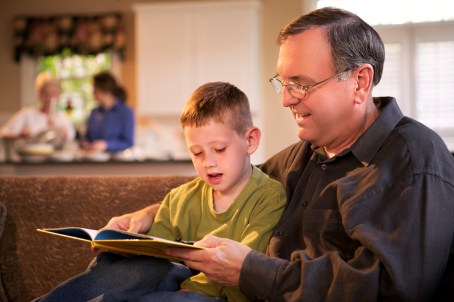
Why do we ask children to read out aloud?

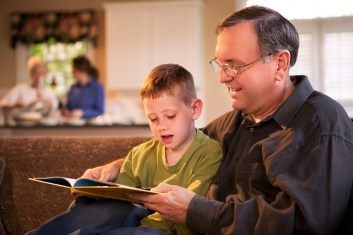
Reading with boy 4506329-1801x2700 (2)

Reading is the ability to first decode the letter sequence of the word (phonics) and then to place meaning to it in relation to the context in which it is being used.

We ask children who are learning to read to ‘read out aloud’, but forget to tell them why. It is not just so we can hear they have decoded a word correctly. The important point is to encourage them to actively listen to what they are saying. The idea is that if they hear the words they will, if it is part of their vocabulary, understand their meaning and therefore fully comprehend the text they have read.

Unfortunately many children just decode, speak and do not actively listen to what they have said, so they do not gain meaning from the words they are reading (poor reading comprehension skills).

Poor reading comprehension skills may also occur because a child has a limited vocabulary usage and /or understanding. A language rich environment is vital to help support and develop a child’s vocabulary and linguistic comprehension which in turn will support their reading comprehension skills.

The Sun is out!

It’s June, the weather is perfect, so why not set up water squirting games in the garden. The kids are waterproof and everything else will dry out, eventually!

This week on our Teach Handwriting Blog we have encouraged water fights and games for developing a child’s hand strength, co-ordination and eye tracking skills (all handwriting skills). However these games are also fantastic for developing sound and word awareness skills.

Try mimicking the sounds that the water makes as it drips on to the floor or hits the targets; use directional language to support your child’s aiming skills; describe how the objects move when hit: bouncing, rolling or flying and talk through the emotions evoked through playing the games.

As well as supporting your child in developing a whole range of physical and language skills you will also increase your cool adult status.

Some fun water games:

  • Try setting up a target wall, using chalk to draw the targets.
    • How many of the targets can you hit with water squirted from a water pistol or squeeze bottle in a set time.
    • How many targets can be washed off.
  • Set up a skittles range.
    • Each skittle hit with water can be worth a certain number of points, or the distance of the skittles may affect their value.
    • A time trial game to hit all the skittles. If you are using plastic bottles as skittles try making some of them a little heavier by putting sand or dirt in them to make it a bit harder to knock them over.
  • Move the object race games.
    • A light toy/ball has to be moved by squirts of water over a distance.
    • A range of objects moved in to target areas to gain points.

The only limitation is you and your child’s imagination and trust me kids never tire of finding new ways to play with water (but then again neither do many adults)!

Have FUN!

Developing and Supporting Your Child’s Reading Journey – Week 4

Reading

Print Awareness to Develop Understanding of Reading Conventions

Print Awareness is knowing that print (words) has meaning, including noticing print around them in the environment (posters & street signs) and understanding how to handle the conventions for reading a book. We can often assume that all young children or pre-readers (as not always young children) will develop print awareness naturally. However, research suggests that 95% of their visual attention is directed towards pictures, which in themselves hold a great deal of meaning and often tell the story very effectively.

Pictures/ illustrations in story books and pure picture books are powerful ways to engage children and adult with books, storytelling and reading. This is not to say that pictures are any easy way to interpret a storyline as they can hold a great deal of meaning, from simple obvious interpretation to more sophisticated symbolic representation.

Young children and pre-readers need opportunities to explore print and be helped to understand that the written word (print) has meaning. Once they start to see print they will begin to notice it everywhere not just in books but on posters, food packets, menus and street signs.

Again we can often assume that a child or pre-reader knows how to handle a book, however this is not always the case and can be due to a lack of experience with books or different cultural reading conventions. So it is important to check and teach these reading conventions for reading English:

  • Front cover opens to the left and we read it from the front to the back.
  • Print on a page is read left to right.
  • Usually print is read from the top of the page across and down (this may differ slightly in some children’s books)

Supporting Print Awareness:

Through Play:

  • Use takeaway menus or create your own as part of role playtime, they could have their own café serving up all sorts of interesting dishes for you. A blackboard can be very useful for this, allowing you or your child to write up their own menu for the day.
  • Travel brochures or leaflets from your local tourist information office are great for roleplay encouraging new language as well as a different way to explore print as they often have maps and timetables.
  • Use sticky labels or post it notes to label items or furniture as part of a ‘can you see or find’ game.

Through Drawing/Writing:

  • Making lists of things to do, or a shopping list. Their version of the list may be just squiggles and dots (so don’t rely on this for your shopping trip) but it is the beginning. I would keep the list and get them to tick off things done or items purchased as part of the experience so that it has a genuine purpose (children really like this).
  • For slightly older children making simple invitations and thank you cards can be fun. Ttry not to make the messages too long or to write too many as they will get bored and see it as a chore not as fun.
  • Making and drawing their own story book.

Through Songs/Nursery Rhymes:

  • Showing the printed words to songs and rhymes

Through Talk:

  • Point out signs, logos and labels when out and about as well as at home.
  • A lot of print awareness skills is developed through the sharing of books and appropriate on-line material.

Through Book Sharing:

What Books to choose?

  • Books that have writing as part of the story
  • Books that have writing as part of the picture
  • Story books; all types
  • Factual (non-fiction) books; all types
  • Comics
  • Children’s magazines and newspapers

Book Sharing Tips

  • Remember babies will chew and bash the pages of the book as you read. This is normal and part of their learning experience so go with it.
  • Encourage and let your child turn the pages.
  • Point to the words of the title as you say them
  • Explain what the author and illustrator do as you say their names.
  • Point to words or repeated phrases as you say them and or as your child says them. This will also help your to develop the skill of reading from left to right and from the top of the page down (English).
  • Point to words of interest and explain how words have spaces between them and why.
  • To help your child understand how to handle a book use the word ‘front’ and ‘back’ of the book. If you are handed a book upside down or with the ‘back’ cover facing you explain that you have to turn it around or over so that you can read it.
  • Explain that page numbers help you to find things in the book as well as to help make sure you do not miss any part of the story.
  • Explain that content pages in story books show the chapters and in factual (non-fiction) they show different subject areas, as well as giving the page numbers on which to find them.
  • Explain how the index page in non-fiction books work
  • Explain what a glossary is in a book.

Developing and Supporting Your Child’s Reading Journey – Week 3

Talking Icon

Vocabulary Development for Comprehension

Vocabulary is knowing the meaning of words including names of things, feelings, concepts and ideas. The larger a child’s vocabulary (understanding what words mean not just being able to say them) the easier it is for them to understand what they are reading.

The more you talk and share words and their meaning with your child the greater their vocabulary will become.

Vocabulary building:

Through Play

  • Introducing and playing sorting games helps your child to build a mental filing cabinet system of categories, this helps them to remember and learn the meaning of words. Start by introducing simple categories of everyday items like food or clothes as their vocabulary increases categories such as colour, size and texture become more appropriate.
  • As babies handle objects and toys describe how they feel, what they look like or the sound they make
  • When you are playing with your child add in new words and descriptions to the words as well as descriptions or expand on words they use in play. For example, if you are playing cars with your child you may comment on the size difference or colours between the cars.
  • Remember children learn new words best when they are learned in context, that is, in a natural setting.
  • If they are trying to say a word, let them finish and then say it back to them clearly and correctly. Do not make them repeat it back to you, they may choose to do so but make it their choice.

Through Drawing/Writing

  • When drawing or painting with your child or they are sharing their pictures with you talk about the shapes, colours types of lines (straight line or curves line), what you like best about the picture, and the objects you can see.

Through Songs and Nursery Rhymes

  • Listening of nursery rhymes and children’s song is a good way of helping your child make the distinction between the music and words (language used) in them. It is a good idea to practise this skill when there are no other noise distractions.
  • Try playing some action songs and rhymes to help your child learn the actions for the rhyme, then let them have a go on their own. Watch them to see if they can do some of the actions at the right time in the song, to see if they are listening for the right cue words. If they are struggling, explain they have to wait for certain words and show them what to do and when to do it.
  • Nursery and silly rhymes are great ways to introduce your child to rhyming sounds and increase sound play in words.
  • Singing often slows down our pronunciation of words, helping your child to pick out unusual or rhyming sound patterns. As with reading aloud it can introduce a wider vocabulary for your child.
  • Finger rhymes and action songs encourage your child to interact with words, the sounds within them and the rhythms they create. Finger rhymes such as ‘Round and Round the Garden’, ‘Pat-a-cake’ and ‘Incy Wincey Spider’. ‘Row, Row Your Boat’ is a lovely whole body movement song that encourages a rhythmic whole body motion, which babies and toddler enjoy (as well as the adults).

Through Talk

  • Speak in ‘parentese’ until a child is about 9 months old as they will listen to you longer and hear more words
  • Talk about feeling and situations throughout the day.
  • When your child points at something tell them the name of the object, for example if they point at an apple, say “Apple”.
  • Explain words or give synonyms
  • Avoid replacing unfamiliar words with familiar ones (explain the meaning). Remember to try to use the new word in context regularly as repetition of the word will help your child to remember it and reinforce the meaning of the word.
  • Repeat and expand on what your child says, so if they say “Dog!” you may say “A big dog!” This also helps them to develop an understanding of sentence structure.

Through Book Sharing

What books to choose?

  • Books with word not used in everyday conversation.
  • Non-fiction books (informational, instructional, true stories) -as they use different words to friction (story) books.
  • Any book really. The language of books in much richer and varied than that of everyday conversation.

Book Sharing Tips

  • Sharing and talking about the books you are reading helps to build word knowledge, as you point to the pictures, picking out different objects.
  • Reading out aloud helps to introduce your child to words that they may not experience in their everyday talk. This helps to expose them to new vocabulary and the sounds to be found in those words.
  • Reading aloud poems and story books with strong rhyme elements, like those found in Dr.Seuss books, helps introduce the new words and rhyming sounds in words.
  • Try exaggerating the rhyming words to help highlight the sound patterns, making it easier for your child to tune into them.
  • Explain unfamiliar words; don’t replace it with a familiar one.
  • When a word has more than one meaning. Talk about the different meanings.
  • Add descriptive words or more information than in the book.
  • Encourage your child to talk about the pictures. Add information and ideas to what they have said.
  • Use words to describe how characters in the book might have felt at a point in the story.
  • Use words to describe ideas in the story even if they are not used in the book.
  • Remember children learn new words and their meaning through repetition, so you will need to be patient as you re-read the same story over and over again or answering the same questions over and over again.
Easter Egg Hunt

Easter egg Hunt

The Easter Holidays will soon be upon us, so here are some fun activities to keep children of all ages entertained whether we have rain or sunshine.

An Easter egg, or treasure, hunt is a great way to teach children directional and placement (prepositions) language. It is important for a child to learn directional and placement vocabulary so that they can both understand instructions given and share information themselves, such as; ‘put your cup on the table’ or to say ‘teddy in car’.

Through Easter egg, or treasure, hunts you can introduce new directional and placement language in a fun and exciting way. There are a number of different ways to approach this:

  • You can give verbal instructions to the hidden egg/treasure.
  • You could create a map for them to follow and ask them to talk you through the map, supporting them with new language as necessary.
  • You could use a mixture of verbal and map clues.
  • For older children get them to hide the egg/treasure and give you instructions, or draw a map.
  • If you have more than one egg and they are of different sizes make the larger eggs more difficult to find.

The important thing is the language shared. Words and phrases to use are: left, right, straight on, forward, backwards, about turn, turn around, up, down, higher, lower, stop, next to, in front, beside, underneath, on top of, behind, on the left of, on the right of, outside, and inside.

Easter egg, or treasure, hunts are a great whole family activity and you are never too young or too old to join in!

Some Words Lose Their Meaning Without a Context

Some words, such as homophones and homonyms, need to be heard or read within a specific context if we are to understand what the word means.

Homonyms are words which are pronounced and spelt the same, however; their meaning can only be truly understood when the context in which the word is being used is made clear. For instance, the word ‘bark’ can be used to mean the bark on a tree or the noise a dog makes.

Homophones are words which are pronounced (sound) the same but have a different meaning and are spelt differently such as ‘pair’ and ‘pear’, ‘their’ and ‘there’ or ‘two’, ‘to’ and ‘too’.

To view more examples, follow this link:  http://bit.ly/2BcUa8N

Vocabulary Building Ideas & Activities

Word Awareness

Helping your child build their vocabulary (word awareness – receptive & expressive language) is vital if your child is to continue to develop good communication skills. Talking, explaining, sharing and playing are all important as well as making sure that you pronounce words clearly and correctly for your child to hear. Your child will not have developed all the skills needed yet to copy you accurately but they will store the sound pattern information for later use.

Click the link for ideas & activities to support your child’s vocabulary development: http://bit.ly/29LajVk

Receptive & Expressive Language

Receptive language is how we take in and understand language; it is what we hear, see and read. This also includes body language and environmental clues. All these elements help us to interpret a situation and give it its meaning, so that we can understand what is being communicated. We do not need to be able to produce language to receive and understand it, so infants and toddlers understand far more than they can express (expressive language).

Expressive language is our ability to put our thoughts, needs and wants into words and sentences in a way that makes sense and is grammatically correct. A baby’s expressive language to begin with is based on cries and gestures and then moves to sound making, gestures and body language signals. We use this expressive language when we speak and write. Even when babies and toddlers move to speaking words they have a limited vocabulary which is why they can get frustrated when we do not understand them.

The Importance of Speaking & Listening

Speaking & Listening Icon 2

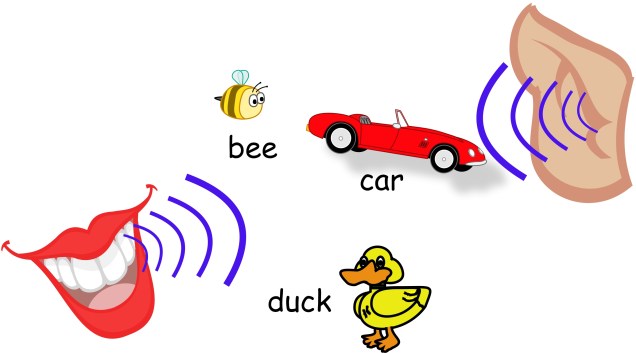
Phonological awareness development incorporates the understanding of, and the learning of how to, communicate through speech, body language and written forms. It relates to our sensitivity and understanding of the sound structures of our oral language. It enables us to progress from our awareness of large sound units (words in sentences) to smaller sound units (phonemes in words).

Speaking and listening skills play a vital role in helping children to develop their awareness of the sounds around them. The more they hear, the more associations they can make to those sounds (what they see, feel and experience), the greater their ability to distinguish between them.

Our tips and ideas help you to support your child’s speaking and listening skills.

https://www.teachphonics.co.uk/how-to-talk-to-your-child.html

Don’t underestimate the importance of everyday chatter or conversation (‘Small Talk), children develop and learn a great deal through ‘Small Talk’ with adults and other children.

What do we mean by ‘Small Talk’? With babies it is the kind of talk that explains what we are doing, what they are doing, where we are going and what we can see.  As they get older our verbal exchanges increase as we support their receptive and expressive vocabulary development. Through these exchanges we also support their general language development and understanding of how words are pronounced, basic sentence structure and using the correct tense.

When we talk with a child we demonstrate and model the use of language in real time so that it has meaning. For instance, a child may point and say “cat” and we would respond with “Yes, the cat is sleeping.” Or we may correct the child and say “That is a dog.” If we could we would point to a cat and explain the difference. We also correct mispronunciation of words and correct tense issues in the same way; repeating the word or sentence using the correct pronunciation or tense back to the child.

The Communication Trust has a link to a free downloadable booklet called Small Talk which is a very useful guide for understanding how your child learns to talk from birth to age 5:

https://www.thecommunicationtrust.org.uk/resources/resources/resources-for-parents/small-talk.aspx

The Skills a Child Needs to Achieve Phonics Success

Phonological Awareness Chart

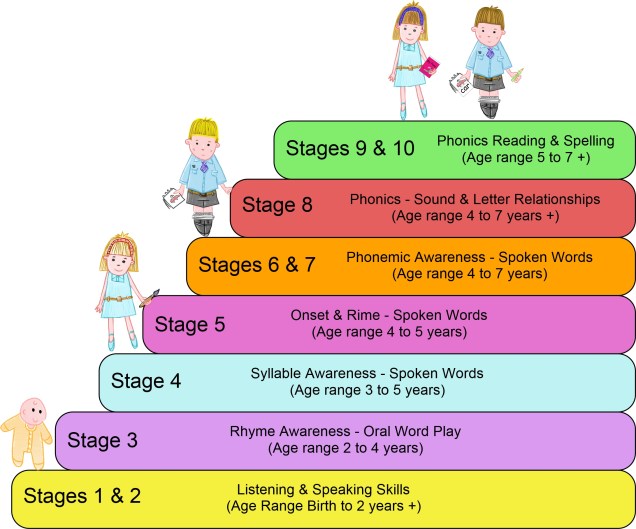
Phonics is actually stage 8 of the 10 distinct and progressive stages of in phonological awareness development.

Pre-phonics skills are those a child learns as they develop through the phonological awareness stages 1 to 7. Throughout this time they are continually developing their understanding and knowledge of our spoken language as well as other communication forms such as gestures, facial expression, body language and social conventions.

Speaking and listening skills play a vital role in helping children develop their phonics knowledge as they need to be exposed to a wide and varied vocabulary that allows them to hear and use the range of sounds that form our language.

Being exposed to a greater range of sound experiences helps children to develop their awareness of the sounds around them. The more they hear, the more associations they can make to those sounds (what they see, feel, experience), the greater their ability to distinguish between them. This skill becomes important later on as they begin to isolate individual words in sentences, being able to distinguish between words that sound similar such as dog and hog.

Through listening and speaking games and activities children are exposed to new vocabulary as well as learning to play with the sounds in their language. This helps them to remember how the sounds feel when they make them as well as how they sound in isolation and when combined with other sounds.

Scientists believe a child’s sound awareness begins before they are born; at about 24 weeks, which highlights the importance of sound awareness, including environmental and speech sounds, as part of our instinctive natural development.

The Phonological Awareness Stages on our website are set in a developmental order from one to ten. Against each stage we have provided an age range guide based on research, which shows when most children develop the various phonological awareness skills. Clicking on a stage will take you to another page which gives more in-depth information and links to tips to help you support children through the stage.

The Simple View of Reading

The term ‘Simple View of Reading’ used by schools may seem strange as there is nothing simple about learning to read.

The Simple View of Reading was adopted by the Government in 2007 and now underpins the English National Curriculum’s programmes of study for reading at Key Stage 1 and 2.

Even though reading, the ability to decode the word and extract the correct meaning of the words, is a complex set of skills; the Simple View of Reading conceptual framework (Stuart et al. 2008, cited Hoover and Gough, 1986) reduces it down to two key components:

  • Word recognition – the ability to decode unknown words and recognise printed words.
  • Language comprehension – the ability to understand the spoken words and use this process to understand the written text.
Reading Comprehension = Decoding x Linguistic Comprehension

So in theory a child’s reading comprehension ability can be predicted by looking at their decoding and linguistic (spoken language) comprehension abilities (Johnston & Watson, 2007).

When using the Simple View of Reading as the basis for teaching reading it becomes clearer as to why:

  • A high quality phonics scheme is required, which the Rose Report (2006) explains ‘…is not a  ‘strategy’ so much as a body of knowledge, skills and understanding that has to be learned.’ (page 20) [This teaches children how to decode.]
  • A language rich environment to develop and encourage linguistic comprehension is vital.

The simple view of Reading diagram

[For a pdf copy of this diagram click here]

Bibliography

Johnston.R. and Watson.J. ‘Teaching Synthetic Phonics’, 2007, Pub: Learning Matters, Sage Publication Ltd.

Rose.J. ’Independent review of the teaching of early reading: final report March 2006’ Pub: DfES Publications

The simple view of reading and evidence based practice’  Rhona Stainthorp Institute of Education, Reading University, Morag Stuart, Institute of Education, University of London (2008) Pdf downloaded from internet