Christmas Card Drawing Ideas to Support Language Development

Drawing pictures with your child is a great way of introducing topic specific language, in this case words relating to Christmas and the winter season (depending in which part of the world you live). As you draw the pictures you can talk about the colours, shapes and sound you might hear. Such as: straight lines, curved line, wavy lines, squiggles spirals, circles, squares, triangles, crossed lines, diagonal lines, press softly, press hard, dark and light.

It is also a great way to help your child develop their pre-handwriting strokes and shape forming skills. It is amazing how using simple shapes can help you and your child create fantastic Christmas cards, pictures or gift tags.

We have put together some quick step by step Christmas drawing ideas for you to try using basic shapes such as circles, rectangles and triangles. 

We hope you find them useful: https://www.teachhandwriting.co.uk/assets/pdfs/Xmas%20card%20pre-handwriting%20drawing%20ideas.pdf

Art Activities to support the Understanding of Pressure – Half Term Fun

Crayoning and printing activities are great ways for a child to experience and experiment with pressure and the amount needed to create different effects. These activities will also encourage and support a child in helping them to understand, and for you to model, the language associated with pressure and how the pressure used feels. By linking the words used to the feelings and the outcome of using the pressure they can start to understand what is needed when asked to press gently or to press harder. 

When supporting a child to understand what we want when we ask them to press harder, we need to model how our body reacts to make this happen. You may need to exaggerate the actions but as you do this you also need to talk about what your body is doing and how it feels. Then point out the effect that this has had on the crayoning for instance.

When we press hard, we tend to lean our body forward over the table slightly as this allows us to put more force down on to the paper through the crayon. We may feel our arm and hand tense and often the movements made are slower and in small strokes. If it is something we are not used to doing it can make our hand and fingers ache and it will feel like hard work. The crayon marks will be thick and dark.

When we want to be gentler with the crayon, so that the crayoning is lighter in texture and colour, we tend to sit back away from the table. This way the hand moves across the paper more easily and often the strokes are longer and quicker, which sometimes feels as if we have less control over the colouring. This is why young children tend to be a bit heavy handed initially with colouring because their fine motor control skills have not reached a point that enables them to have control.

There are many creative ideas to be found on the internet and in books published by companies such as Usborne.

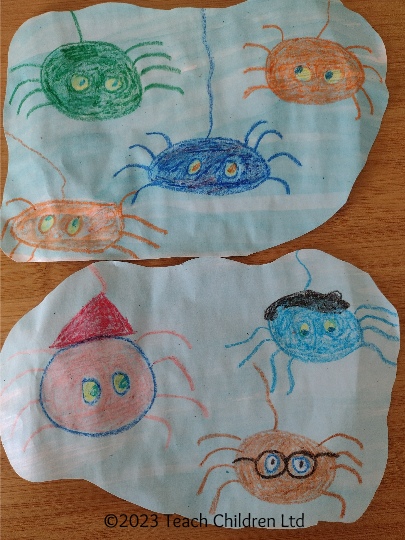
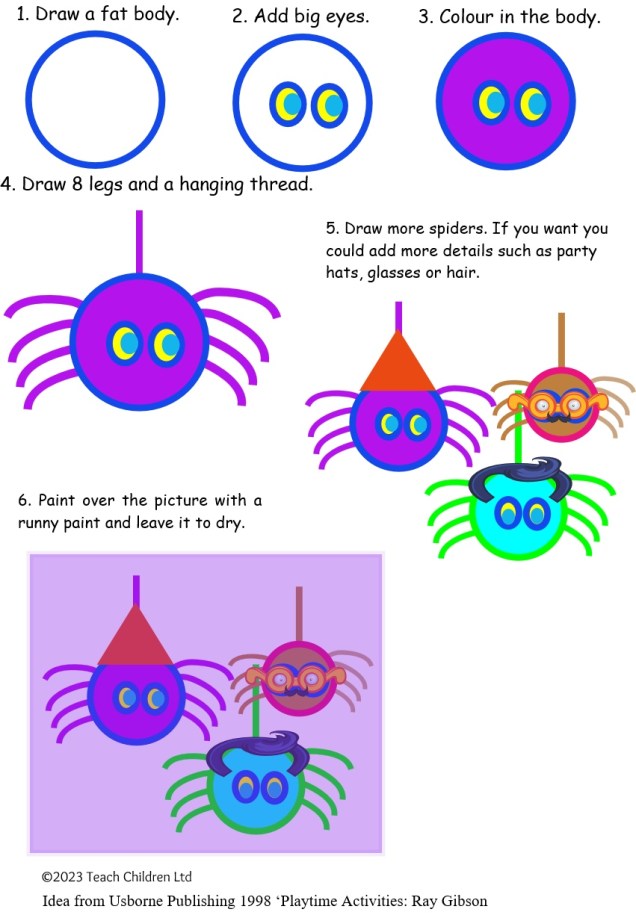
This crayon technique can be used to create a vast range of pictures. Here are just a couple of ideas to get you started: Spider Party Time:

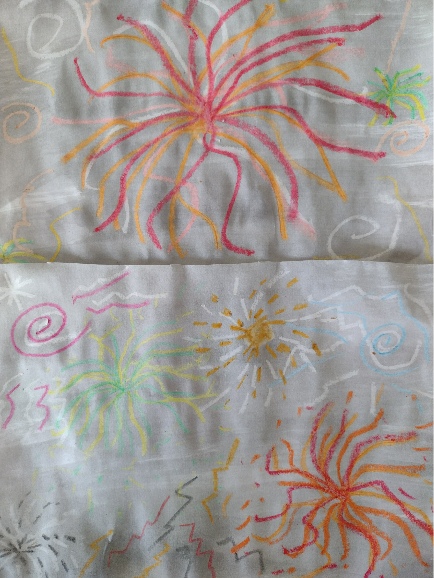
The same technique can also be used to create great firework pictures:

It is also worth remembering that drawing also helps to develop a range of different line formations, also needed for developing a good handwriting style.

Have FUN!

Why Vocabulary Building with your Child is so Important!  

Building your child’s vocabulary is a vital pre-reading skill. This is because schools teach what is referred to as the ‘The Simple View of Reading’(explained on our blog on 28/08/25).

This means that a child decodes the words using their phonics skills and their own vocabulary knowledge to help them understand the text they are reading.

So, for a child to have good reading skills they need to be able to speedily decode unknown words and recognize familiar printed words. And, understand the meaning and grammatical structure of the spoken language and then use this knowledge to understand the printed text.

This means that a child:

• Who does not fully understand the meaning of all the words and/or the grammatical structure of the spoken language (age appropriate) will also be unable to fully understand the printed text; even if they decoded it correctly.

• Whose ability to understand the spoken word is poor will also be unable to understand the printed text; even if they have managed to decode a few words.

Helping your child build their vocabulary is also vital, if they are to continue to develop good communication skills. Talking, explaining, sharing and playing are all important in developing your child’s vocabulary, their understanding of the words meaning in the context of the conversation and the grammatical conventions of our spoken language.

Why Placement (Preposition) and Directional Vocabulary is Important

Teaching your child the vocabulary related to placement (preposition) and direction is import in supporting them to understand and follow instructions, as well as sharing information themselves, such as; ‘put your cup on the table’ or to say ‘teddy in car’.

We also use this placement (preposition) and directional language to explain how to draw shapes, patterns and write letters and numbers.

With handwriting now having to be taught separately from phonics and starting from the first term in reception, the writing framework recognizes that on joining reception:

“They may also need additional support to ensure they are secure in their understanding of key directional words such as, ‘up’, ‘down’, ‘round’ and ‘back’.”

Department of Education; The writing framework: July 2025; page 24/25; https://www.gov.uk/government/publications/the-writing-framework

To help support the development of this vocabulary we have created three sets of picture cards and games to help you support your child in developing and using positional (preposition) and directional vocabulary.

You can find these free resources on our Phonics website by following this link: https://www.teachphonics.co.uk/phonics-resources.html

You can find these free resources in the Parent section of the Teach Handwriting website by following this link: https://teachhandwriting.co.uk/more-activities.html

What are prepositions?

A word used with a noun or pronoun to show place, position, time or means, e.g. at home, in the hall, on Sunday, by train.” Definition from Oxford School Dictionary, third edition 2002.

Here are just some preposition and directional phrases you might like to use:

On the … On top of the … Above the … Over the…

Under the… Below the … Beneath … Underneath …

Behind the …

In front of the…

Next to …Beside the … On the right of … To the right of … On the right-hand side … On the left of … To the left of … On the left-hand side… Before the … After the …

In the…  Inside the …

Out of the … Outside of the …

Between the … In between the … In the middle … In the center …

Going up the ….  Going down the … Going towards the… Going away from …

Summer Fun – Think more Play, Play and Play!!!

We are half way through the summer holidays, six weeks may have seemed like a long time but it is amazing how quickly it is passing.

The last thing you and your child probably want to think about right now is developing your child’s phonological awareness skills ready for next term; and quite right too!

So, don’t think about it in the conventional way of practise, practise and practise.

Think more play, play and play!!!

Children learn so much through just playing; developing physical, mental, communication and vocabulary strengths and skills, which all support them at school and with learning. Once introduced to a new game or activity children will very often take it and make it their own, making new rules and introducing extra characters or challenges.

The skill as a parent is remembering to let go of your preconceived ideas about how a game should be played and letting your child take the initiative.

If you provide the opportunities it is amazing how they will take on the challenge of inventing a new game or (in their eyes) improving an existing one.

This does not have to cost a penny; use the toys they already have or make games using empty plastic bottles or cardboard tubes.

The following kind of play supports and develops language and communication skills your child needs to help them learn and you have not had to mention school or homework.

  • The local play park is a fantastic free resource; running, jumping, crawling and climbing can all be encouraged. If your child is a little reluctant then it may well be that they are unsure how to do some of these activities. Explain when jumping that they needed to land on their feet and bend their knees as they land. Start small and as their confidence grows so does the height or distance they jump. Climbing can be scary for some children so again explain how to climb, moving one hand or foot at a time so that there are always three other points of contact.
  • If you are lucky enough to have a garden then mud play is messy but so much fun, it can be contained in a small area and will not only make you a cool adult but, if you join in, it will knock years off you (have a go, it is a great free therapy session).
  • Skittle games are always fun. Extend the activity by decorating the skittles (plastic bottles or cardboard tubes) using anything from crayons, paint or even dress them up as people or animals.

Turn Taking Skills for Play

This week we will look at turn taking in play a skill children need to learn to take part in meaningful interaction with others. These interactions are a vital part of children’s physical, emotional, social and intellectual growth and wellbeing.

Children need to learn the importance of waiting for their turn when playing with others, something many find hard to understand to begin with. 

Like most skills it needs to be taught and practised and is part of our phonological awareness development as it requires us to learn an associated vocabulary along with facial and other physical cue.

A child who is taught and given lots of practise at taking turns will find interacting and playing with others easier later on.

Turn taking is easy to implement into everyday activities and play and something you probably do anyway, without even thinking about it

Here are some ideas to help you to support your child:

  • Try to use the phrase “My turn”, “Your turn” or “Daddy’s turn” (name a third person) when playing or doing an activity such as sharing a book.
  • Toddlers have a short attention span so keep the turn short to start with.
  • Physical games such as rolling and kicking a ball or running and jumping activities can help to encourage turn taking and learning to wait for your turn. Again, don’t make the turns too long and to help keep your child engaged while you have your turn, talk with them about what you are doing during your turn and when they are having theirs.
  • Count Down or Up – To help young children develop an understanding that if they wait, they will get their turn, explain that you will count to 10 and then it is time to swap and someone else has a turn, count to 10 again and return the toy or wanted object to your child. It won’t take long for them to understand that they will get their turn without a fuss.
  • Turn Time – As your child gets older try using a timer/clock to help them increase the time scale between taking turns. Try not to make the gaps between turns too long to start with, as young children find the concept of time very difficult, 1 minute might as well be an hour in their eyes. Show clearly a start point and the finish point for the time scale so your child can watch or come back and check the passing of time. Don’t be tempted to ignore the timer if it is your child’s turn, make sure they are offered the toy or turn that is due to them, otherwise they will feel cheated and some of the trust is lost.
  • As children get older, playing card and board games helps to further develop their turn taking skills.

Vocabulary Development for Comprehension

Vocabulary is knowing the meaning of words including names of things, feelings, concepts and ideas. The larger a child’s vocabulary (understanding what words mean not just being able to say them) the easier it is for them to understand what they are reading.

The more you talk and share words and their meaning with your child the greater their vocabulary will become.

Vocabulary building:

Through Play:

  • Introducing and playing sorting games helps your child to build a mental filing cabinet system of categories, this helps them to remember and learn the meaning of words. Start by introducing simple categories of everyday items like food or clothes as their vocabulary increases categories such as colour, size and texture become more appropriate.
  • As babies handle objects and toys describe how they feel, what they look like or the sound they make
  • When you are playing with your child add in new words (explain their meaning), descriptions or expand on words they use in play. For example, if you are playing cars with your child you may comment on the size difference or colours between the cars.
  • Remember children learn new words best when they are learned in context, that is, in a natural setting.
  • If they are trying to say a word let them finish and then say it back to them clearly and correctly. Do not make them repeat it back to you, they may choose to do so but make it their choice.

Through Drawing/Writing

  • When drawing or painting with your child, or they are sharing their pictures with you, talk about the shapes, colours types of lines (straight line or curves line), what you like best about the picture, and the objects you can see.

Through Songs and Nursery Rhymes

  • Listening of nursery rhymes and children’s song is a good way of helping your child make the distinction between the music and words (language used) in them. It is a good idea to practise this skill when there are no other noise distractions. 
  • Try playing some action songs and rhymes to help your child learn the actions for the rhyme, then let them have a go on their own. Watch them to see if they can do some of the actions at the right time in the song, to see if they are listening for the right cue words. If they are struggling, explain they have to wait for certain words and show them what to do and when to do it.
  • Nursery and silly rhymes are great ways to introduce your child to rhyming sounds and increase sound play in words.
  • Singing often slows down our pronunciation of words, helping your child to pick out unusual or rhyming sound patterns. As with reading aloud it can introduce a wider vocabulary for your child.
  • Finger rhymes and action songs encourage your child to interact with words, the sounds within them and the rhythms they create. Finger rhymes such as ‘Round and Round the Garden’, ‘Pat-a-cake’ and ‘Incy Wincey Spider’. ‘Row, Row Your Boat’ is a lovely whole-body movement song that encourages a rhythmic whole-body motion, which babies and toddler enjoy (as well as the adults).

Through Talk

  • Speak in ‘parentese’- you to talk to them using regular words (normal adult vocabulary) in a slightly higher pitched and more sing-song way; until a child is about 9 months old as they will listen to you longer and hear more words.
  • Talk about feeling and situations throughout the day.
  • When your child points at something tell them the name of the object, for example if they point at an apple, say “Apple”.
  • Explain words or give synonyms
  • Avoid replacing unfamiliar words with familiar ones (explain the meaning). Remember to try to use the new word in context regularly as repetition of the word will help your child to remember it and reinforce the meaning of the word.
  • Repeat and expand on what your child says, so if they say “Dog!” you may say “A big dog!” This also helps them to develop an understanding of sentence structure.

Through Book Sharing

What books to choose?

  • Books with words not used in everyday conversation.
  • Non-fiction books (informational, instructional, true stories) -as they use different words to fiction (story) books.
  • Any book really. The language of books in much richer and varied than that of everyday conversation.

Book Sharing Tips

  • Sharing and talking about the books you are reading helps to build word knowledge, as you point to the pictures, picking out different objects. 
  • Reading out aloud helps to introduce your child to words that they may not experience in their everyday talk. This helps to expose them to new vocabulary and the sounds to be found in those words.
  • Reading aloud poems and story books with strong rhyme elements, like those found in Dr.Seuss books, helps introduce the new words and rhyming sounds in words.
  • Try exaggerating the rhyming words to help highlight the sound patterns, making it easier for your child to tune into them.
  • Explain unfamiliar words; don’t replace them with familiar ones.
  • When a word has more than one meaning. Talk about the different meanings.
  • Add descriptive words or more information than in the book.
  • Encourage your child to talk about the pictures. Add information and ideas to what they have said.
  • Use words to describe how characters in the book might have felt at a point in the story.
  • Use words to describe ideas in the story even if they are not used in the book.
  • Remember children learn new words and their meaning through repetition, so you will need to be patient as you re-read the same story over and over again or answer the same questions over and over again.

Why do we ask children to ‘read out aloud’?

Reading is the ability to first decode the letter sequence of the word (phonics) and then to place meaning to it in relation to the context in which it is being used.

Unfortunately, many children just decode, speak and do not actively listen to what they have said, so they do not gain meaning from the words they are reading (poor reading comprehension skills).

We ask children who are learning to read to ‘read out aloud’, but forget to tell them why. It is not just so we can hear they have decoded a word correctly. The important point is to encourage them to actively listen to what they are saying. The idea is that if they hear the words they will, if it is part of their vocabulary, understand their meaning and therefore fully comprehend the text they have read.

Poor reading comprehension skills may also occur because a child has a limited vocabulary usage and/or understanding. A language rich environment is vital to help support and develop a child’s vocabulary and linguistic comprehension, which in turn, will support their reading comprehension skills.

How to Develop a Child’s Interest in Books and Reading

Research suggests that children who enjoy books are more likely to want to learn to read and will keep trying even when they find it hard. Therefore, it is important to keep their interaction around books a positive one.

Through Play

Books come in all shapes and sizes and are made from various materials.

  • Have a few bath books. even if most of the time your baby or toddler just chews on them, they will be handling a book and possibly turning the pages. Giving you the opportunity to talk about the pictures with them.
  • Try to have a range of cloth, hard books and suitable picture books around the house and in your child’s play area so they can pick them up at any time. This way they can explore them for themselves, (even if it is to give them a quick chew on) not as an adult sharing activity.

Through Drawing & Writing

Drawing and making your own simple story book can be a great way of getting your child interested in books and reading. Children love to hear stories about them. Simple homemade books about them can be a great way of introducing children to books and reading. This can be a very effective approach to encourage reluctant readers.

  • Draw simple pictures with, or for, your child and talk through what you are drawing, for example; a picture of a house with matchstick people. The pictures could be telling the events of the day for example going to the park or walking the dog.
  • If drawing is not your thing (like me) use fuzzy felt instead to make a picture to share the story of their day.

Through Songs and Nursery Rhymes

Children’s songs and nursery rhymes cover a wide range of concepts such as going through every day sequences in the nursery rhyme ‘Here we go Round the Mulberry Bush’ which uses the phrase ‘This is the way we…’ to order the event of getting up in the morning. Some introduce concept such as size, numbers, colours and shapes. While others tell stories for example ‘Baa Baa Black Sheep’ or ‘We’re going on a Bear Hunt’ by Michael Rosen & Helen Oxenbury.

Sharing books that enable you and your child to sing along (retell) their favourite songs and nursery rhymes means that the child knows what to expect and that they are going to have fun and enjoy the experience. Over time you will then be able to introduce books with new songs and nursery rhymes, building on your child’s positive experience of other book sharing sessions with you. Remember you may have to revert back to the old favourite time and time again, but stick with it.

Through Book Sharing

What books should you choose?

  • Pick children’s books you enjoy
  • Pick books your child enjoys
  • Give your child time to choose and look at books (your local library is a great place for this).
  • Follow your child’s interests
  • Use ‘true’ books and stories (not those specifically written for developing phonics knowledge or rigidly structured reading scheme books for teaching and learning to read, these will come from school and serve a different purpose).

Book Sharing Tips

  • Remember that a child’s age personality, mood and stage of development will affect how they interact with the book.
  • Keep the interaction around the book positive and fun, if you are not enjoying it your child will pick up on this.
  • Keep your child involved, remember you do not have to read the book word for word, it is the positive sharing experience that is important.
  • If your child does not seem interested in reading or sharing books, start slowly by sharing /reading one or two pages at a time. Keep the interaction positive and over time their interest will grow.
  • If your child is showing no interest then try again another time.
  • When reading a book with your child that you really like then tell them that you like the book or story. Your child may not agree with you and insist on their favourite book which after reading for the 500th time you may be bored with but keep with it, there will be another favourite book!
  • Try to share books throughout the day not just at nap and bed times. I found having a couple of books in my bag really useful as I could then share a book with one of my girl’s while the other was swimming or with them both while waiting for the bus or sharing tea and cake in a café.
  • Read with your child every day. There are some days where this just seems impossible to manage. Remember one minute is better than no minutes and it does not have to be a book you are reading, there are lots of environment reading matter you could use such as paintings/pictures, posters, advertisements, road signs and maps.

Developing #Listening & #Speaking Skills week 8 – Music Fun

These games are designed to help a child learn about the different levels of sound, pitch, tone and volume.

Music Fun

  • Skittle Band – Use, or make, a drum stick (wooden spoons are good for this) and explore with your child the different sounds the drum stick makes against objects made of different materials, such as steel saucepan, another wooden spoon, plastic bottles etc. Choose items that are safe and you are happy for them to play with. You could photograph the objects, record the sounds they make, or video (on your phone), to play back and talk about later on. Try moving the activity outside for a different sound quality experience.
  • Orchestral Conductor – Once your child is happy and enjoys playing and making sounds, with different objects and instruments, try the conductor game. You can use your hands or a baton to point and encourage them to play certain sounds just like an orchestral conductor does, but make sure you have a clear stop gesture which your child will understand (you may need to say stop at the same time as the gesture to begin with, but they will soon get the idea). Then swap places and you become the musician and they the conductor; it may not be a classic you create but it is great fun. As your child develops their skills you can add new elements and hand gestures to make the sound louder or softer.
  • Musical Bottles – Use plastic bottles with different amounts of water/sand in them and different things as a beater. Talk about how:
    • Low/deep or high pitched a sound is compared with another.
    • Using different beaters can change the quality of the sound when used on the same bottle.
    • Using different amounts of pressure to hit the bottle makes the sound louder (harsher) or quieter (softer).

Try organizing the bottles in order of pitch to create a musical instrument and using this as part of the Orchestral Conductor game. You could number each bottle or use a different picture on the bottle as a way of encouraging your child to play the bottles in different orders (making music).