Why Vocabulary Building with your Child is so Important!  

Building your child’s vocabulary is a vital pre-reading skill. This is because schools teach what is referred to as the ‘The Simple View of Reading’(explained on our blog on 28/08/25).

This means that a child decodes the words using their phonics skills and their own vocabulary knowledge to help them understand the text they are reading.

So, for a child to have good reading skills they need to be able to speedily decode unknown words and recognize familiar printed words. And, understand the meaning and grammatical structure of the spoken language and then use this knowledge to understand the printed text.

This means that a child:

• Who does not fully understand the meaning of all the words and/or the grammatical structure of the spoken language (age appropriate) will also be unable to fully understand the printed text; even if they decoded it correctly.

• Whose ability to understand the spoken word is poor will also be unable to understand the printed text; even if they have managed to decode a few words.

Helping your child build their vocabulary is also vital, if they are to continue to develop good communication skills. Talking, explaining, sharing and playing are all important in developing your child’s vocabulary, their understanding of the words meaning in the context of the conversation and the grammatical conventions of our spoken language.

The Importance of Using Letter Names for Developing Handwriting, Phonics and Reading Skills

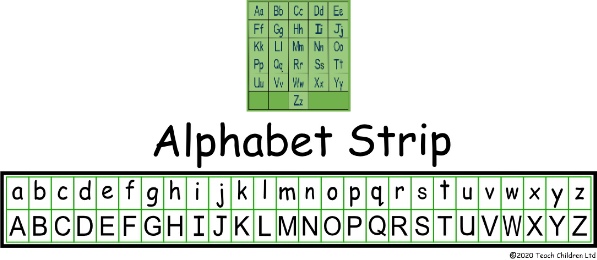
Here at Teach Children we have always promoted the importance and power of teaching the correct letter names to begin with; through our Teach Handwriting website, Schemes and Teach Phonics website.

Unfortunately, over the years this has proved to be a challenge as schools have felt they needed to focus more on phonics skills and relied on the handwriting element that were incorporated within the phonics schemes, which frankly just didn’t work for so many.

The Department of Education published on 08/07/2025 its new writing framework, which now recognizes and clearly emphasises the importance of teaching handwriting from EYFS right through the primary years.

Their acknowledgement that handwriting has to be taught separately from phonics means that children will have to learn the letter names as part of a good handwriting scheme:

“Pupils should be taught both phonics and handwriting consistently and systematically, in line with the programme for each.”

Department of Education; The writing framework: July 2025; page 37; https://www.gov.uk/government/publications/the-writing-framework

In learning to handwrite, a letter is a shape which only represents a sound when it is placed within a word or sentence (has a context). Also, a letter or combination of letters can represent more than one sound and so the only unique way of identifying alphabet letters when we talk about them is to use their names.

Learning the correct letter names helps to reinforce that when talking about the letter ‘a’ (ay) for example it has a set shape regardless of the sound that it will be representing in the word. This further supports children’s handwriting development as the communication of your requirements is unambiguous.

Teaching the correct letter names is important when supporting handwriting as this can in turn affect a child’s phonics understanding later on. For example, it can seem very easy when explaining to a child which letter to write when they ask which one is making a ‘kuh’ sound in a word such as cat to say a ‘curly kuh’. There is no such letter in the alphabet called ‘curly kuh’ it is the letter ‘c’ (cee). By adding the ‘kuh’ sound to the letter it reinforces incorrect phonics knowledge. The letter ‘c’ does not make a ‘kuh’ sound in words such as: city, circle, cycle and centre.

It should also be pointed out that learning the unique letter names of the alphabet is a pre-phonics skill; as well as an early years learning goal.

Phonics is a powerful decoding and encoding tool. However, so is the alphabet letter naming system. Both need to work side by side to support our children, especially in those early years of their educational journey.

The English phonic system is very complex but this is why our language is so rich. Young children need to use letter names as an additional tool, as it takes many years for them to be introduced to the more complex phonics coding system.

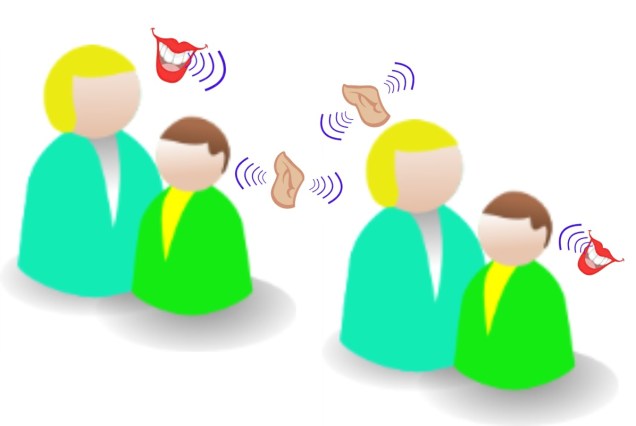
Developing a Child’s Speaking and Listening Skills is Vital!

It is not just the key to literacy success but an essential social communication skill.

Sadly, although the covid lockdowns are well behind us schools are still reporting ever increasing concerns over the decline in young children’s speaking and listening skills. So, over the next 8 weeks, we are looking again at the different developmental elements of speaking and listening; providing practical games and activities to help build a child’s skills. 

Week 1. Conversational Turn Taking Skills

Week 2. Different Types of Talk

Week 3. The Importance of Small Talk

Week 4. How to Encourage Your Child to Keep Talking

Week 5. What is Listening?

Week 6. Games to Develop Listening Skills – Sound Screen Games

Week 7. Games to Develop Listening Skills – Sound Scanning Games

Week 8. Games to develop Listening Skills – Music Fun

Pre-phonics Skills – Phonological Awareness: Stage 7 – (5 years – 7 years)

Phonological awareness relates to our sensitivity and understanding of the sound structures of our oral language. It enables us to progress from our awareness of large sound units (words in sentences) to smaller sound units (phonemes in words). It also incorporates the ways in which we communicate through speech, body language and written forms.

Your child needs to continue developing their understanding of language, its sound structure, grammatical rules and conventions through talking and playing. They need to be able to say what they think and can often only write what they can say, so they need to be able to talk it before they can write it. We cannot expect them to write well later if they cannot talk or express their thoughts and ideas through language, whether that be spoken or signed. So, you need to continue engaging them in conversation and exposing them to new vocabulary and concepts.

Phonemic Awareness – Part 2 – Phoneme substitution and deletion

Having mastered Phonemic Awareness Part 1, the next stage in the process is learning and understanding how substituting and deleting phonemes can create new words. This is still based on what we hear, not the written word.

We usually introduce this concept to children using one syllable CVC words, a word that has a Consonant followed by a Vowel and then another Consonant, such as hat, cat and mat.

Phoneme substitution

To begin with focus on helping your child to substitute the first sound in a word, for example replacing the ‘h’ sound in hat with an ‘m’ sound gives mat; or replacing with a ‘b’ sound gives bat.

Once they become comfortable with substituting the initial sound, progress to substituting the last sound in the word, for example replacing the ‘t’ sound in mat with a ‘p’ sound gives map; or replacing it with an ‘n’ sound gives man.

Then focus on the medial, or middle, sound in the word, for example substituting the ‘a’ in hat with an ‘i’ sound gives hit, or replacing it with an ‘o’ sound gives hot and with an ‘u’ sound gives hut.

Phoneme deletion

As with substitution begin by focusing on helping your child to delete the first sound in a word, for example removing the ‘s’ sound in stop gives the new word top; or deleting the ‘c’ sound in cart gives the new word art.

Once they become comfortable with deleting the initial sound, progress to removing the last sound in the word, for example deleting the ‘t’ sound in cart gives the new word car; or removing the ‘k’ sound in fork gives the new word for.

However not all children will find the concept of substitution and deletion of phonemes easy and it may be beneficial to move on to the next stage and then revisit this section, as the visual aid of letters that Stage 8 provides may help support their learning.

Research suggests that, when entering school, having good phonological skills based just on speaking and being able to hear and play with the sounds of language (Stages 1-7) is often a strong predictor of a child’s reading success later.

Pre-phonics Skills – Phonological awareness: Stage 1

Phonological awareness relates to our sensitivity and understanding of the sound structures of our oral language. It enables us to progress from our awareness of large sound units (words in sentences) to smaller sound units (phonemes in words). It also incorporates the ways in which we communicate through speech, body language and written forms.

Stage 1 – (Unborn – 1 year)

Your child will learn to recognize, differentiate and respond to both speech and non-speech sounds, start to recognize words and interpret facial expressions and body gestures. They will begin making sounds, mimic speech patterns and start to use body language to express their needs, wants and thoughts.

Research suggests that our phonological awareness begins in the womb at about 24 weeks. New born babies have a preference for their mother’s voice, as they have had an extended period of time hearing the voice before they are born, and so find it comforting. They do not understand the words, just the sound rhythm and intonation of her speech pattern; more like music.

It is suggested that reading, talking and singing to your unborn child in the same manner you would to a baby or toddler could help to begin the sound storage/recognition process. Like many parents who have their children close together (14 months in our case) the second child’s language skills seemed to develop earlier than the firsts. This may have been because the book sharing time with our first (who was about 5 months old when I fell pregnant again) and the type of language we were using stimulated our unborn second child.

So, talk to your baby even before they are born, they will not understand what you are saying but their brain is busy; starting to store sound information that will later help them to understand language and learning to speak.

Babies initially have no language preference; they respond only to the sounds and facial gestures and mouth shapes that accompany them.

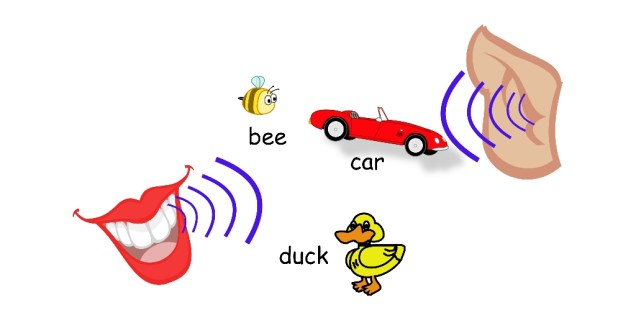
Try to expose them to a greater range of sound experiences as they develop their awareness of sounds around them. The more they hear and the associations they make to those sounds (what they see, feel, experience) the greater their ability to distinguish between them. This skill becomes important later on as they begin to isolate individual words in sentences, being able to distinguish between words that sound similar such as dog and hog.

By 6 months old linguists can tell, by the cooing and babbling that your child is producing, what range of language you have shared with them through ‘Direct Talk’.  The cooing and babbling sound your baby or toddler make are their first steps towards expressive language, producing the sounds that eventually form words.

A baby who can talk through cooing and babbling is more likely to initiate and continue verbal interaction and play with you and others. The first cooing sounds represent more vowel sounds such as ah, ooh, eee, uh, ah-ee, while the later babbling stage is more consonant sounds repeated such as ba, ba, ba, da, da, da, ma, ma, ma, ga, ga, ga.

At about 7 months old your child is now recognizing words and developing an understanding of what these words mean (receptive language).

Talk to your baby, talk all the time, about what you are doing, what is going on and just about how wonderful and beautiful they are.

How you talk to your baby has an impact. Research has shown that babies prefer you to talk to them using regular words (normal adult vocabulary) in a slightly higher pitched and more sing-song way. Although many adults do this naturally when talking to babies it has become known as ‘Parentese’ and is very different from ‘Baby Talk’.

Parentese is:

● Slower speech pace

● Articulate clearly, well-formed, elongated vowel sounds and clearly voiced consonants, so ‘hello’ becomes ‘heellooo’

● Use shorter sentences that are grammatically correct

● Vary and raise pitch of voice (as much as an octave)

● Stress words by pitch, intensity and length so ‘sweet baby’ becomes ‘sweeet baybeee’

● Use exaggerated facial expressions (eye contact, raised eyebrows, big smiles)

● Frequently use repetition

● Leave a gap/pause between sentences so that your child can coo and babble back (developing the turn taking structure of conversation)

● Talk face to face so that they can clearly see how your lips move and other facial expressions (this about 20 cm or 8 inches for a new born)

● Try using your child’s name first then the important word in the sentence and follow with the complete sentence; for example, “Jo, bottle, here is your bottle!”  Research suggests that at about 3- 4 months old a baby will turn their head when their name is called and that they will then focus on the next word that follows their name.

Baby Talk

Is where we replace regular words with nonsense or over simplified words; so “who is the cutest baby in the world!” becomes “oo es da  cutsie wootsiest beebee in da wold!”.  This does not help a child to develop the language skills they need to communicate effectively with others and can delay some children’s speech and language development.  What you may think sounds cute and adorable may actually hold your child back because others just cannot understand them, which can be very frustrating for your child.

Are your child’s #phonics skills good for their age?

With more and more expected of our pre-school and 4 to 7 year old children it can be difficult to know what the realistic age appropriate skills are in relation to phonics.

In fact, phonics is only part of the story starting at stage 8 of a child’s phonological awareness development.

Stages 1 to 7 of a child’s phonological awareness, what we refer to as pre-phonics skills, are the continual development of their understanding and knowledge of our spoken language as well as other communication forms, such as gestures, facial expressions, body language and social conventions.

Stages 8 to 10 of a child’s phonological awareness, the phonics reading and writing stages are the continual development of their understanding and knowledge for learning to reading and write.

As a child’s phonological awareness skills build on each stage, the age at which a child reaches them varies making it difficult to know how your child is doing.

We recognise this variation and use age ranges as a rough guide to help you understand where your child is in their phonological awareness skills.

By clicking on the various stages of phonological awareness you will find appropriate age range information, advice and activities to support your child. Try not to jump a stage as each one is important in unlocking the knowledge and skills for the stage above.

Stages 1 to 7 (Pre-phonics skills): https://www.teachphonics.co.uk/phonological-development.html

Stages 8 to 10 (Phonics): https://www.teachphonics.co.uk/phonological-development-phonics.html

The Key to Good Phonics Skills – Part 12

Developing #Listening & #Speaking Skills – Rhyme & Alliteration (Word Play)

Young children develop their vocabulary and understanding of sound patterns within words through word play.

Rhyme awareness and the enjoyment of alliteration begins early, usually between the ages of 2 and 3 years old (Stage 3 of phonological awareness: https://www.teachphonics.co.uk/phonological-awareness-stage-3.html ). This develops in to an important tool, supporting a child in developing an understanding of how words are formed and the sound patterns within them. These are important pre-phonics skills a child needs to develop to support their future ability to succeed with phonics, reading and writing.

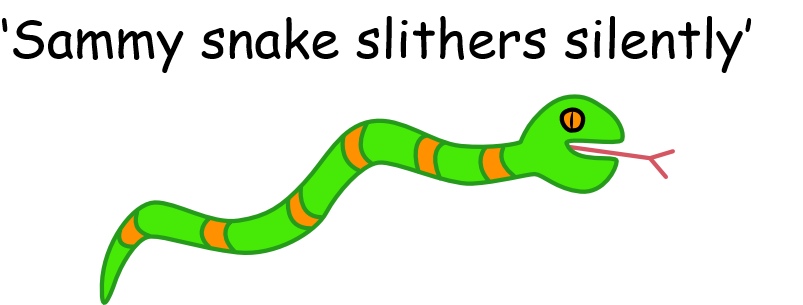
This Rhyme awareness is supported and developed through the singing of songs and nursery rhymes and finger chants. Alliteration (words that begin with the same sounds) such as ‘Sammy snake slithers silently’, which children love to hear in rhymes and stories, also supports their word knowledge and understanding of sounds in words.

Being able to repeat, and join in with, short phrases they have anticipated in a story or rhyme, is another important step in a child beginning to understand the use of words in stories and story structure; such as, “I’ll huff and puff and blow your house down!” in the story of The Three Little Pigs.

For more information on this, and other pre-phonics skills (Phonological Awareness) your child develops through from birth to 7 +years old, check out the Pre-phonics section of our website: https://www.teachphonics.co.uk/phonological-development.html

The Key to Good Phonics Skills – Part 2

Developing #Listening Skills – Sound Screen/Barrier Games

Last week we explained the three things required for good listening skills:

  • To pay attention – being able to focus on a particular voice or sound by filtering out other voices and ambient noises.
  • To concentrate on the voice or sounds to take in the information, building the stamina needed to listen for extended periods of time.
  • To interpret that information to gain meaning – comprehension.

Here are some games to help build these skills.

These games are designed to help a child learn how to block out ambient noises so that they focus and concentrate on one particular sound.

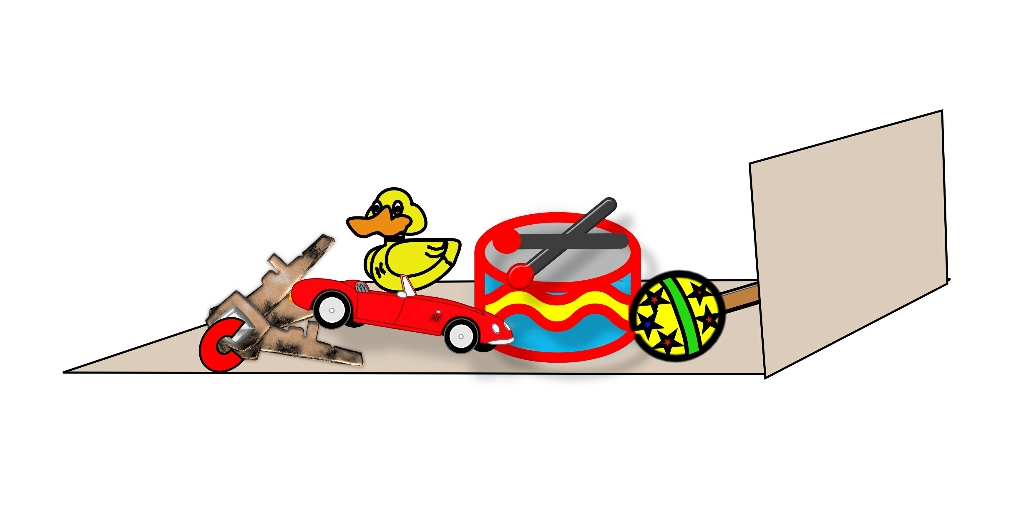
Create a barrier between you and your child so that they cannot see the object you are going to use to make noises with and see if they can guess the object. Try to use objects that make sounds that occur around them a lot of the time, for example keys rattling together or wooden blocks being knocked together. There are many variations of the game that can be played but you need to make sure your child has the opportunity to experience the sounds with the relevant object beforehand so they don’t get frustrated by the game.

  • Mrs Blog has a box… To the tune of Old Macdonald changing the name as best fits the situation. Place a box, on its side with a number of objects inside that make a noise (choose items your child is familiar with the sound of), between you and your child so they can’t see what is in the box. Start singing “My mummy has a box ee, i, ee, i, o and in that box she has…” Stop and gesture to encourage your child to listen (maybe a cupped hand to your ear) then pick one of the objects and make a sound; your child then tries to guess what it is. Continue to sing but imitating the sound of the object you played, which your child can now see. If it was a bunch of keys for example; “with a jingle, jangle here and a jingle jangle there, my mummy has a box ee, i, ee, i, o.” Swap places so your child can choose an object in the box, change the song so you are using their name, for example “My James has a box…”
  • Same or Different?  Place a barrier between you and your child so they cannot see which object you will use to make a sound and that you duck behind so they cannot see your face when you make vocal sounds.  This can be played at different levels. At the basic level using animal noises such as baa, moo, woof etc. A more complex level would be to use shakers with different size things inside to make different shaking sounds. Plastic containers or bags of the same size and type can be used to make the shakers with different small items in such as dried pea, rice, sand or small coins, pebbles or small Lego bricks. Make the noise once and then repeat either with the same noise or a different one. The child then says if they were the same or different.
  • Copy Cat!  Place a barrier between you and your child so they cannot see which object you will use to make a sound and that you duck behind so they cannot see your face when you make vocal sounds.  You will need two set of the same objects, a set for you and one for your child. The aim of the game is for you to make a noise with either an object or your voice and for your child to copy that sound choosing the correct object in front of them or using their voice as you did. The game can become more complicated as you mix a number of sounds using objects and your voice. Swap roles so that your child becomes the leader of the game and you have to copy them.

Have Fun! N.B. Be careful of small objects, especially those escaping from shakers, as these can be a choke hazard.

When do phonics skills start?

There are 10 stages of phonological awareness. Stages 1 to 7 are what we class as the pre-phonics skill stages (https://www.teachphonics.co.uk/phonological-development.html) and stages 8 to 10 (https://www.teachphonics.co.uk/phonological-development-phonics.html) we would class as the phonics stages.

Phonological awareness skills relate to our sensitivity and understanding of the sound structures of our spoken (oral) language. It enables us to progress from our awareness of large sound units (words in sentences) to smaller sound units (phonemes in words). It also incorporates the ways in which we communicate through speech, body language and written forms.

Research suggests that our phonological awareness (Stage 1: https://www.teachphonics.co.uk/phonological-awareness-stage-1.html) begins in the womb at about 24 weeks.  New born babies have a preference for their mother’s voice, as they have had an extended period of time hearing the voice before they are born, and so find it comforting. They do not understand the words, just the sound, rhythm and intonation of her speech pattern; more like music.

So, talk to your baby even before they are born, they will not understand what you are saying but their brain is busy; starting to store sound information that will later help them to understand language and learning to speak.

Babies initially have no language preference; they respond only to the sounds and facial gestures and mouth shapes that accompany them.

How you talk to your baby also has an impact; research has shown that babies prefer you to talk to them using regular words (normal adult vocabulary) in a slightly higher pitched and more sing-song way. Although many adults do this naturally when talking to babies it has become known as ‘Parentese’ and is very different from ‘Baby Talk’. For more information about ‘Parentese’: https://www.teachphonics.co.uk/how-to-speak-parentese.html

What is #phonics and #phonemic awareness?

With the new school year well under way many new parents are being introduced to the world of phonics and all the technical language associated with it. So, we thought we would take this opportunity to demystify some of that technical language.

Phonics is the association of sounds (phonemes) to written alphabet letters (graphemes). For reading (decoding) the phonics coding system is used to convert the written word into sounds. For spelling (encoding) the same phonics coding system is used to covert sounds heard into letters to form written words.

Phonemic awareness is our ability to split words into their smallest sound units (individual phonemes) and to manipulate these sounds through segmentation, blending, substitution, re-ordering and deletion. This is based on what we hear and say, not the written word.

Good phonemic awareness is the vital skill required before phonics can be introduced successfully as a tool for learning to read and spell.

  • Segmentation – being able to split words into their individual sounds, for example ‘cat’ into c-a-t.
  • Blending – being able to blend individual sounds together to say a word, for example d-o-g into dog.
  • Substitution – being able to swap one sound for another in a word, for example swapping the /k,(k)/ sound in the word ‘cat’ with a /h,(h)/ sound to say the word ‘hat’.
  • Reordering – being able to swap the sounds around to create a new word, for example changing the order of the letters in the word ‘cat’ to form the new word ‘act’.
  • Deletion (omission) – being able to remove a sound from a word to create a new word, for example removing the /t,(t)/ sound from the word ‘cart’ to say the new word ‘car’.

These are developed further when phonics is introduced, sound to letter association.

Watch our ‘Single Word Reading’ animation to see these manipulation skills in action: bit.ly/20JAHSa