Phonics Skills – Phonological Awareness: Stage 8 – (4 years – 7+ years)

Phonics is learning the relationship between the individual sounds (phonemes) of our language and the way we represent them in writing through letters (graphemes).

The phonics stage in phonological awareness development is being introduced to our children at a much younger age, it used to be the second term of reception class, but phonic schemes in the UK have moved to starting in the first term of Reception. This is regardless of the child’s actual phonological ability levels.

For us, as adults, this can seem a little daunting as most of us were not brought up with phonics as the main strategy for learning to read or spell.

For a child who has developed through all the pre-phonic stages 1 to 7 for good phonological awareness the phonics stage is a natural progression, allowing them to use all the segmentation, blending, substitution and deletion skills previously learnt.

It is important that your child understands that letters have names; just like they do, and just like them they make different sounds. Knowing the letter names allows them to understand which letter you are talking about when discussing letters and sounds as the letter name is the unique characteristic of the letter – as it can make more than one sound. A classic example is the word ‘was’, if spelt phonetically it would be ‘woz’.

Your child should already have been taught the names (not sounds) of the letters of the alphabet, this is an early years requirement. Sadly, some feel that if a child can recite the alphabet song, they know the names of the letters, this I just not true!

Understanding letter names is important in the teaching of phonics as children need to develop an understanding that a letter can make different sounds depending on the location and pairing with other letters.

For example, the letter ‘a’ can make a number of different sounds on its own depending on the word it is in: ant, baby, swan and with other letters as in words like day, train and car.

Phonics programs tend to teach:

The use of phonic skills to blend and segment the written forms of words (CVC words) starting with one sound – one letter correspondence such as sat, pat and dog.

Develop understanding that one sound consonant can be represented by two letters (digraph) such as ‘ch’ in ‘chip’ or ‘sh’ in ‘shop’.

Develop understanding that one vowel sound can be represented by two letters (vowel digraph) such as ‘ea’ in ‘head’, ‘ai’ in ‘rain’.

Develop understanding that some sounds are represented by 3 or 4 letter combinations such as ‘igh’ in ‘light’ and ‘eigh’ in ‘eight’.

Identifying the initial, end and medial sounds and their corresponding letter(s).

However, many phonics schemes teach high frequency words by rote as they do not teach the letter associations required for children to decode / encode them phonetically. Word such as: is, the, was, what, and any.
Letter & Sound Relationships That Break the #Phonics Rules

Back in September we explained that Phonics is very useful as a decoding tool used for developing reading skills and an encoding tool for spelling. It is the simple process of linking sounds to letters, its complexity comes from how many sounds (phonemes) to letter combinations (graphemes) there are.

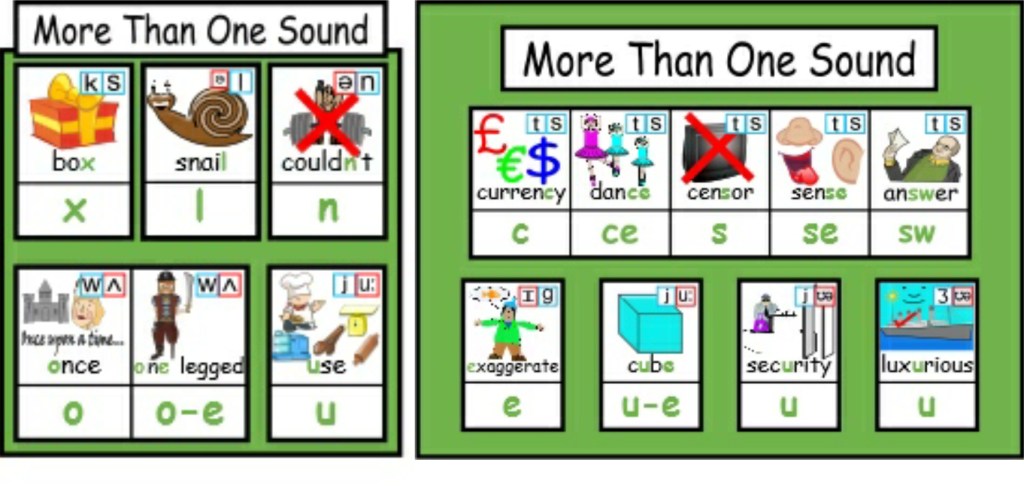
Some letter and sound associations just don’t follow the normal phonics rule of a single sound being associated to a letter or letter combination. A few letters represent two sounds, such as the letter ‘u’ which in the word ‘cupid’ represents the two sounds /y,(j)/ and /oo,(uː)/.

A more common one letter two sound relation is that of the letter ‘x’ representing the two sounds /k,(k)/ and /s,(s)/ as in thewords: six and box.

Here are some other examples of single letters and split digraphs making two sounds instead of the usual phonics rule of only making one sound:

What is #phonics and #phonemic awareness?

With the new school year well under way many new parents are being introduced to the world of phonics and all the technical language associated with it. So, we thought we would take this opportunity to demystify some of that technical language.

Phonics is the association of sounds (phonemes) to written alphabet letters (graphemes). For reading (decoding) the phonics coding system is used to convert the written word into sounds. For spelling (encoding) the same phonics coding system is used to covert sounds heard into letters to form written words.

Phonemic awareness is our ability to split words into their smallest sound units (individual phonemes) and to manipulate these sounds through segmentation, blending, substitution, re-ordering and deletion. This is based on what we hear and say, not the written word.

Good phonemic awareness is the vital skill required before phonics can be introduced successfully as a tool for learning to read and spell.

  • Segmentation – being able to split words into their individual sounds, for example ‘cat’ into c-a-t.
  • Blending – being able to blend individual sounds together to say a word, for example d-o-g into dog.
  • Substitution – being able to swap one sound for another in a word, for example swapping the /k,(k)/ sound in the word ‘cat’ with a /h,(h)/ sound to say the word ‘hat’.
  • Reordering – being able to swap the sounds around to create a new word, for example changing the order of the letters in the word ‘cat’ to form the new word ‘act’.
  • Deletion (omission) – being able to remove a sound from a word to create a new word, for example removing the /t,(t)/ sound from the word ‘cart’ to say the new word ‘car’.

These are developed further when phonics is introduced, sound to letter association.

Watch our ‘Single Word Reading’ animation to see these manipulation skills in action: bit.ly/20JAHSa

Half-term Fun – Clothes Peg Games

Some fun indoor activities may be the order of the day for this half term as the weather is not so hot.

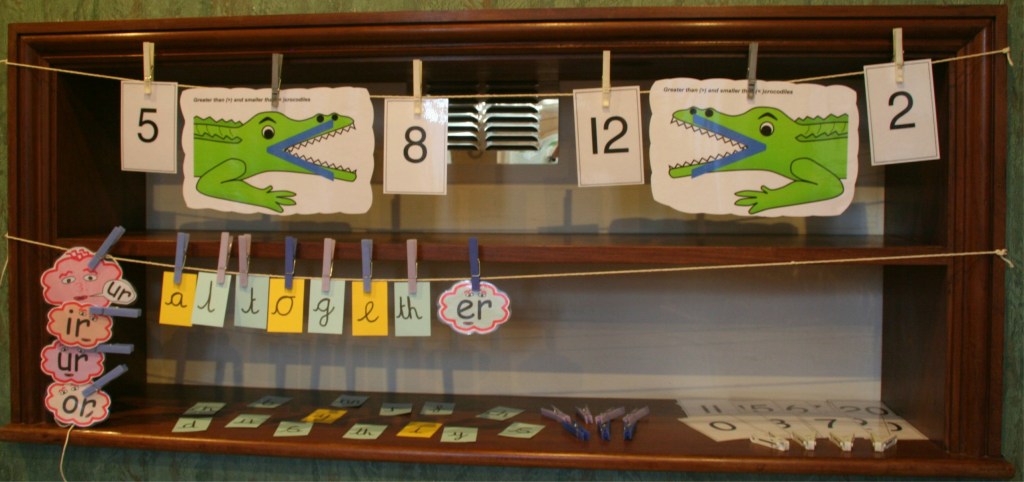
This is a very simple idea which children love because they can take greater ownership of it. The aim of the activity is to help build up hand and finger strength through using the pegs; however, it can have a dual purpose, helping to keep track of the week by using it as a timetable or for learning spellings or maths activities, as well as supporting the development of language skills.

You do not need anything fancy, just some string (for the washing line), clothes pegs and pieces of paper or card to peg onto the washing line. The washing line can be a permanent fixture or you can just pop it up when you need to use it.

The clothes line needs to be at a height suitable for your child to peg things on to (placed against a wall is a safe option so that no-one can walk into it by accident and hurt themselves).

There are a whole range of games that can be played using this simple washing line and pegs concept:

Memory games – Get your child to peg up 5 to 10 different pictures or items on the line. Then give them 1 minute to remember the items. Once the time is up ask them to look away, or close their eyes, and then you remove one or more of the items. Get them to look back at the line. Can they work out what is missing?

  • You could try just moving one or two of the items around. Can they figure out which ones are in the wrong place and put them back in their correct place?
  • Try swapping an item for something new, which your child did not hang up on the line. Can they work out which is the new item on the line?

Odd One Out – Hang pictures on the line that belong together. Can they pick out the odd item on the line and explain why it is the odd one out.

  • They could all be pictures of fruit with a picture of some clothing
  • They could be shapes with straight sides and one with curves
  • They could all be animals but all are wild with only one being domestic

Sorting – Ask your child to sort all the pictures or items from a selection and to hang all the identical things on the washing line. They could all be the same;

  • Colour
  • Shape
  • Type

Pattern Work – Using pictures, different colour and shaped paper or items create different patterns. The patterns can be based on colour, size or type of object. You can create a pattern sequence on the washing line and then ask your child to try and copy the sequence. Can they explain the pattern and create their own for you to copy and explain?

Pairing or What is the Same? – Hang a range of pictures or items on the line, making sure that some of the items can be paired together because they are exactly the same. They could match because;

  • They are exactly the same e.g., a pair of socks
  • Match numbers to a picture with the same number of items on
  • Match capital to lower-case letters

Or have items that can be put together because they are both from the same set, for example they are types of fruit or are the same

Letter & Sound Relationships That Break the #Phonics Rules

Back in September we explained that Phonics is very useful as a decoding tool used for developing reading skills and an encoding tool for spelling. It is the simple process of linking sounds to letters, its complexity comes from how many sounds (phonemes) to letter combinations (graphemes) there are.

Some letter and sound associations just don’t follow the normal phonics rule of a single sound being associated to a letter or letter combination. A few letters represent two sounds, such as the letter ‘u’ which in the word ‘cupid’ represents the two sounds /y,(j)/ and /oo,(uː)/.

A more common one letter two sound relation is that of the letter ‘x’ representing the two sounds /k,(k)/ and /s,(s)/ as in the words: six and box.

Here are some other examples of single letters and split digraphs making two sounds instead of the usual phonics rule of only making one sound:

The Consonant Sounds with their Most Common Letter and Letter Combinations

There are 24 consonant sounds in the English language. A consonant sound is made (produced) when the air flow is being restricted in some way, which means that the mouth doesn’t open as wide and so the jaw doesn’t drop noticeably, which is different from vowel sounds.

Here is a list of just some of the most commonly seen letter and letter combinations used to represent the 24 consonant sounds. For a more comprehensive lists check out our English Phoneme Chart (https://www.teachphonics.co.uk/phonics-phoneme-chart.html) or Alphabet Keyboard (https://www.teachphonics.co.uk/phonics-alphabet-chart.html) which can be found on our ‘Phonics’ page (https://www.teachphonics.co.uk/phonics.html):                    

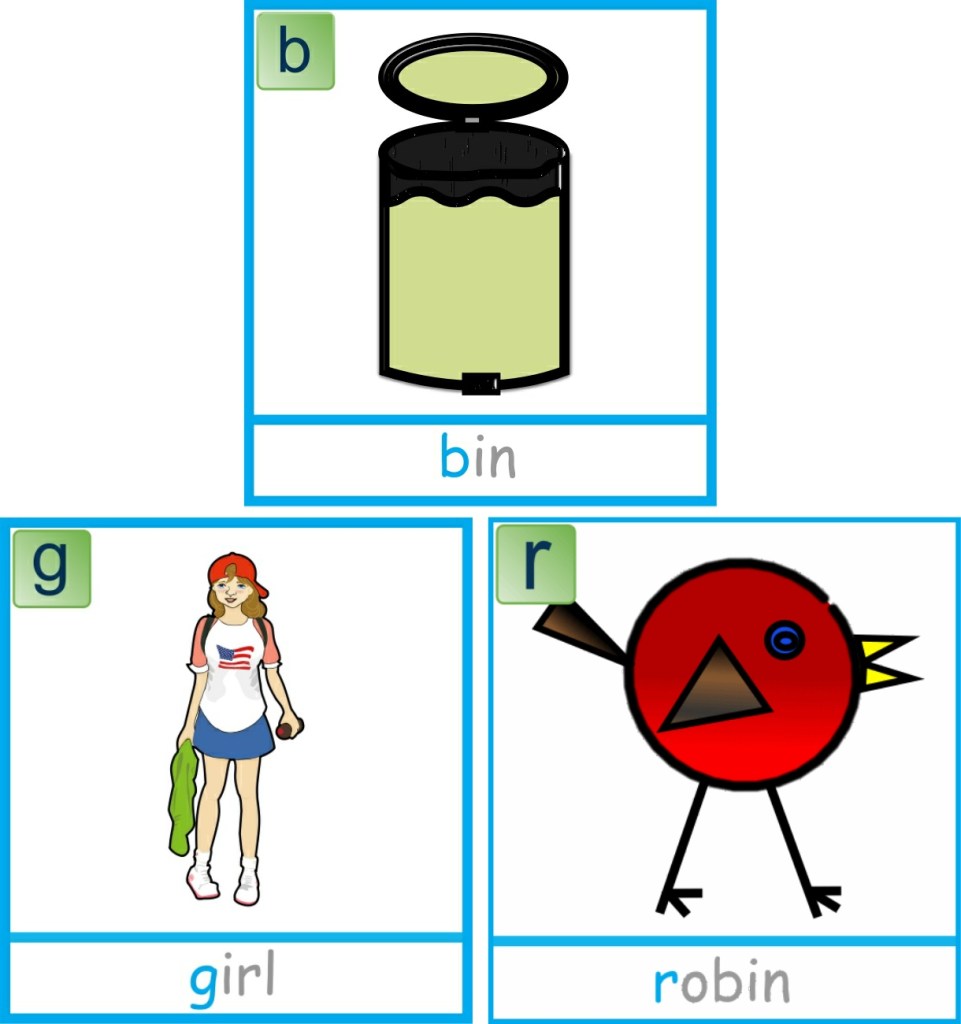
  • /b,(b)/      bin, rabbit
  • /k,(k)/      cat, key, duck, queen, anchor, broccoli
  • /ch,(ʧ)/    church, watch
  • /d,(d)/     dog, ladder, towed
  • /f,(f)/       fish, puffin, phone, laugh
  • /g,(g)/     girl, digger, ghost
  • /h,(h)/     hen, who
  • /j,(ʤ)/     jigsaw, giant, bridge
  • /l,(l)/        lion, llama
  • /m,(m)/   man, hammer, lamb
  • /n,(n)/     nest, penny, knife, gnome
  • /ng,(ŋ)/  king, sink
  • /p,(p)/    panda, hippo
  • /r,(r)/      robin, lorry, wrist
  • /s,(s)/    sun, dress, city, geese, castle
  • /sh,(ʃ)/    ship, chef, delicious, initials, sugar
  • /t,(t)/     tent, butterfly, jumped
  • /th,(θ)/   thumb
  • /th,(ð)feather, breathe
  • /v,(v)/   van, sleeve, of
  • /w,(w)well, whale, penguin
  • /y,(j)/    yo-yo, euro
  • /z,(z)/   zero, puzzle, sneeze, cheese, is
  • /zh,(Ʒ)measure, television