The Consonant Sounds with their Most Common Letter and Letter Combinations

There are 24 consonant sounds in the English language. A consonant sound is made (produced) when the air flow is being restricted in some way, which means that the mouth doesn’t open as wide and so the jaw doesn’t drop noticeably, which is different from vowel sounds.

Here is a list of just some of the most commonly seen letter and letter combinations used to represent the 24 consonant sounds. For a more comprehensive lists check out our English Phoneme Chart or Alphabet Keyboard which can be found on our ‘Phonemes’ page: https://www.teachphonics.co.uk/phonics.html            

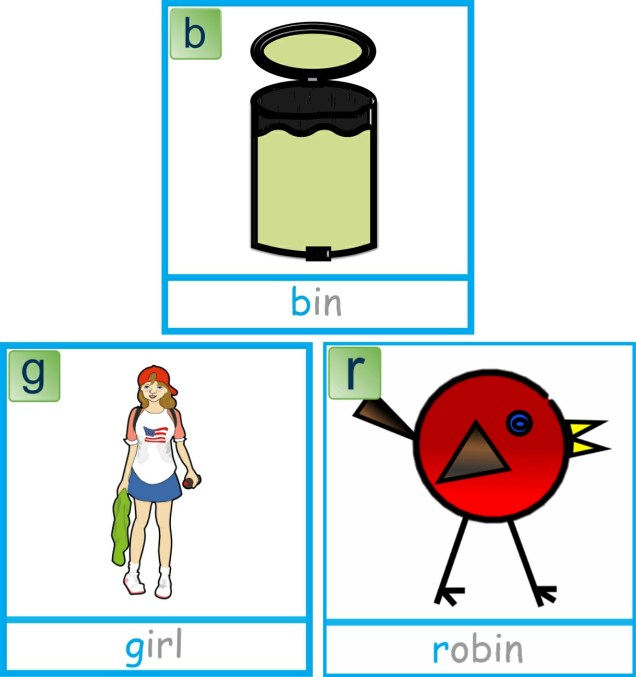
  • /b,(b)/      bin, rabbit
  • /k,(k)/      cat, key, duck, queen, anchor, broccoli
  • /ch,(ʧ)/    church, watch
  • /d,(d)/      dog, ladder, towed
  • /f,(f)/        fish, puffin, phone, laugh
  • /g,(g)/     girl, digger, ghost
  • /h,(h)/     hen, who
  • /j,(ʤ)/      jigsaw, giant, bridge
  • /l,(l)/        lion, llama
  • /m,(m)/   man, hammer, lamb
  • /n,(n)/     nest, penny, knife, gnome
  • /ng,(ŋ)/   king, sink
  • /p,(p)/     panda, hippo
  • /r,(r)/      robin, lorry, wrist
  • /s,(s)/    sun, dress, city, geese, castle
  • /sh,(ʃ)/   ship, chef, delicious, initials, sugar
  • /t,(t)/      tent, butterfly, jumped
  • /th,(θ)/   thumb
  • /th,(ð)feather, breathe
  • /v,(v)/   van, sleeve, of
  • /w,(w)well, whale, penguin
  • /y,(j)/    yo-yo, euro
  • /z,(z)/    zero, puzzle, sneeze, cheese, is
  • /zh,(Ʒ)measure, television

Art Activities to support the Understanding of Pressure – Half Term Fun

Crayoning and printing activities are great ways for a child to experience and experiment with pressure and the amount needed to create different effects. These activities will also encourage and support a child in helping them to understand, and for you to model, the language associated with pressure and how the pressure used feels. By linking the words used to the feelings and the outcome of using the pressure they can start to understand what is needed when asked to press gently or to press harder. 

When supporting a child to understand what we want when we ask them to press harder, we need to model how our body reacts to make this happen. You may need to exaggerate the actions but as you do this you also need to talk about what your body is doing and how it feels. Then point out the effect that this has had on the crayoning for instance.

When we press hard, we tend to lean our body forward over the table slightly as this allows us to put more force down on to the paper through the crayon. We may feel our arm and hand tense and often the movements made are slower and in small strokes. If it is something we are not used to doing it can make our hand and fingers ache and it will feel like hard work. The crayon marks will be thick and dark.

When we want to be gentler with the crayon, so that the crayoning is lighter in texture and colour, we tend to sit back away from the table. This way the hand moves across the paper more easily and often the strokes are longer and quicker, which sometimes feels as if we have less control over the colouring. This is why young children tend to be a bit heavy handed initially with colouring because their fine motor control skills have not reached a point that enables them to have control.

There are many creative ideas to be found on the internet and in books published by companies such as Usborne.

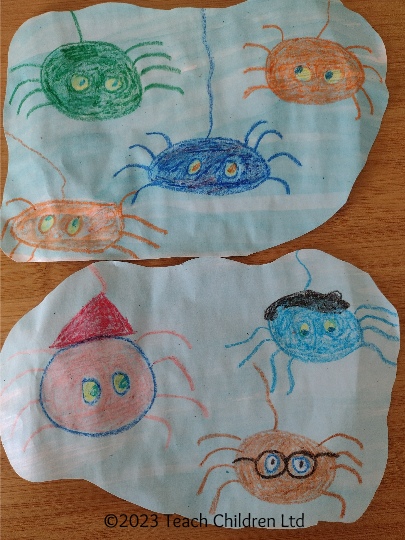
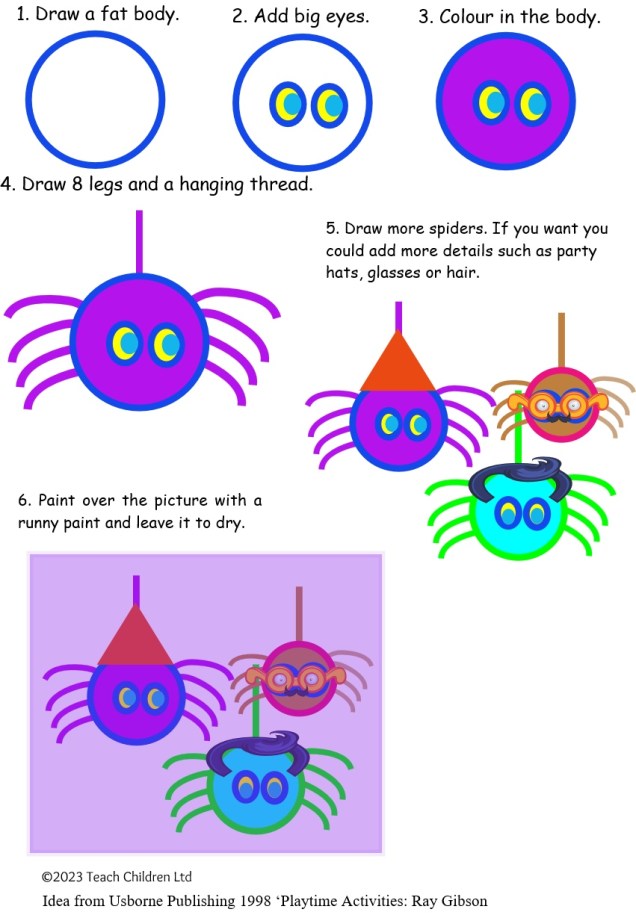
This crayon technique can be used to create a vast range of pictures. Here are just a couple of ideas to get you started: Spider Party Time:

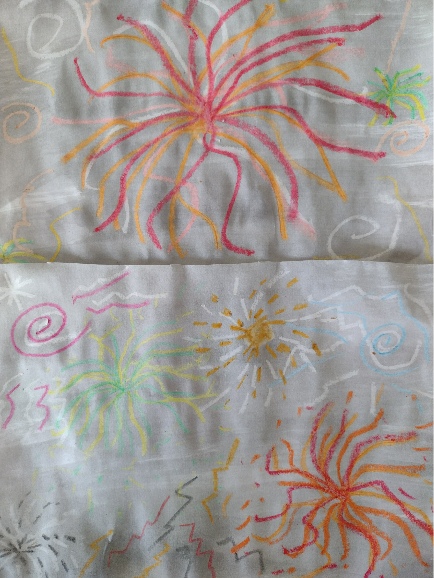
The same technique can also be used to create great firework pictures:

It is also worth remembering that drawing also helps to develop a range of different line formations, also needed for developing a good handwriting style.

Have FUN!

What are CVC Words in #Phonics?

With many parents sadly having to tackle home learning again; we thought it would be useful to re-run this blog from last year explaining CVC words in phonics.

The letter C means a consonant letter is required.

The letter V means that a vowel letter is required.

So, a CVC word is one that has a consonant letter followed by a vowel and then a consonant as in the following examples:

cat    dog    mat

There are 26 letters in the English alphabet and these can be split in to two categories:

Vowels – ‘a’, ‘e’, ‘i’, ‘o’, ‘u’ and the letter ‘y’, when it is used as a semi-vowel, in words such as by, my and fly.

Consonants – ‘b’, ‘c’, ‘d’, ‘f’, ‘g’, ‘h’, ‘j’, ‘k’, ‘l’, ‘m’, ‘n’, ‘p’, ‘q’, ‘r’, ‘s’, ‘t’, ‘v’, ‘w’, ‘x’, ‘z’ and the letter ‘y’ when it is being used as a consonant, in words such as yak, yam and yellow.

Schools will often use the abbreviation CV, CVC, CVCC words when sending home phonics work or suggestions for phonics games. It is also used by many phonics computer games, activity programs and schemes.

Here are some examples for:

What are Vowels and Consonants?

The English Language is created through the different combinations of 44 sounds (phonemes), 20 vowels and 24 consonants. In our written language we refer to the 26 letters of the alphabet as being consonant or vowel letters depending on which type of sound they are representing.

Vowel sounds allow the air to flow freely, causing the chin to drop noticeably, whilst consonant sounds are produced by restricting the air flow.

Vowel sounds are usually (in the UK Education System) split into two main categories based on sound quality:

  • ‘Short’ vowel sounds, due to the short duration of the sound being made. The sound cannot be held onto without becoming distorted
  • ‘Long’ vowel sounds, due to the length of their pronunciation. These can often be held without distorting their sound.

The letters of the alphabet that we normally associate as being the vowel letters are: a, e, i, o and u. The letter ‘y’ is sometimes referred to as an honorary or semi vowel as it is used to replace one of the other vowel letters in words such as: fly, shy, why or my.

All words in the English language have at least one vowel sound in them so the written version must have at least one vowel letter in it.

Consonant sounds are made (produced) when the air flow is being restricted in some way, for example, changes in tongue position resulting in the mouth not opening as wide. This means that the jaw doesn’t drop noticeably, which is different to vowel sounds.

The letters of the alphabet that usually represent the consonant sounds are: b, c, d, f, g, h, j, k, l, m, n, p, q, r, s, t, v, w, x, y, z. 

How the Body’s Sensory Systems affect Academic Success

Sometime ago, I posted a blog with a link to an article which we felt highlighted, and backed, our own thoughts of why we need to look at the whole child and their physical and sensory development alongside their intellectual development.

It made very interesting reading then but having talked with different therapists, SENCos and teachers over the past year it seems that it has become very relevant. This is because it appears that more and more children are struggling in school and displaying learning difficulty traits that relate to sensory system difficulties.

This article explains how sensory systems impact on and affect a child’s ability to learn and are essential developmental building blocks to a child’s academic future. It also provides some practical advise.

The article ‘Sensory Systems that Make up the Learning Hierarchy of a Strong Academic Foundation’ was written and released by Integrated Learning Strategies Learning Corner on 24/02/16 http://ilslearningcorner.com/2016-02-sensory-systems-that-make-up-the-learning-hierarchy-of-a-strong-academic-foundation/

The Pre-phonics section of our website (http://www.teachphonics.co.uk/phonological-development.html ) explains how to support and develop all the visual and auditory sensory systems highlighted in the article for a strong foundation for learning.

The activity ideas work on providing a range of stimulus for a child to experience, supporting their visual and auditory development. These activity ideas can be played at home and easily built into or adapted in a school as cross curricular activity experiences.

The Key to Good Phonics Skills – Part 11

Developing #Listening & #Speaking Skills – Games to Encourage Talking and Language Knowledge

A few weeks ago, we explained the importance of developing your child’s word awareness skills here are some further games ideas to encourage them to use this new language.

  • Playing tapes or CDs of nursery rhymes and children’s song are good for helping your child to make the distinction between the music and words (language used) in them. It is a good idea to practise this skill when there are no other noise distractions.
  • When your child points at something tell them the name of the object, for example if they point at an apple, say “Apple”.
  • Try to use the new word in context regularly as repetition of the word will help your child to remember it and reinforce the meaning of the word.
  • Try playing some action songs and rhymes to help your child learn the actions for the rhyme, then let them have a go on their own. Watch them to see if they can do some of the actions at the right time in the song, to see if they are listening for the right cue words. If they are struggling, explain they have to wait for certain words and show them what to do and when to do it.
  • If they are trying to say a word, let them finish and then say it back to them clearly and correctly. Do not make them repeat it back to you, they may choose to do so but make it their choice.
  • Repeat and expand on what your child says, so if they say “Dog!” you may say “A big dog!” This also helps them to develop an understanding of sentence structure.
  • Finger rhymes, such as ‘Round and Round the Garden’, ‘Pat-a-cake’ and ‘Incy Wincey Spider’ and action songs encourage your child to interact with words, the sounds within them and the rhythms they create. ‘Row, Row Your Boat’ is a lovely whole body movement song that encourages a rhythmic whole-body motion, which babies and toddler enjoy (as well as the adults).
  • Sharing and talking about the books you are reading helps to build word knowledge, as you point to the pictures, picking out different objects.  Reading out aloud helps to introduce your child to words that they may not experience in their everyday talk. This helps to expose them to new vocabulary and the sounds to be found in those words.
  • Introducing and playing sorting games helps your child to build a mental filing cabinet system of categories, this helps them to remember and learn the meaning of words. Start by introducing simple categories of everyday items like food or clothes as their vocabulary increases categories such as colour, size and texture become more appropriate.

Back to School – Ways to Support Your Child’s Phonics Knowledge

grapheme chart keyboard

After such a long break from school it is good to take some time to check your child has not slipped back.

Playing some simple letter name and sound games can really help get your child (and you) back into school mode.

Some simple game ideas:

  • You can use words in books, cards, on labels or signs when out and about. Ask your child to point to a particular letter in the word using the letter name. Then ask your child to say the word, or you can say it. Then ask them to tell you what sound the letter is making in that word.
  • Pick a card at random, using lower-case and capital letter flash cards (you can make your own); show your child and ask them to tell you the name of the letter on the card, and to give you a sound the letter makes. Ask older children to give you the other sounds the letter can make. For older children you can also use cards that have common digraphs (two letters representing one sound) and trigraphs (three letters representing one sound) on.
  • Play Pelmanism (Memory Game). How to Play:
    • You will need two sets of flash cards. The cards are thoroughly mixed and spread face down on the table or floor. They can be arranged in a regular pattern or randomly, but they must not overlap.
    • One player turns over a card, leaving it in the same place, they say what it is (letter name and/or sound) and then turn over another saying what it is. If the two cards match then the player keeps them and has another go. If the cards do not match then the cards are turned back over in the same location as before and it is the next players turn.
    • The game is finished when all the cards have been matched and the winner is the one with the most pairs.

If you are not sure of all the sounds a letter, or combination of letters, can represent then use our Alphabet Keyboard to help you find the sounds (phonemes): bit.ly/2bUtZae

Summer Fun – Part 4 – Get Cooking!

Cooking 1

Cooking is a great fun way to practise getting both hands to work together. This helps to develop coordination, hand and finger strength and dexterity skills; all skills required for handwriting. However, it is amazing how much talk can come from this as well; not just at the time with you but when they share the day’s experience with others later on (developing their phonological awareness).

An added benefit at this time of year is that you can do ‘Pick Your Own’. Getting out and about and encouraging your child to pick their own fruit is not only great fun but another sneaky way of working on their hand and finger strength and dexterity.

There are so many recipes, especially online, for making quick easy great tasting food (make a large batch and freeze the rest).

So, if the sun is shining, or it is just not raining, get out there find your local ‘Pick Your Own’ or check out the bargains at your local shops/market and get cooking!

Summer Fun – Part 3 – Think more Play, Play and Play!!!

Play play play 2

We are nearly through the summer holidays; six weeks may have seemed like a long time but it is amazing how quickly it passes.

The last thing you and your child probably want to think about right now is handwriting or phonics and getting ready for next term; and quite right too!

So, don’t think about it in the conventional way of practise, practise and practise.

Think more play, play and play!!!

Children learn so much through just playing; developing physical, mental, communication and vocabulary strengths and skills, which all support them at school and with learning.

Once introduced to a new game or activity children will very often take it and make it their own, making new rules and introducing extra characters or challenges.

The skill as a parent is remembering to let go of your preconceived ideas about how a game should be played and letting your child take the initiative.

If you provide the opportunities it is amazing how they will take on the challenge of inventing a new game or (in their eyes) improving an existing one.

This does not have to cost a penny; use the toys they already have or make games using empty plastic bottles or cardboard tubes.

The following types of play can support and develop the key strengths and skills your child needs for handwriting and you have not had to mention school or homework.

  • The local play park is a fantastic free resource; running, jumping, crawling and climbing can all be encouraged. If your child is a little reluctant then it may well be that they are unsure how to do some of these activities. Explain when jumping that they needed to land on their feet and bend their knees as they land. Start small and as their confidence grows so does the height or distance they jump. Climbing can be scary for some children so again explain how to climb, moving one hand or foot at a time so that there are always three other points of contact.
  • If you are lucky enough to have a garden then mud play is messy but so much fun, it can be contained in a small area and will not only make you a cool adult but, if you join in, it will knock years off you (have a go, it is a great free therapy session).
  • Skittle games are always fun, extend the activity by decorating the skittles (plastic bottles or cardboard tubes) using anything from crayons, paint or even dress them up as people or animals.

Enjoy!

Summer Fun Part 2 – Water, water everywhere!

Water fun 2

The SUN is out which makes it time for the water fights and games to begin.

It is August and for once, the weather is perfect, so why not set up water squirting games in the garden. The kids are waterproof and everything else will dry out, eventually!

How can water fights and games, where you can get wet, be handwriting and phonics homework?

You will be encouraging your child to develop their hand strength, co-ordination and eye tracking skills (all handwriting skills). However, these games are also fantastic for developing sound and word awareness skills.

Try mimicking the sounds that the water makes as it drips on to the floor or hits the targets; use directional language to support your child’s aiming skills; describe how the objects move when hit: bouncing, rolling or flying and talk through the emotions evoked through playing the games.

As well as supporting your child in developing a whole range of physical and language skills you will also increase your cool adult status.

Some fun water games:

  • Try setting up a target wall, using chalk to draw the targets.
    • How many of the targets can you hit with water squirted from a water pistol or squeeze bottle in a set time.
    • How many targets can be washed off.
  • Set up a skittles range.
    • Each skittle hit with water can be worth a certain number of points, or the distance of the skittles may affect their value.
    • A time trial game to hit all the skittles. If you are using plastic bottles as skittles try making some of them a little heavier by putting sand or dirt in them to make it a bit harder to knock them over.
  • Move the object race games.
    • A light toy/ball has to be moved by squirts of water over a distance.
    • A range of objects moved in to target areas to gain points.

The only limitation is you and your child’s imagination and trust me kids never tire of finding new ways to play with water (but then again neither do many adults)!

Homework has never been so much FUN!