The Key to Good Phonics Skills – Part 11

Developing #Listening & #Speaking Skills – Games to Encourage Talking and Language Knowledge

Last week we explained the importance of developing your child’s word awareness skills here are some further games ideas to encourage them to use this new language.

  • Playing tapes or CDs of nursery rhymes and children’s song are good for helping your child to make the distinction between the music and words (language used) in them. It is a good idea to practise this skill when there are no other noise distractions.
  • When your child points at something tell them the name of the object, for example if they point at an apple, say “Apple”.
  • Try to use the new word in context regularly as repetition of the word will help your child to remember it and reinforce the meaning of the word.
  • Try playing some action songs and rhymes to help your child learn the actions for the rhyme, then let them have a go on their own. Watch them to see if they can do some of the actions at the right time in the song, to see if they are listening for the right cue words. If they are struggling, explain they have to wait for certain words and show them what to do and when to do it.
  • If they are trying to say a word, let them finish and then say it back to them clearly and correctly. Do not make them repeat it back to you, they may choose to do so but make it their choice.
  • Repeat and expand on what your child says, so if they say “Dog!” you may say “A big dog!” This also helps them to develop an understanding of sentence structure.
  • Finger rhymes, such as ‘Round and Round the Garden’, ‘Pat-a-cake’ and ‘Incy Wincey Spider’ and action songs encourage your child to interact with words, the sounds within them and the rhythms they create. ‘Row, Row Your Boat’ is a lovely whole body movement song that encourages a rhythmic whole-body motion, which babies and toddler enjoy (as well as the adults).
  • Sharing and talking about the books you are reading helps to build word knowledge, as you point to the pictures, picking out different objects.  Reading out aloud helps to introduce your child to words that they may not experience in their everyday talk. This helps to expose them to new vocabulary and the sounds to be found in those words.
  • Introducing and playing sorting games helps your child to build a mental filing cabinet system of categories, this helps them to remember and learn the meaning of words. Start by introducing simple categories of everyday items like food or clothes as their vocabulary increases categories such as colour, size and texture become more appropriate.

The Key to Good Phonics Skills – Part 10

Developing #Listening & #Speaking Skills – Developing Word Awareness

A good word awareness (receptive and expressive language) is a key phonics skill.

Helping a child build their vocabulary (word awareness – receptive & expressive language) is vital if they are to continue to develop good communication skills. Talking, explaining, sharing and playing are all important as well as making sure that you pronounce words clearly and correctly for a child to hear. A child may not have developed all the skills needed to copy you accurately but they will store the sound pattern information for later use. The more they hear the correct sound patterns the sooner they will start to use them themselves.

Click the link for ‘Tips to Help Develop Word Awareness (Receptive & Expressive Language)’:

https://teachphonics.co.uk/word-awareness.html

The Key to Good Phonics Skills – Part 9

Developing #Listening & #Speaking Skills – How to encourage your child to keep talking!

Learning to the conventions of conversation start from birth, as parents we do not really think about it in this way but it is what we tend to do naturally.

Sometime though we all need a few pointers to help us, so here are some ideas to help you develop and encourage your child’s talking skills:

From Birth to 1 Years Old

  • To encourage cooing and babbling. Get yourselves comfortable in a face-to-face interaction position, babies often like lying on their back or on your lap looking up at you.
  • Start by talking to your child while gently tickling their tummy or neck.
  • Anytime they make a sound you imitate or match the sound as best you can. It is best to wait until they have finished before you try (one of the conventions of conversation).
  • Try changing or adding a new sound to the one your child has made, so if they say ‘ah’ you might say ‘ah-ooh’, this will help to keep the game interesting.
  • Show that you are excited by the sound they make – smile and laugh, if you are enjoying the interaction, they will be excited by it too.
  • Vocal play works best when it occurs naturally, such as playing with farm animals, for instance sheep go baa, baa or cows make a moo, moo sound.

1 to 2 Years Old

  • Talk directly to your baby/toddler so they can see your facial expressions and how your lips move, as this is the beginnings of learning the conventions of communicating, listening and responding (something they cannot get from the TV, iPad or overheard conversations – indirect talk).
  • Talk through everyday events, such as getting dressed; what is happening, where you are going and what the plan is for the day.
  • Use your body language, expressions and gestures to help reinforce and develop your child’s neurological pathways to support understanding and comprehension.
  • Share books with your baby/toddler, they may not understand what you are saying to begin with but they will be listening to the different sounds that the words make. By reading aloud you are probably using words that will introduce new sounds that your child may not be picking up from your normal day to day conversations. As they get older you are developing and increasing the range of their vocabulary.
  • Babies and young children love to hear you singing and saying rhymes, this is because the language is slowed down, allowing them to hear the small units of sounds and patterns which are often repeated several times in a short time lapse. Again, the language used is often different from your day-to-day talk.
  • To encourage and help your child to generate and play with sound, repeat the sounds that they make.
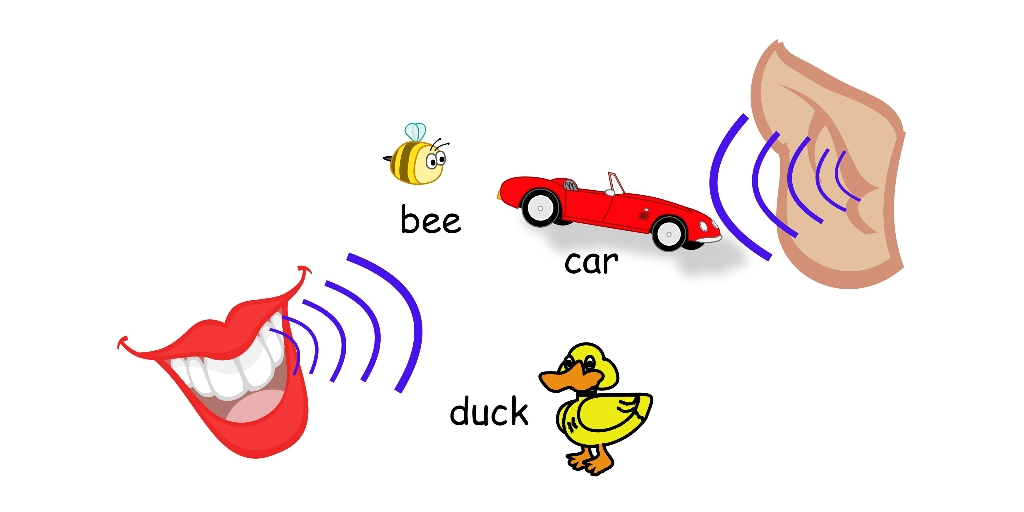
  • Using familiar objects and toys make the noises associated with them for example a toy car, broom, broom or a toy bumble bee buzz, buzz.
  • When you are out and about talk about what you can see and about the sounds they make, a cat goes meow or a train Choo, Choo, for example.
  • You can use other onomatopoeic words to describe sounds, such as wooden spoons on saucepans could be bang, bang or blocks being knocked together could be click, clack.

2 to 5 Years Old

  • When playing, talking and sharing new words it is important to get down to your child’s level so they can see your face and how your mouth and lips move to form the words or sounds being explored.
  • Remember toddlers learn to listen best when they are taking an active role in what they are doing, especially when you or others join in eagerly with them to play the games.
  • Give your child thinking and response time, this may seem like a long pause but it is worth waiting, be sure your child has finished what they wanted to say before you respond.
  • Try not to finish off your child’s sentence, yes sometimes it may be quicker but just give them a little moment longer and they will get there. If it is clear they cannot think of the word they want then that is of course different.
  • Before a child can really take part in meaningful interactions with others, they need to learn how to take turns. It is one of the basic elements of communication, when we are talking to someone, we leave a gap/pause so that the other person has the opportunity to respond, taking turns. Turn taking skills need to be modelled and taught to help your child develop and understand this element of communicating with others.
  • To encourage your child to keep talking try nodding, smiling and using comments such as; wow, really or acknowledging something they have said by repeating rather than always asking them questions.
  • We are all guilty of half-listening, especially when we are busy trying to cook dinner for example. If it is obvious that what your child wants to tell you is really important then make it clear that you are interested by saying “Just let me finish this and then I can listen to you more carefully.”

The Key to Good Phonics Skills – Part 8

Developing #Listening & #Speaking Skills – The Importance of Small Talk!

Don’t underestimate the importance of everyday chatter or conversation (‘Small Talk’), children develop and learn a great deal through ‘Small Talk’ with adults and other children.

What do we mean by ‘Small Talk’?

With babies it is the kind of talk that explains what we are doing, what they are doing, where we are going and what we can see.  As they get older our verbal exchanges increase as we support their receptive and expressive vocabulary development. Through these exchanges we also support their general language development and understanding of how words are pronounced, basic sentence structure and using the correct tense.

When we talk with a child we demonstrate and model the use of language in real time so that it has meaning. For instance, a child may point and say “cat” and we would respond with “Yes, the cat is sleeping.” Or we may correct the child and say “That is a dog.” If we could we would point to a cat and explain the difference. We also correct mispronunciation of words and correct tense issues in the same way; repeating the word or sentence using the correct pronunciation or tense back to the child. The Communication Trust is now part of the I Can organisation and has a great range of information and guidance for parents and professionals: https://www.icancharity.org.uk/

The Key to Good Phonics Skills – Part 7

Developing #Listening & Speaking Skills – Different Types of Talk

There are different types of talk:

  • Business Talk – this is when we use more everyday instructional and informational kinds of vocabulary and sentence structures.
  • Play Talk/Rich Talk – this is more conversational, informal and descriptive.
  • Small Talk – this is everyday chatter or conversations, informal and often less descriptive and more factual.
  • Parentese – this research has shown is how babies prefer you to talk to them using regular words (normal adult vocabulary) in a slightly higher pitched and more sing-song way.

It is important that a child is exposed to the different types of talk as it helps them to build their vocabulary (word awareness – receptive & expressive language) this is vital if they are to continue to develop good communication skills.

The Difference Between Receptive and Expressive Language

Receptive language is how we take in and understand language; it is what we hear, see and read. This also includes body language and environmental clues. All these elements help us to interpret a situation and give it its meaning, so that we can understand what is being communicated. We do not need to be able to produce language to receive and understand it, so infants and toddlers understand far more than they can express (expressive language).

Expressive language is our ability to put our thoughts, needs and wants into words and sentences in a way that makes sense and is grammatically correct. A baby’s expressive language to begin with is based on cries and gestures and then moves to sound making, gestures and body language signals. We use this expressive language when we speak and write. When babies and toddlers move to speaking words, they have a limited vocabulary which is why they can get frustrated when we do not understand them.

Good word awareness (receptive and expressive language) is a key pre- phonics skill.

Click the link for ‘Tips to Help Develop Word Awareness (Receptive & Expressive Language)’: https://www.teachphonics.co.uk/word-awareness.html

The Key to Good Phonics Skills – Part 6

Developing #Listening & Speaking Skills – Turn Taking Skills – Conversation

This week we will look at turn taking in conversation a skill children need to learn to take part in meaningful interaction with others. These interactions are a vital part of children’s physical, emotional, social and intellectual growth and wellbeing.

Children need to learn that in conversation they need to take turns listening and speaking.

This is more complex process than we often give it credit for as often we, especially in our busy lives, can be guilty of only listening to reply rather than listening to understand.

Children need to learn when to talk and when to listen; for this to happen they need to do the following:

Children need to learn when to talk and when to listen; for this to happen they need to do the following:

  • Actively Listen to the other person. This means:
    • Concentrate on the words being said, by blocking out other environmental noises and voices.For most children and adults this also means looking at the person, watching their facial expression and body language.Listening for the verbal cues and/or changes in the tone of voice that signifies that the person has finished speaking.
    • Recognising that it is either your turn to respond by formulating a reply or not.
  • Formulate a Response. This means:
    • Extracting meaning – taking understanding from the words that have been spoken.
    • Mentally searching for words to compile a grammatically correct set of sentences.

In young children this can take time, not because they do not have the answer, because they just take longer to recall and formulate their responses. This is due to the constant acquisition of new language and understanding of the grammatical conventions that need to be applied.

  • Formulate a Response. This means:
    • Extracting meaning – taking understanding from the words that have been spoken.
    • Mentally searching for words to compile a grammatically correct set of sentences.

In young children this can take time, not because they do not have the answer, because they just take longer to recall and formulate their responses. This is due to the constant acquisition of new language and understanding of the grammatical conventions that need to be applied.

  • Communicate Response. This means
    • Speaking clearly, pronouncing words correctly in coherent sentences.
    • Using socially appropriate facial expressions and body language to accompany the response.
    • Using the appropriate verbal cues and/or changes in the tone of voice that allow the other person to understand it is now their turn.
  • Wait. This means giving time for the other person to formulate their response.
  • Actively Listen to the other person.

Learning these skills takes time and needs to be taught as well as modelled by those around the children. It begins very early on for instance, when we talk to a baby, as if expecting an answer. As a baby starts to make cooing and babbling sounds, they begin to respond to you in those gaps, their first conversations.

Something that is worth remembering:

“When you talk, you are only repeating what you already know. But if you listen, you may learn something new.” (Dalai Lama)

Indoor/Outdoor Circuits Ideas – To Support Language Development

Well, true to form, the Easter Holiday weather is a mixed bag, sunny one minute then pouring with rain the next!  

So, here are a couple of ideas to help your child burn off some of that pent-up energy. Best of all you can class it as language development homework (working on instructional, directional, body awareness vocabulary and listening skills).

An indoor/outdoor circuit training course does not have to take up much space or be messy (but it might be a good idea if indoors to move ornaments a little further out of the way).

Simple activities can be fun if they are done for short periods of time and children do love a time challenge. Make each activity last anything from 30 seconds to 1 minute.

You could record how many they did in the time and see if they have improved when you try it again.

Why not try:

  • Hopping on one leg and then the other (balance & coordination)
  • Use the bottom step of the stairs for step ups (bilateral coordination)
  • Curl ups (core strength)
  • With a cushion balanced on their head can they touch their toes without dropping the cushion (balance, coordination, bilateral coordination and core strength)
  • Star Jumps (balance & coordination)

For more fun, simple activity ideas check out our games page, it is amazing how much fun you can have just hopping, jumping, skipping and dancing on the spot: https://teachhandwriting.co.uk/games.html

If you are feeling really brave why not try building an obstacle course, a lot of the fun is in the designing and making.

Let go and have fun!!!

Treasure or Easter Egg Hunts Develop both Handwriting & Language Skills

The Easter Holidays have started, so here are some fun activities to keep children of all ages entertained whether we have rain or sunshine.

An Easter egg, or treasure, hunt is a great way to teach children directional language. Being able to understand directional and placement (prepositions) vocabulary is important for understanding everyday instructions such as ‘put your cup on the table’; ‘go along the hall and stop at the door in front of you’.

We also use this directional language to explain how to draw patterns and write letters, which is another reason why it is important for young children to be introduced to, and have a good understanding of, this kind of vocabulary.

Through Easter egg, or treasure, hunts you can introduce new directional and placement language in a fun and exciting way. There are a number of different ways to approach this:

  • You can give verbal instructions to the hidden egg/treasure.
  • You could create a map for them to follow and ask them to talk you through the map, supporting them with new language as necessary.
  • You could use a mixture of verbal and map clues.
  • For older children get them to hide the egg/treasure and give you instructions, or draw a map.
  • If you have more than one egg/treasure and they are of different sizes make the larger ones more difficult to find.

The important thing is the language shared. Words and phrases to use are: left, right, straight on, forward, backwards, about turn, turn around, up, down, higher, lower, stop, next to, in front, beside, underneath, on top of, behind, on the left of, on the right of, outside, and inside.

Easter egg, or treasure, hunts are a great whole family activity and you are never too young or too old to join in!

The ‘What’s That?’, What You Doing?’ and ‘Why?’ Stages

As children interact more with the world and those around them so their language and communications skills increase and the ‘What’s That?’, ‘What You Doing?’ and ‘Why?’ stages begin. Yes! It can drive you insane at times, but it is at these stages they are cementing their knowledge and understanding, their brains are like a sponge, absorbing all sorts of information and linking them together.

It is at these stages that a child can easily misunderstand explanations and develop misconceptions as they try to find reasons and meanings for themselves. So, it can be very useful to talk through some things again later, checking their understanding and thinking. A good way of doing this is to ask them to tell someone else who was not there, perhaps Dad or an older brother/sister for instance. This way you can help them to develop a better understanding of the meaning of the word or concept.

You can also broaden their experiences, on which to draw understanding, by setting up play scenarios or other activities.

Why Vocabulary Building with your Child is so Important!

Building your child’s vocabulary is a vital pre-reading skill. This is because schools teach what is referred to as the ‘The Simple View of Reading’:

Reading Comprehension = Decoding (Phonics) x Linguistic (Spoken Language) Comprehension  

This means that a child decodes the words using their phonics skills and their own vocabulary knowledge to help them understand the text they are reading.

So, for a child to have good reading skills they need to be able to speedily decode unknown words and recognise familiar printed words. And, understand the meaning and grammatical structure of the spoken language and then use this knowledge to understand the printed text.

This means that a child:

  • Who does not fully understand the meaning of all the words and/or the grammatical structure of the spoken language (age appropriate) will also be unable to fully understand the printed text; even if they decoded it correctly.
  • Whose ability to understand the spoken word is poor will also be unable to understand the printed text; even if they have managed to decode a few words.

Helping your child build their vocabulary is also vital, if they are to continue to develop good communication skills. Talking, explaining, sharing and playing are all important in developing your child’s vocabulary, their understanding of the words meaning in the context of the conversation and the grammatical conventions of our spoken language.