Word Play – Syllable Awareness & Counting

syllables 1

At about the age of 4 years old children start to develop an understanding that words can be split into sound parts (syllables) and that these parts give the word its rhythm.  A syllable is the largest phonological unit (one or a group of sounds) of a word and is like the rhythmic beat of the word.

They should be able to orally blend syllables together to form words and segment words into syllables.

A fun activity to help develop syllable understanding:

How Many Syllables?     

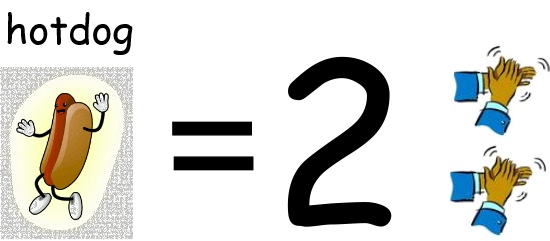
Children love to clap out the number of syllables in a word. It is important to say the word at a normal speed rather than really slowly as this can distort the word and make it difficult to hear the syllables. To start with a child just needs to be able to recognize them by clapping, stamping or jumping for each syllable of a word; they don’t need to be able to count them. It is thought that only about 50% of children can count out the syllables by the age of 4, so you can do the counting for them.

Spoken syllables are organised around the vowel sounds, making counting them easy; as the jaw drops when the vowel sound is spoken in the syllable. Try placing your hand under your jaw with your mouth closed before you say a word. Start with ‘cat’ you will notice the jaw drops once, this is because it is a one syllable (monosyllabic) word.

Most children will find it easier to identify syllables in compound words to start with. A compound word is formed by two words (root words) put together such as: sunset, hotdog, snowman and postman. They find it easier because the jaw tends to drop quite distinctly as we say the vowel sound in each of the root words and because we tend to say these words slowly.

Word Play – Rhyme & Alliteration

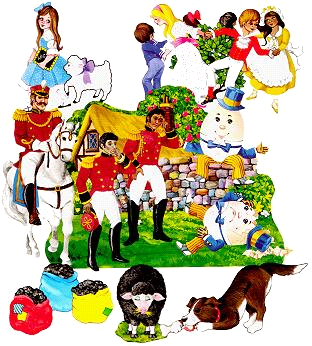
Nursery Rhymes

Young children develop their vocabulary and understanding of sound patterns within words through word play.

Rhyme awareness and the enjoyment of alliteration begins early, usually between the ages of 2 and 3 years old (Stage 3 of phonological awareness). This develops in to an important tool, supporting a child in developing an understanding of how words are formed and the sound patterns within them. These are important pre-phonics skills a child needs to develop to support their future ability to succeed with phonics, reading and writing.

This Rhyme awareness is supported and developed through the singing of songs and nursery rhymes and finger chants. Alliteration (words that begin with the same sounds) such as ‘Sammy snake slithers silently’, which children love to hear in rhymes and stories, also supports their word knowledge and understanding of sounds in words.

Being able to repeat, and join in with, short phrases they have anticipated in a story or rhyme, is another important step in a child beginning to understand the use of words in stories and story structure; such as, “I’ll huff and puff and blow your house down!” in the story of The Three Little Pigs.

For more information on this, and other pre-phonics skills (Phonological Awareness) your child develops through from birth to 7 +years old, check out the Pre-phonics section of our website.

Games to Develop Listening Skills – Part 6

Music Inst 1

These games are designed to help a child learn about the different levels of sound, pitch, tone and volume.

Music Fun

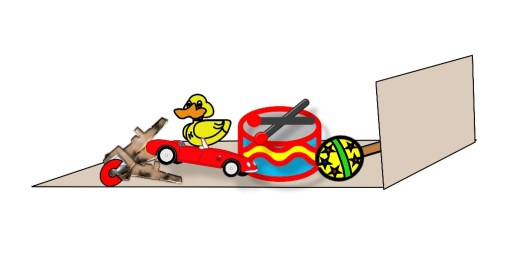
  • Skittle Band – Use, or make, a drum stick (wooden spoons are good for this) and explore with your child the different sounds the drum stick makes against objects made of different materials, such as steel saucepan, another wooden spoon, plastic bottles etc. Choose items that are safe and you are happy for them to play with. You could photograph the objects, record the sounds they make, or video (on your phone), to play back and talk about later on. Try moving the activity outside for a different sound quality experience.
  • Orchestral Conductor – Once your child is happy and enjoys playing and making sounds, with different objects and instruments, try the conductor game. You can use your hands or a baton to point and encourage them to play certain sounds just like an orchestral conductor does, but make sure you have a clear stop gesture which your child will understand (you may need to say stop at the same time as the gesture to begin with, but they will soon get the idea). Then swap places and you become the musician and they the conductor; it may not be a classic you create but it is great fun. As your child develops their skills you can add new elements and hand gestures to make the sound louder or softer.
  • Musical Bottles – Use plastic bottles with different amounts of water/sand in them and different things as a beater. Talk about how:
    • Low/deep or high pitched a sound is compared with another.
    • Using different beaters can change the quality of the sound when used on the same bottle.
    • Using different amounts of pressure to hit the bottle makes the sound louder (harsher) or quieter (softer).

Try organizing the bottles in order of pitch to create a musical instrument and using this as part of the Orchestral Conductor game. You could number each bottle or use a different picture on the bottle as a way of encouraging your child to play the bottles in different orders (making music).

This is the last in our ‘Speaking and Listening Development’ series we hope you have found it useful and enjoyed the games and activities!

Sound Scanning Games to Develop Listening Skills – Part 5

Scanning Games 1

These games are designed to help a child learn how to block out ambient noises so that they focus and concentrate on one particular sound.

Games

The idea is to identify and talk about different sounds in different locations; in the park or at home in different rooms. Ask the child to listen for a moment (timed activity 30 seconds to start with then increase) and to pick out different sounds they can hear. Some will be close and easier to identify; other sounds may be further away and require more focused concentration to work out what they may be.

  • Sound Scanning Questions to help:
    • What can you hear that is far away?
    • What can you hear that is close by?
    • What can you hear that is loud?
    • What can you hear that is quiet?
    • What can you hear that makes a high-pitched sound?
    • What can you hear that makes a low-pitched sound?
    • What can you hear that sounds big?
    • What can you hear that sounds small?
  • Listening Walk Activities- You could record some of the sounds heard and talked about on the walk. Try changing the ‘What can you …?’ questions to ‘What did you…?’ Depending on your child’s age they may be able to draw a sound scape picture showing all the things they heard on the walk.
  • Where is the Sound? – The aim of the game is finding out where the sound is coming from. Start by using something that makes a good clear sound. Ask your child to cover their eyes (can use a blindfold) and have them sit or stand in the middle of the room. Move around the room, starting not too far away from them and make the sound. Pause between each sound to give your child time to settle and focus on it before you make the next sound. Try to keep an even, slow pace. The aim is for your child to point in the direction they believe the sound is coming from. Gradually move further away, maintaining the same sound level. Swap places with your child, so you have to guess where the sound is coming from.

To make it more challenging:

  • Change the volume of the noise.
  • Change the object that is making the noise.
  • Change the speed (rhythm), as well as the location, at which the sounds are made.

Have Fun!

Sound Screen/Barrier Games – Part 4

Barriers Game 2

Last week we explained the three things required for good listening skills:

  • To pay attention – being able to focus on a particular voice or sound by filtering out other voices and ambient noises.
  • To concentrate on the voice or sounds to take in the information, building the stamina needed to listen for extended periods of time.
  • To interpret that information to gain meaning – comprehension.

Here are some games to help build these skills.

These games are designed to help a child learn how to block out ambient noises so that they focus and concentrate on one particular sound.

Create a barrier between you and your child so that they cannot see the object you are going to use to make noises with and see if they can guess the object. Try to use objects that make sounds that occur around them a lot of the time, for example keys rattling together or wooden blocks being knocked together. There are many variations of the game that can be played but you need to make sure your child has the opportunity to experience the sounds with the relevant object beforehand so they don’t get frustrated by the game.

  • Mrs Blog has a box… To the tune of Old MacDonald changing the name as best fits the situation. Place a box, on its side with a number of objects inside that make a noise (choose items your child is familiar with the sound of), between you and your child so they can’t see what is in the box. Start singing “My mummy has a box ee, i, ee, i, o and in that box she has…” Stop and gesture to encourage your child to listen (maybe a cupped hand to your ear) then pick one of the objects and make a sound; your child then tries to guess what it is. Continue to sing but imitating the sound of the object you played, which your child can now see. If it was a bunch of keys for example; “with a jingle, jangle here and a jingle jangle there, my mummy has a box ee, i, ee, i, o.” Swap places so your child can choose an object in the box, change the song so you are using their name, for example “My James has a box…”
  • Same or Different? Place a barrier between you and your child so they cannot see which object you will use to make a sound and that you duck behind so they cannot see your face when you make vocal sounds.  This can be played at different levels. At the basic level using animal noises such as baa, moo, woof etc. A more complex level would be to use shakers with different size things inside to make different shaking sounds. Plastic containers or bags of the same size and type can be used to make the shakers with different small items in such as dried pea, rice, sand or small coins, pebbles or small Lego bricks. Make the noise once and then repeat either with the same noise or a different one. The child then says if they were the same or different.
  • Copy Cat! Place a barrier between you and your child so they cannot see which object you will use to make a sound and that you duck behind so they cannot see your face when you make vocal sounds.  You will need two set of the same objects, a set for you and one for your child. The aim of the game is for you to make a noise with either an object or your voice and for your child to copy that sound choosing the correct object in front of them or using their voice as you did. The game can become more complicated as you mix a number of sounds using objects and your voice. Swap roles so that your child becomes the leader of the game and you have to copy them.

Have Fun! N.B. Be careful of small objects, especially those escaping from shakers, as these can be a choke hazard.

What is listening? – Part 3

Listening Skills 1

Listening is a complicated skill that requires children to learn how to pay attention – being able to focus on a particular voice or sound by filtering out other voices and ambient noises. They then have to concentrate on the voice or sounds to take in the information, building the stamina needed to listen for extended periods of time. Then they have to interpret that information to gain meaning – comprehension.

The usual approach to teaching children to listen is based on three behaviours:

  1. Sitting or standing still
  2. Looking at the person who is speaking
  3. Thinking about what the person is saying or said

However just because your child is replicating these behaviours doesn’t mean they are listening.

It is also surprising how often children are happy to follow steps 1 and 2 but completely miss step 3.

This is not surprising really as listening is not a set of behaviours but a set of skills that need to be taught and developed, starting from birth.

A child with poor listening skills will find it difficult to complete tasks, as they have not taken in all the information and so not understood the full extent of the task, or what was required of them. This can lead to a child flitting from one activity to another and never finishing anything, slowing down their learning. They also miss out on the sense of achievement and feeling of pride when a task is completed. This helps to build a child’s confidence, self-esteem and self-motivation to try again or attempt a more challenging task.

For many children good listening skills do not develop naturally, they have to be taught!

The Importance of Small Talk – Week 1

Dad & Girl 1

Don’t underestimate the importance of everyday chatter or conversation (‘Small Talk’), children develop and learn a great deal through ‘Small Talk’ with adults and other children.

What do we mean by ‘Small Talk’?

With babies it is the kind of talk that explains what we are doing, what they are doing, where we are going and what we can see.  As they get older our verbal exchanges increase as we support their receptive and expressive vocabulary development. Through these exchanges we also support their general language development and understanding of how words are pronounced, basic sentence structure and using the correct tense.

When we talk with a child we demonstrate and model the use of language in real time so that it has meaning. For instance, a child may point and say “cat” and we would respond with “Yes, the cat is sleeping.” Or we may correct the child and say “That is a dog.” If we could we would point to a cat and explain the difference. We also correct mispronunciation of words and correct tense issues in the same way; repeating the word or sentence using the correct pronunciation or tense back to the child.

The Communication Trust has a link to a free downloadable booklet called Small Talk which is a very useful guide for understanding how your child learns to talk from birth to age 5:

https://www.thecommunicationtrust.org.uk/resources/resources/resources-for-parents/small-talk.aspx

Speaking & Listening Skills

Developing a Child’s Speaking and Listening Skills is Vital!

It is not just the key to literacy success but an essential social communication skill.

Sadly, schools are still reporting ever increasing concerns over the decline in young children’s speaking and listening skills. So, over the next 6 weeks, we are looking again at the different developmental elements of speaking and listening; providing practical games and activities to help build a child’s skills.

Week 1. The Importance of Small Talk

Week 2. Conversational Turn Taking Skills

Week 3. What is Listening?

Week 4. Games to Develop Listening Skills – Sound Screen Games

Week 5. Games to Develop Listening Skills – Sound Scanning Games

Week 6. Games to develop Listening Skills – Music Fun

Christmas Finger Printing a Fun Way to Support Language Development

Christmas printing 2

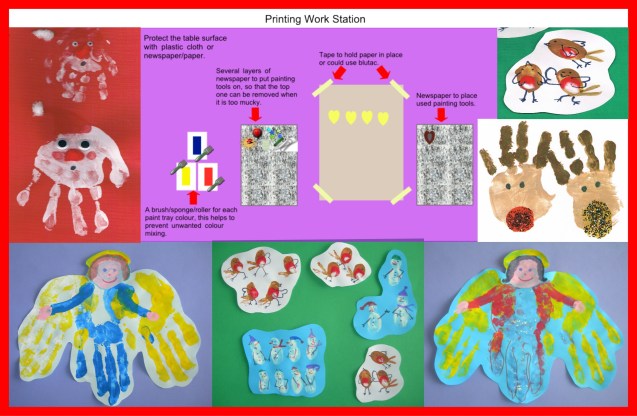
Hand and finger printing can be a fun way of getting your child used to touching, using different textured mediums and descriptive language associated with it. Such as: slimy, smooth, slippery, squidgy, wet, dry, squelch, ooze, press, push down, harder, softer, gentle, lift, light and dark.

Printing activities also help your child to start to become aware of how to control the amount of pressure they use and to develop a vocabulary to describe the different range of pressures required. Learning to control the amount of pressure exerted and how it feels can be very difficult for some children and it takes time and a range of experiences to develop these skills.

There are some fabulous printing ideas out on the internet; one of my favourite art resources is The Usborne Art Idea Books. Hand and finger printing can create some amazing artwork which can be used to make wonderful personalised Christmas cards, tags and paper.

Who could not be charmed by these fun thumb and fingertip snowmen or robins or delighted by a hand print angel or Father Christmas?

For other useful tips on printing and setting up a printing work station (http://bit.ly/35Z7pWQ ), check out our ‘More fun handwriting activities in our Resources section: http://bit.ly/2kyeo3w

The difference between receptive and expressive language

Receptive & Expressive 2

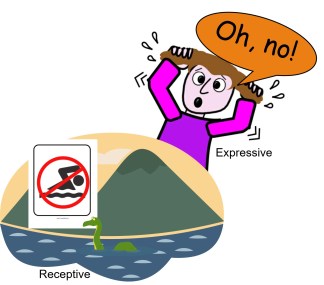
Receptive language is how we take in and understand language; it is what we hear, see and read. This also includes body language and environmental clues. All these elements help us to interpret a situation and give it its meaning, so that we can understand what is being communicated. We do not need to be able to produce language to receive and understand it, so infants and toddlers understand far more than they can express (expressive language).

Expressive language is our ability to put our thoughts, needs and wants into words and sentences in a way that makes sense and is grammatically correct. A baby’s expressive language to begin with is based on cries and gestures and then moves to sound making, gestures and body language signals. We use this expressive language when we speak and write. When babies and toddlers move to speaking words, they have a limited vocabulary which is why they can get frustrated when we do not understand them.

A good word awareness (receptive and expressive language) is a key phonics skill.

Helping a child build their vocabulary (word awareness – receptive & expressive language) is vital if they are to continue to develop good communication skills. Talking, explaining, sharing and playing are all important as well as making sure that you pronounce words clearly and correctly for a child to hear. A child may not have developed all the skills needed to copy you accurately but they will store the sound pattern information for later use. The more they hear the correct sound patterns the sooner they will start to use them themselves.

Click the link for ‘Tips to Help Develop Word Awareness (Receptive & Expressive Language)’: http://bit.ly/29LajVk