The Importance of Using Letter Names for Developing Handwriting, Phonics and Reading Skills

Here at Teach Children we have always promoted the importance and power of teaching the correct letter names to begin with; through our Teach Handwriting website, Schemes and Teach Phonics website.

Unfortunately, over the years this has proved to be a challenge as schools have felt they needed to focus more on phonics skills and relied on the handwriting element that were incorporated within the phonics schemes, which frankly just didn’t work for so many.

The Department of Education published on 08/07/2025 its new writing framework, which now recognizes and clearly emphasises the importance of teaching handwriting from EYFS right through the primary years.

Their acknowledgement that handwriting has to be taught separately from phonics means that children will have to learn the letter names as part of a good handwriting scheme:

“Pupils should be taught both phonics and handwriting consistently and systematically, in line with the programme for each.”

Department of Education; The writing framework: July 2025; page 37; https://www.gov.uk/government/publications/the-writing-framework

In learning to handwrite, a letter is a shape which only represents a sound when it is placed within a word or sentence (has a context). Also, a letter or combination of letters can represent more than one sound and so the only unique way of identifying alphabet letters when we talk about them is to use their names.

Learning the correct letter names helps to reinforce that when talking about the letter ‘a’ (ay) for example it has a set shape regardless of the sound that it will be representing in the word. This further supports children’s handwriting development as the communication of your requirements is unambiguous.

Teaching the correct letter names is important when supporting handwriting as this can in turn affect a child’s phonics understanding later on. For example, it can seem very easy when explaining to a child which letter to write when they ask which one is making a ‘kuh’ sound in a word such as cat to say a ‘curly kuh’. There is no such letter in the alphabet called ‘curly kuh’ it is the letter ‘c’ (cee). By adding the ‘kuh’ sound to the letter it reinforces incorrect phonics knowledge. The letter ‘c’ does not make a ‘kuh’ sound in words such as: city, circle, cycle and centre.

It should also be pointed out that learning the unique letter names of the alphabet is a pre-phonics skill; as well as an early years learning goal.

Phonics is a powerful decoding and encoding tool. However, so is the alphabet letter naming system. Both need to work side by side to support our children, especially in those early years of their educational journey.

The English phonic system is very complex but this is why our language is so rich. Young children need to use letter names as an additional tool, as it takes many years for them to be introduced to the more complex phonics coding system.

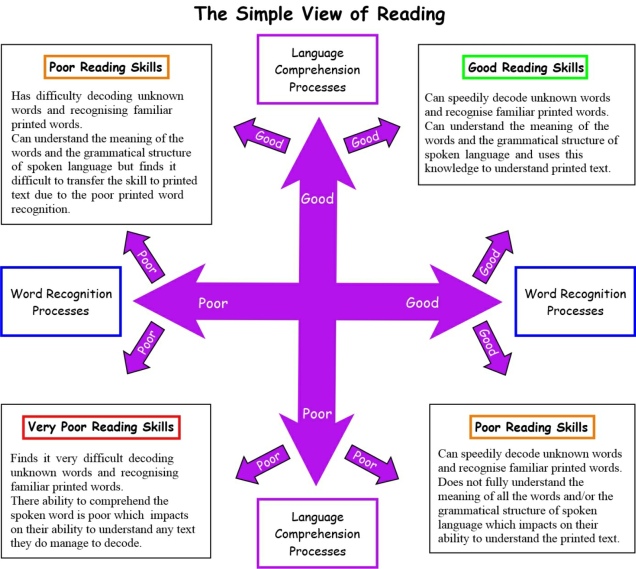
What is ‘The Simple View of Reading’?

[For a pdf copy of this diagram click here]

PDF:  https://www.teachphonics.co.uk/assets/pdfs/the-simple-view-of-reading.pdf

The term ‘Simple View of Reading’ used by schools may seem strange as there is nothing simple about learning to read.

‘The Simple View of Reading’ was adopted by the Government in 2007 and now underpins the English National Curriculum’s programmes of study for reading at Key Stage 1 and 2.

Even though reading, the ability to decode the word and extract the correct meaning of the words, is a complex set of skills; ‘the Simple View of Reading’ conceptual framework (Stuart et al. 2008, cited Hoover and Gough, 1986) reduces it down to two key components:

  • Word recognition – the ability to decode unknown words and recognise printed words.
  • Language comprehension – the ability to understand the spoken words and use this process to understand the written text.
Reading Comprehension = Decoding x Linguistic Comprehension

So in theory a child’s reading comprehension ability can be predicted by looking at their decoding and linguistic (spoken language) comprehension abilities (Johnston & Watson, 2007).

When using ‘the Simple View of Reading’ as the basis for teaching reading it becomes clearer as to why:

  • A high quality phonics scheme is required, which  the Rose Report (2006) explains ‘…is not a  ‘strategy’ so much as a body of knowledge, skills and understanding that has to be learned.’ (page 20) [This teaches children how to decode.]
  • A language rich environment to develop and encourage linguistic comprehension is vital.

Bibliography

Johnston.R. and Watson.J. ‘Teaching Synthetic Phonics’, 2007, Pub: Learning Matters, Sage Publication Ltd.

Rose.J. ’Independent review of the teaching of early reading: final report March 2006’ Pub: DfES Publications

The simple view of reading and evidence based practice’ Rhona Stainthorp Institute of Education, Reading University, Morag Stuart, Institute of Education, University of London (2008) Pdf downloaded from internet

Back to School – Ways to Support Your Child’s Phonics Knowledge

After such a long break from school it is good to take some time to check your child has not slipped back.

Playing some simple letter name and sound games can really help get your child (and you) back into school mode.

Some simple game ideas:

  • You can use words in books, cards, on labels or signs when out and about.  Ask your child to point to a particular letter in the word using the letter name. Then ask your child to say the word, or you can say it. Then ask them to tell you what sound the letter is making in that word.
  • Pick a card at random, using lower-case and capital letter flash cards (you can make your own); show your child and ask them to tell you the name of the letter on the card, and to give you a sound the letter makes. Ask older children to give you the other sounds the letter can make. For older children you can also use cards that have common digraphs (two letters representing one sound) and trigraphs (three letters representing one sound) on.
  • Play Pelmanism (Memory Game). How to Play:
    • You will need two sets of flash cards. The cards are thoroughly mixed and spread face down on the table or floor. They can be arranged in a regular pattern or randomly, but they must not overlap.
    • One player turns over a card, leaving it in the same place, they say what it is (letter name and/or sound) and then turn over another saying what it is. If the two cards match then the player keeps them and has another go. If the cards do not match then the cards are turned back over in the same location as before and it is the next players turn.
    • The game is finished when all the cards have been matched and the winner is the one with the most pairs.

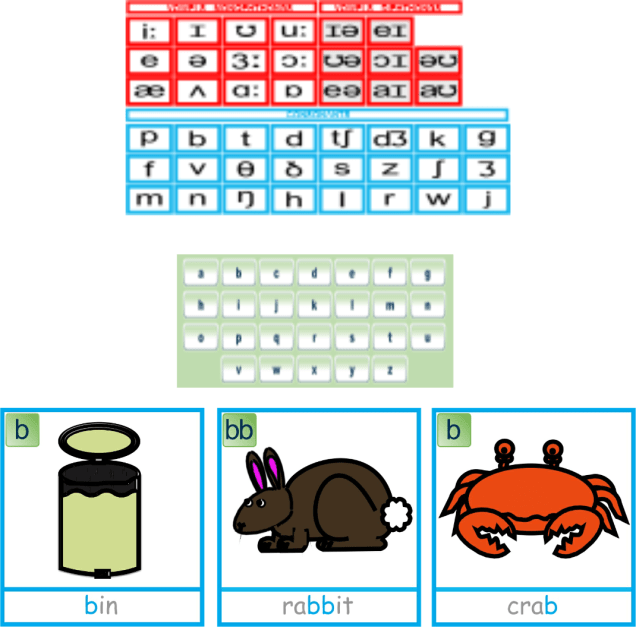
If you are not sure of all the sounds a letter, or combination of letters, can represent then use our Alphabet Keyboard to help you find the sounds (phonemes):  https://www.teachphonics.co.uk/phonics-alphabet-chart.html

Why do we ask children to ‘read out aloud’?

Reading is the ability to first decode the letter sequence of the word (phonics) and then to place meaning to it in relation to the context in which it is being used.

Unfortunately, many children just decode, speak and do not actively listen to what they have said, so they do not gain meaning from the words they are reading (poor reading comprehension skills).

We ask children who are learning to read to ‘read out aloud’, but forget to tell them why. It is not just so we can hear they have decoded a word correctly. The important point is to encourage them to actively listen to what they are saying. The idea is that if they hear the words they will, if it is part of their vocabulary, understand their meaning and therefore fully comprehend the text they have read.

Poor reading comprehension skills may also occur because a child has a limited vocabulary usage and/or understanding. A language rich environment is vital to help support and develop a child’s vocabulary and linguistic comprehension, which in turn, will support their reading comprehension skills.

Homonyms & Homophones!

Homonyms and homophones need to be heard or read within a specific context if we are to understand what the word means, for instance, if I say the word ‘bank’ and do not give any other verbal or written clues what do I mean?

The word on its own could mean a couple of things the bank of a river or sand bank or a bank where I can collect money. If it is not put into a context its meaning is unclear. The word ‘bank’ is classed as a homonym.

Homonyms are words which are pronounced and spelt the same; therefore, their meaning can only be truly understood when the context in which the word is being used is made clear. For instance, the word ‘bark’ can be used to mean the bark on a tree or the noise a dog makes.

Homophones are words which are pronounced (sound) the same but have a different meaning and are spelt differently such as, ‘their’ and ‘there’, ‘one’ and ‘won’ or ‘two’, ‘to’ and ‘too’.

Phonics Skills – Phonological Awareness: Stage 9 & 10 – (4 years – 7+ years)

Phonics is learning the relationship between the individual sounds (phonemes) of our language and the way we represent them in writing through letters (graphemes).

Stage 9 – Phonetic reading

With the introduction of phonics into the National Curriculum children are being taught to read by using their phonics knowledge as a decoding tool to work out what words are. First, they have to recognize the letters and combinations, then attach associated sounds (phonemes) to them and finally blend the sounds together to form the word.

Children are not encouraged to focus on anything else, such as pictures or context, just the phonics element of the text. For phonics teaching schemes that haven’t taught a comprehensive range of letter to sound associations, phonics at an early stage is not sufficient and children also need to learn to recognize whole words which are not spelt phonetically, the tricky words (sight words) such as: was, want, because and like.

To emphasize this point; The National Curriculum for Year 1 Reading, as part of the statutory requirements, states that children should be taught to:

“read aloud accurately books that are consistent with their developing phonic knowledge and that do not require them to use other strategies to work out words” (DfE Sept 2014).

Stage 10 – Phonetic spelling

It is generally accepted that using phonics for spelling develops at a slower rate than that for reading; due to the child having to learn how to form the letters (handwriting) rather than just recognizing the visual association between the sounds and corresponding letters.

Children are taught to use their phonics knowledge as an encoding tool for spelling, first identifying the individual sounds (phonemes) in the word, then attaching associated letters for those phonemes and finally writing the letters and self-checking the spelling using their phonetic reading skills.

It is important that children understand, and can easily use, the letter names of the alphabet and not just make a certain sound associated to the letter. Using the letter name is the only way to distinguish between alternative spellings of the same sound. For example, ‘ph’ in the word ‘photo’ cannot be spelt out phonetically, you have to use the letter names otherwise children will spell it ‘foto’. A similar, more common, tricky spelling is the word ‘what’; you have to use the letter names to explain this spelling otherwise a child will spell it ‘wot’.

“Tricky” words

Because many phonics schemes do not teach the letter associations required for children to decode / encode high frequency words phonetically, such as: was, they, my, are. These are taught by rote.

Phonics Skills – Phonological Awareness: Stage 8 – (4 years – 7+ years)

Phonics is learning the relationship between the individual sounds (phonemes) of our language and the way we represent them in writing through letters (graphemes).

The phonics stage in phonological awareness development is being introduced to our children at a much younger age, it used to be the second term of reception class, but phonic schemes in the UK have moved to starting in the first term of Reception. This is regardless of the child’s actual phonological ability levels.

For us, as adults, this can seem a little daunting as most of us were not brought up with phonics as the main strategy for learning to read or spell.

For a child who has developed through all the pre-phonic stages 1 to 7 for good phonological awareness the phonics stage is a natural progression, allowing them to use all the segmentation, blending, substitution and deletion skills previously learnt.

It is important that your child understands that letters have names; just like they do, and just like them they make different sounds. Knowing the letter names allows them to understand which letter you are talking about when discussing letters and sounds as the letter name is the unique characteristic of the letter – as it can make more than one sound. A classic example is the word ‘was’, if spelt phonetically it would be ‘woz’.

Your child should already have been taught the names (not sounds) of the letters of the alphabet, this is an early years requirement. Sadly, some feel that if a child can recite the alphabet song, they know the names of the letters, this I just not true!

Understanding letter names is important in the teaching of phonics as children need to develop an understanding that a letter can make different sounds depending on the location and pairing with other letters.

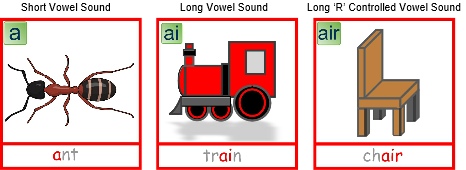
For example, the letter ‘a’ can make a number of different sounds on its own depending on the word it is in: ant, baby, swan and with other letters as in words like day, train and car.

Phonics programs tend to teach:

The use of phonic skills to blend and segment the written forms of words (CVC words) starting with one sound – one letter correspondence such as sat, pat and dog.

Develop understanding that one sound consonant can be represented by two letters (digraph) such as ‘ch’ in ‘chip’ or ‘sh’ in ‘shop’.

Develop understanding that one vowel sound can be represented by two letters (vowel digraph) such as ‘ea’ in ‘head’, ‘ai’ in ‘rain’.

Develop understanding that some sounds are represented by 3 or 4 letter combinations such as ‘igh’ in ‘light’ and ‘eigh’ in ‘eight’.

Identifying the initial, end and medial sounds and their corresponding letter(s).

However, many phonics schemes teach high frequency words by rote as they do not teach the letter associations required for children to decode / encode them phonetically. Word such as: is, the, was, what, and any.

Half-term Fun – Clothes Peg Games

Some fun indoor activities may be the order of the day for this half term as the weather is not so hot.

This is a very simple idea which children love because they can take greater ownership of it. The aim of the activity is to help build up hand and finger strength through using the pegs; however, it can have a dual purpose, helping to keep track of the week by using it as a timetable or for learning spellings or maths activities, as well as supporting the development of language skills.

You do not need anything fancy, just some string (for the washing line), clothes pegs and pieces of paper or card to peg onto the washing line. The washing line can be a permanent fixture or you can just pop it up when you need to use it.

The clothes line needs to be at a height suitable for your child to peg things on to (placed against a wall is a safe option so that no-one can walk into it by accident and hurt themselves).

There are a whole range of games that can be played using this simple washing line and pegs concept:

Memory games – Get your child to peg up 5 to 10 different pictures or items on the line. Then give them 1 minute to remember the items. Once the time is up ask them to look away, or close their eyes, and then you remove one or more of the items. Get them to look back at the line. Can they work out what is missing?

  • You could try just moving one or two of the items around. Can they figure out which ones are in the wrong place and put them back in their correct place?
  • Try swapping an item for something new, which your child did not hang up on the line. Can they work out which is the new item on the line?

Odd One Out – Hang pictures on the line that belong together. Can they pick out the odd item on the line and explain why it is the odd one out.

  • They could all be pictures of fruit with a picture of some clothing
  • They could be shapes with straight sides and one with curves
  • They could all be animals but all are wild with only one being domestic

Sorting – Ask your child to sort all the pictures or items from a selection and to hang all the identical things on the washing line. They could all be the same;

  • Colour
  • Shape
  • Type

Pattern Work – Using pictures, different colour and shaped paper or items create different patterns. The patterns can be based on colour, size or type of object. You can create a pattern sequence on the washing line and then ask your child to try and copy the sequence. Can they explain the pattern and create their own for you to copy and explain?

Pairing or What is the Same? – Hang a range of pictures or items on the line, making sure that some of the items can be paired together because they are exactly the same. They could match because;

  • They are exactly the same e.g., a pair of socks
  • Match numbers to a picture with the same number of items on
  • Match capital to lower-case letters
  • Or have items that can be put together because they are both from the same set, for example they are types of fruit or are the same colour.

Pre-phonics Skills – Phonological Awareness: Stage 4 – (3 years – 5 years)

Phonological awareness relates to our sensitivity and understanding of the sound structures of our oral language. It enables us to progress from our awareness of large sound units (words in sentences) to smaller sound units (phonemes in words). It also incorporates the ways in which we communicate through speech, body language and written forms.

As your child interacts more with the world and those around them so their language and communications skills increase and the “Why?” stage is upon you. Yes! It can drive you insane at times but their brains are like a sponge, absorbing all sorts of information.

It is at this stage that your child can easily misunderstand your explanations and develop misconceptions as they try to find reasons and meanings for themselves. So, it can be useful to talk through some things again later, to check what they have understood or think about something. A good way of doing this is to ask them to tell someone else who was not there, perhaps Dad or an older brother/sister for instance. This way you can help them to develop a better understanding of the meaning of the word or concept. You can also broaden their experiences, on which to draw understanding, by setting up play scenarios or other activities.

Syllables

At about 4 years old your child is starting to split words into syllables, this allows them to break down words into manageable sound lengths. A syllable is the largest phonological unit (one or a group of sounds) of a word and is like the rhythmic beat of the word.

Your child is starting to refine their sound unit detection skills, moving them on from the previous stage of hearing and detecting articulatory gestures or features in rhymes, to recognizing them in syllables. They start to hear these sound units in different parts of a word, not just as the final sound unit of a word.

Spoken syllables are organized around the vowel sounds, making counting them easy, as the jaw drops when the vowel sound is spoken in the syllable. Try placing your hand under your jaw with your mouth closed before you say a word. Start with ‘cat’; you will notice the jaw drops once; this is because it is a one syllable (monosyllabic) word. Now try the same thing with the word ‘sunset’; your jaw drops twice as this is a two syllable (disyllabic) word, then try saying ‘important’; your jaw drops three times as this is a three syllable word (trisyllabic). Words that have more than three syllables such as hippopotamus are called polysyllabic words.

Most children will find it easier to identify syllables in compound words to start with. A compound word is formed by two words (root words) put together such as: sunset, hotdog, snowman and postman. They find it easier because the jaw tends to drop quite distinctly as we say the vowel sound in each of the root words and the slow speed at which we tend to say the word.

Children love to clap out the number of syllables in a word. It is important to say the word at a normal speed rather than really slowly as this can distort the word and make it difficult to hear the syllables. To start with your child does not need to be able to count the number of syllables in a word but just be able to recognize them by clapping, stamping or jumping for each syllable of a word. It is thought only about 50% of children can count out the syllables by the age of 4, so you can do the counting for them.

Being able to instinctively break down words into their syllables is the next step in breaking them into smaller logical sound chunks and an important skill set needed later on when your child is developing their reading and spelling strategies.

How we identify syllables in speech is slightly different from how we use syllables to de-code for reading and as a spelling strategy, but we need to talk and hear it first before moving to the written form.

Letter & Sound Relationships That Break the #Phonics Rules

Back in September we explained that Phonics is very useful as a decoding tool used for developing reading skills and an encoding tool for spelling. It is the simple process of linking sounds to letters, its complexity comes from how many sounds (phonemes) to letter combinations (graphemes) there are.

Some letter and sound associations just don’t follow the normal phonics rule of a single sound being associated to a letter or letter combination. A few letters represent two sounds, such as the letter ‘u’ which in the word ‘cupid’ represents the two sounds /y,(j)/ and /oo,(uː)/.

A more common one letter two sound relation is that of the letter ‘x’ representing the two sounds /k,(k)/ and /s,(s)/ as in thewords: six and box.

Here are some other examples of single letters and split digraphs making two sounds instead of the usual phonics rule of only making one sound: