Easter Egg Hunt

Easter egg Hunt

The Easter Holidays will soon be upon us, so here are some fun activities to keep children of all ages entertained whether we have rain or sunshine.

An Easter egg, or treasure, hunt is a great way to teach children directional and placement (prepositions) language. It is important for a child to learn directional and placement vocabulary so that they can both understand instructions given and share information themselves, such as; ‘put your cup on the table’ or to say ‘teddy in car’.

Through Easter egg, or treasure, hunts you can introduce new directional and placement language in a fun and exciting way. There are a number of different ways to approach this:

  • You can give verbal instructions to the hidden egg/treasure.
  • You could create a map for them to follow and ask them to talk you through the map, supporting them with new language as necessary.
  • You could use a mixture of verbal and map clues.
  • For older children get them to hide the egg/treasure and give you instructions, or draw a map.
  • If you have more than one egg and they are of different sizes make the larger eggs more difficult to find.

The important thing is the language shared. Words and phrases to use are: left, right, straight on, forward, backwards, about turn, turn around, up, down, higher, lower, stop, next to, in front, beside, underneath, on top of, behind, on the left of, on the right of, outside, and inside.

Easter egg, or treasure, hunts are a great whole family activity and you are never too young or too old to join in!

Syllable Awareness & Counting

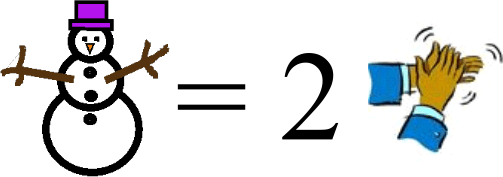
Syllables snowman

At about the age of 4 years old children start to develop an understanding that words can be split into parts (syllables) and that these parts give the word its rhythm.  A syllable is the largest phonological unit (one or a group of sounds) of a word and is like the rhythmic beat of the word.

They should be able to orally blend syllables together to form words and segment words into syllables.

A fun activity to help develop syllable understanding:

How Many Syllables?     

Children love to clap out the number of syllables in a word. It is important to say the word at a normal speed rather than really slowly as this can distort the word and make it difficult to hear the syllables. To start with your child just needs to be able to recognize them by clapping, stamping or jumping for each syllable of a word; they don’t need to be able to count them. It is thought that only about 50% of children can count out the syllables by the age of 4, so you can do the counting for them.

Spoken syllables are organised around the vowel sounds, making counting them easy; as the jaw drops when the vowel sound is spoken in the syllable. Try placing your hand under your jaw with your mouth closed before you say a word. Start with ‘cat’ you will notice the jaw drops once, this is because it is a one syllable (monosyllabic) word.

Most children will find it easier to identify syllables in compound words to start with. A compound word is formed by two words (root words) put together such as: sunset, hotbed, snowman and postman. They find it easier because the jaw tends to drop quite distinctly. As we say the vowel sound in each of the root words and because we tend to say these words slowly.

Word Play – Rhyme & Alliteration

Nursery Rhymes

Rhyme awareness and the enjoyment of alliteration begins early, usually between the ages of 2 and 3 years old (Stage 3 of phonological awareness). This develops in to an important tool, supporting a child in developing an understanding of how words are formed and the sound patterns within them. These are important pre-phonics skills a child needs to develop to support their future ability to succeed with phonics, reading and writing.

This Rhyme awareness is supported and developed through the singing of songs and nursery rhymes and finger chants. Alliteration (words that begin with the same sounds) such as ‘Sammy snake slithers silently’, which children love to hear in rhymes and stories, also supports their word knowledge and understanding of sounds in words.

Being able to repeat, and join in with, short phrases they have anticipated in a story or rhyme, is another important step in a child beginning to understand the use of words in stories and story structure; such as, “I’ll huff and puff and blow your house down!” in the story of The Three Little Pigs.

For more information on this, and other pre-phonics skills (Phonological Awareness) your child develops through from birth to 7 +years old, check out the Pre-phonics section of our website: bit.ly/1KRi6YX

The Five Common Stages of Play Development

Kids Playing

Last week we discussed the five types of play necessary to support your children’s physical, intellectual, social and emotional growth and well-being. Here we explain the five common stages of play so that you can better understand your child’s play development and how best to support them through play.

The Five Common Stages of Play:

Watching – A child watches what others are doing but does not join in, they are purely an onlooker.

Solitary Play – They play on their own without regard, or need for others, and enjoy independent activities that do not require others to participate.

Parallel Play– This is when they play near others but do not interact with them, even if they are using the same play materials.

Associative Play – When children play in small groups with no defined rules or assigned roles.

Co-operative Play – Is when children work together in building projects, or pretend play, assigning roles for each member of the group.

Children are all so different and the length of time they spend at each stage varies greatly because of this; but they all find their way in time.

The physical strengths and skills developed through different play experiences build the key strengths, flexibility, co-ordination and dexterity skills that children need as they grow.  All these strengths are required to perform everyday activities such as eating, washing and getting dressed. As your child starts school these skill levels need to be supported and refined even further as they face new challenges such as learning to handwrite.

Through play children continue to develop key communication skills including turn taking. There are a whole new set of facial expressions, body language and spoken vocabulary to be learnt and understood as part of play and learning the social conventions of turn taking. For tips and ideas for developing Turn Taking skills follow this link and then click on the light bulb: bit.ly/1STTKY5

You are your child’s first, and most important, playmate. They just love it when you are silly and play games with them; become a pilot, rally car diver or fairy princess for 10 minutes. Can’t remember how? Then let your child show you!

To Play is to Learn

There has been a lot in the press recently about the changes the Government are looking to make to the Early Years curriculum, such as a greater influence on teaching phonics, reading and maths skills (Ofsted’s Bold Beginnings Report). It feels as if they are pushing quite advanced skill sets down in to the Early Years. This seems to be going against the ethos of other countries that are often quoted to us as having exemplary Early Years curriculums. These are using and developing more play structured curriculum approaches; such as Finland (children start school at 7 years old).

We are always being shown how important play is in the development of young animals’ survival and hunting skills. How many times have you thought how cute or lovely when watching kittens, puppies or polar bears playing.

Humans are also animals which thrive and develop through play; in fact play is so important the United Nations High Commission for Human Rights state it as a right for every child (Ginsburg, 2013).

Here at Teach Children we see play as a vital part of a child’s physical, emotional, social and intellectual growth and well-being.

There has been considerable research over the years on play, which supports our point of view, with the consensus being that children need to experience five different types of play. These five types of play are roughly based on the developmental opportunities they provide, especially if it is child driven rather than adult lead:

Physical Play – active exercise (running, jumping, skipping etc..), rough & tumble and fine motor skills activities to develop whole body and hand and eye co-ordination strength and endurance. The outdoor element of such play develops independence, resourcefulness and self-regulation while the fine motor skills activities support the development of concentration and perseverance.

Play with Objects – starts as soon as a child can grasp and hold an object; mouthing, biting, turning, stroking, hitting and dropping. It’s how we all learn through the exploration of our senses (sensory-motor play). This type of play develops our abilities to; physically manipulate items, think, reason and problem solve, to set challenges and goals as well as to monitor our own progress.

Symbolic Play – refers to the development of spoken language, visual symbols such as letters and numbers, music, painting, drawing and other media used for communication of thought and ideas. This type of play allows children to develop the abilities to express and reflect on experience, ideas and emotions. Sound and language play develops phonological awareness required for literacy, while number play that relates to real life situations supports numeracy skills.

Pretence/socio-dramatic Play – Pretend play provides the opportunity to develop cognitive, social, self-regulatory and academic skills. This kind of play means children have to learn and pick up on unspoken rules of interaction, taking on the role of a character and playing within the expected confines of that role.

Games with Rules – physical games such as chase, hide & seek, sport, board and computer games. Develop social skills and the emotional skills of taking turns, winning and losing as well as other people’s perspectives.

(Dr.D Whitebread, 2012)

Here are some articles from home and around the world I thought you may find interesting that support and highlight the importance of play in learning:

Bibliography

Kenneth R. Ginsburg, MD, MSEd, 25/07/2013; ‘The Importance of Play in Promoting Healthy Child Development and Maintaining Strong Parent-Child Bonds’: THE AMERICAN ACADEMY OF PEDIATRICS: http://pediatrics.aappublications.org/content/119/1/182.full

Dr.D. Whitebread, April 2012: ‘The Importance of Play’; Commissioned for the Toy Industries of Europe:  http://www.importanceofplay.eu/IMG/pdf/dr_david_whitebread_-_the_importance_of_play.pdf


Some Words Lose Their Meaning Without a Context

Some words, such as homophones and homonyms, need to be heard or read within a specific context if we are to understand what the word means.

Homonyms are words which are pronounced and spelt the same, however; their meaning can only be truly understood when the context in which the word is being used is made clear. For instance, the word ‘bark’ can be used to mean the bark on a tree or the noise a dog makes.

Homophones are words which are pronounced (sound) the same but have a different meaning and are spelt differently such as ‘pair’ and ‘pear’, ‘their’ and ‘there’ or ‘two’, ‘to’ and ‘too’.

To view more examples, follow this link:  http://bit.ly/2BcUa8N

Vocabulary Building Ideas & Activities

Word Awareness

Helping your child build their vocabulary (word awareness – receptive & expressive language) is vital if your child is to continue to develop good communication skills. Talking, explaining, sharing and playing are all important as well as making sure that you pronounce words clearly and correctly for your child to hear. Your child will not have developed all the skills needed yet to copy you accurately but they will store the sound pattern information for later use.

Click the link for ideas & activities to support your child’s vocabulary development: http://bit.ly/29LajVk

Receptive & Expressive Language

Receptive language is how we take in and understand language; it is what we hear, see and read. This also includes body language and environmental clues. All these elements help us to interpret a situation and give it its meaning, so that we can understand what is being communicated. We do not need to be able to produce language to receive and understand it, so infants and toddlers understand far more than they can express (expressive language).

Expressive language is our ability to put our thoughts, needs and wants into words and sentences in a way that makes sense and is grammatically correct. A baby’s expressive language to begin with is based on cries and gestures and then moves to sound making, gestures and body language signals. We use this expressive language when we speak and write. Even when babies and toddlers move to speaking words they have a limited vocabulary which is why they can get frustrated when we do not understand them.

The Importance of Speaking & Listening

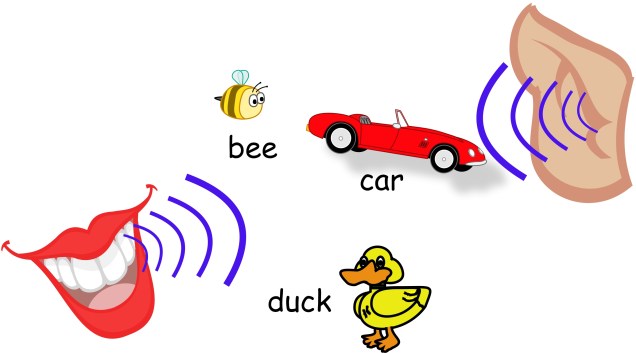
Speaking & Listening Icon 2

Phonological awareness development incorporates the understanding of, and the learning of how to, communicate through speech, body language and written forms. It relates to our sensitivity and understanding of the sound structures of our oral language. It enables us to progress from our awareness of large sound units (words in sentences) to smaller sound units (phonemes in words).

Speaking and listening skills play a vital role in helping children to develop their awareness of the sounds around them. The more they hear, the more associations they can make to those sounds (what they see, feel and experience), the greater their ability to distinguish between them.

Our tips and ideas help you to support your child’s speaking and listening skills.

https://www.teachphonics.co.uk/how-to-talk-to-your-child.html

Don’t underestimate the importance of everyday chatter or conversation (‘Small Talk), children develop and learn a great deal through ‘Small Talk’ with adults and other children.

What do we mean by ‘Small Talk’? With babies it is the kind of talk that explains what we are doing, what they are doing, where we are going and what we can see.  As they get older our verbal exchanges increase as we support their receptive and expressive vocabulary development. Through these exchanges we also support their general language development and understanding of how words are pronounced, basic sentence structure and using the correct tense.

When we talk with a child we demonstrate and model the use of language in real time so that it has meaning. For instance, a child may point and say “cat” and we would respond with “Yes, the cat is sleeping.” Or we may correct the child and say “That is a dog.” If we could we would point to a cat and explain the difference. We also correct mispronunciation of words and correct tense issues in the same way; repeating the word or sentence using the correct pronunciation or tense back to the child.

The Communication Trust has a link to a free downloadable booklet called Small Talk which is a very useful guide for understanding how your child learns to talk from birth to age 5:

https://www.thecommunicationtrust.org.uk/resources/resources/resources-for-parents/small-talk.aspx

The Skills a Child Needs to Achieve Phonics Success

Phonological Awareness Chart

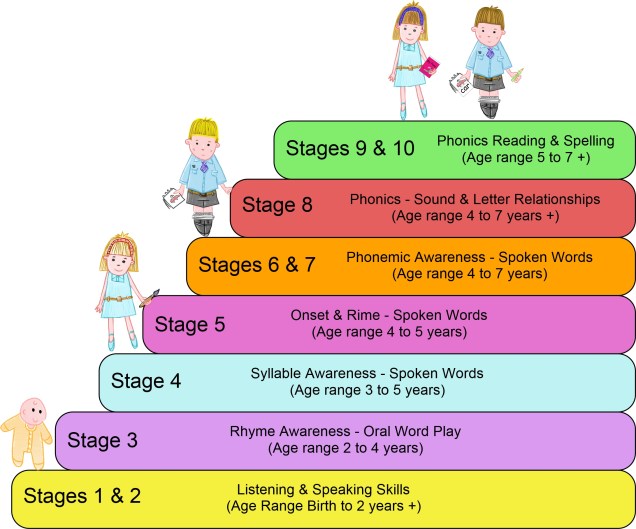
Phonics is actually stage 8 of the 10 distinct and progressive stages of in phonological awareness development.

Pre-phonics skills are those a child learns as they develop through the phonological awareness stages 1 to 7. Throughout this time they are continually developing their understanding and knowledge of our spoken language as well as other communication forms such as gestures, facial expression, body language and social conventions.

Speaking and listening skills play a vital role in helping children develop their phonics knowledge as they need to be exposed to a wide and varied vocabulary that allows them to hear and use the range of sounds that form our language.

Being exposed to a greater range of sound experiences helps children to develop their awareness of the sounds around them. The more they hear, the more associations they can make to those sounds (what they see, feel, experience), the greater their ability to distinguish between them. This skill becomes important later on as they begin to isolate individual words in sentences, being able to distinguish between words that sound similar such as dog and hog.

Through listening and speaking games and activities children are exposed to new vocabulary as well as learning to play with the sounds in their language. This helps them to remember how the sounds feel when they make them as well as how they sound in isolation and when combined with other sounds.

Scientists believe a child’s sound awareness begins before they are born; at about 24 weeks, which highlights the importance of sound awareness, including environmental and speech sounds, as part of our instinctive natural development.

The Phonological Awareness Stages on our website are set in a developmental order from one to ten. Against each stage we have provided an age range guide based on research, which shows when most children develop the various phonological awareness skills. Clicking on a stage will take you to another page which gives more in-depth information and links to tips to help you support children through the stage.

Letter & Sound Relationships That Break the Phonics Rules

Back in September we explained that Phonics is a very useful decoding tool used for developing reading skills and as an encoding tool for spelling. It is the simple process of linking sounds to letters, its complexity comes from how many sound (phonemes) to letter combinations (graphemes) there are.

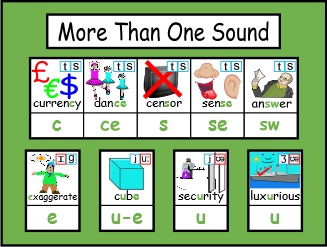
Some letter and sound associations just don’t follow the normal phonics rule of a single sound being associated to a letter or letter combination. A few letters represent two sounds, such as the letter ‘u’ which in the word ‘cupid’ represents the two sounds /y,(j)/ and /oo,(uː)/.

A more common one letter two sound relation is that of the letter ‘x’ representing the two sounds /k,(k)/ and /s,(s)/ as in the words: six and box.

Here are some other examples of single letters and split digraphs making two sounds instead of the usual phonics rule of only making one sound:

Level 1 More Than 1 soundLevel 2 More Than 1 sound