Some Words Lose Their Meaning Without a Context

Some words, such as homophones and homonyms, need to be heard or read within a specific context if we are to understand what the word means.

Homonyms are words which are pronounced and spelt the same, however; their meaning can only be truly understood when the context in which the word is being used is made clear. For instance, the word ‘bark’ can be used to mean the bark on a tree or the noise a dog makes.

Homophones are words which are pronounced (sound) the same but have a different meaning and are spelt differently such as ‘pair’ and ‘pear’, ‘their’ and ‘there’ or ‘two’, ‘to’ and ‘too’.

To view more examples, follow this link:  http://bit.ly/2BcUa8N

Vocabulary Building Ideas & Activities

Word Awareness

Helping your child build their vocabulary (word awareness – receptive & expressive language) is vital if your child is to continue to develop good communication skills. Talking, explaining, sharing and playing are all important as well as making sure that you pronounce words clearly and correctly for your child to hear. Your child will not have developed all the skills needed yet to copy you accurately but they will store the sound pattern information for later use.

Click the link for ideas & activities to support your child’s vocabulary development: http://bit.ly/29LajVk

Receptive & Expressive Language

Receptive language is how we take in and understand language; it is what we hear, see and read. This also includes body language and environmental clues. All these elements help us to interpret a situation and give it its meaning, so that we can understand what is being communicated. We do not need to be able to produce language to receive and understand it, so infants and toddlers understand far more than they can express (expressive language).

Expressive language is our ability to put our thoughts, needs and wants into words and sentences in a way that makes sense and is grammatically correct. A baby’s expressive language to begin with is based on cries and gestures and then moves to sound making, gestures and body language signals. We use this expressive language when we speak and write. Even when babies and toddlers move to speaking words they have a limited vocabulary which is why they can get frustrated when we do not understand them.

The Importance of Speaking & Listening

Speaking & Listening Icon 2

Phonological awareness development incorporates the understanding of, and the learning of how to, communicate through speech, body language and written forms. It relates to our sensitivity and understanding of the sound structures of our oral language. It enables us to progress from our awareness of large sound units (words in sentences) to smaller sound units (phonemes in words).

Speaking and listening skills play a vital role in helping children to develop their awareness of the sounds around them. The more they hear, the more associations they can make to those sounds (what they see, feel and experience), the greater their ability to distinguish between them.

Our tips and ideas help you to support your child’s speaking and listening skills.

https://www.teachphonics.co.uk/how-to-talk-to-your-child.html

Don’t underestimate the importance of everyday chatter or conversation (‘Small Talk), children develop and learn a great deal through ‘Small Talk’ with adults and other children.

What do we mean by ‘Small Talk’? With babies it is the kind of talk that explains what we are doing, what they are doing, where we are going and what we can see.  As they get older our verbal exchanges increase as we support their receptive and expressive vocabulary development. Through these exchanges we also support their general language development and understanding of how words are pronounced, basic sentence structure and using the correct tense.

When we talk with a child we demonstrate and model the use of language in real time so that it has meaning. For instance, a child may point and say “cat” and we would respond with “Yes, the cat is sleeping.” Or we may correct the child and say “That is a dog.” If we could we would point to a cat and explain the difference. We also correct mispronunciation of words and correct tense issues in the same way; repeating the word or sentence using the correct pronunciation or tense back to the child.

The Communication Trust has a link to a free downloadable booklet called Small Talk which is a very useful guide for understanding how your child learns to talk from birth to age 5:

https://www.thecommunicationtrust.org.uk/resources/resources/resources-for-parents/small-talk.aspx

The Skills a Child Needs to Achieve Phonics Success

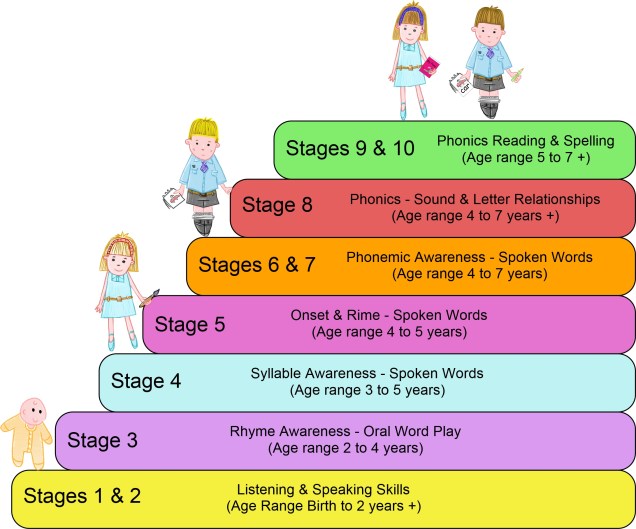
Phonological Awareness Chart

Phonics is actually stage 8 of the 10 distinct and progressive stages of in phonological awareness development.

Pre-phonics skills are those a child learns as they develop through the phonological awareness stages 1 to 7. Throughout this time they are continually developing their understanding and knowledge of our spoken language as well as other communication forms such as gestures, facial expression, body language and social conventions.

Speaking and listening skills play a vital role in helping children develop their phonics knowledge as they need to be exposed to a wide and varied vocabulary that allows them to hear and use the range of sounds that form our language.

Being exposed to a greater range of sound experiences helps children to develop their awareness of the sounds around them. The more they hear, the more associations they can make to those sounds (what they see, feel, experience), the greater their ability to distinguish between them. This skill becomes important later on as they begin to isolate individual words in sentences, being able to distinguish between words that sound similar such as dog and hog.

Through listening and speaking games and activities children are exposed to new vocabulary as well as learning to play with the sounds in their language. This helps them to remember how the sounds feel when they make them as well as how they sound in isolation and when combined with other sounds.

Scientists believe a child’s sound awareness begins before they are born; at about 24 weeks, which highlights the importance of sound awareness, including environmental and speech sounds, as part of our instinctive natural development.

The Phonological Awareness Stages on our website are set in a developmental order from one to ten. Against each stage we have provided an age range guide based on research, which shows when most children develop the various phonological awareness skills. Clicking on a stage will take you to another page which gives more in-depth information and links to tips to help you support children through the stage.

The Simple View of Reading

The term ‘Simple View of Reading’ used by schools may seem strange as there is nothing simple about learning to read.

The Simple View of Reading was adopted by the Government in 2007 and now underpins the English National Curriculum’s programmes of study for reading at Key Stage 1 and 2.

Even though reading, the ability to decode the word and extract the correct meaning of the words, is a complex set of skills; the Simple View of Reading conceptual framework (Stuart et al. 2008, cited Hoover and Gough, 1986) reduces it down to two key components:

  • Word recognition – the ability to decode unknown words and recognise printed words.
  • Language comprehension – the ability to understand the spoken words and use this process to understand the written text.
Reading Comprehension = Decoding x Linguistic Comprehension

So in theory a child’s reading comprehension ability can be predicted by looking at their decoding and linguistic (spoken language) comprehension abilities (Johnston & Watson, 2007).

When using the Simple View of Reading as the basis for teaching reading it becomes clearer as to why:

  • A high quality phonics scheme is required, which the Rose Report (2006) explains ‘…is not a  ‘strategy’ so much as a body of knowledge, skills and understanding that has to be learned.’ (page 20) [This teaches children how to decode.]
  • A language rich environment to develop and encourage linguistic comprehension is vital.

The simple view of Reading diagram

[For a pdf copy of this diagram click here]

Bibliography

Johnston.R. and Watson.J. ‘Teaching Synthetic Phonics’, 2007, Pub: Learning Matters, Sage Publication Ltd.

Rose.J. ’Independent review of the teaching of early reading: final report March 2006’ Pub: DfES Publications

The simple view of reading and evidence based practice’  Rhona Stainthorp Institute of Education, Reading University, Morag Stuart, Institute of Education, University of London (2008) Pdf downloaded from internet

The Sounds of Bonfire Night

Firework 2

Bonfire night, for many children, can be a very exciting and stimulating time but describing the event is not always as easy.

So this week we have come up with a list of words (onomatopoeic) that imitate the sounds heard on bonfire night, so that you can support your child in giving a more interesting description of the night events: bang, pop, whizz, whoosh, whistle, crackle, snap, sizzle, buzz, hiss, screech, scream, squeal, boom, fizz, roar, whoop, argh, ooh, whine, fizzle.

For a fun activity link this with our firework pre-handwriting pattern picture which you can find on this week’s Teach Handwriting Blog.

Have Fun!