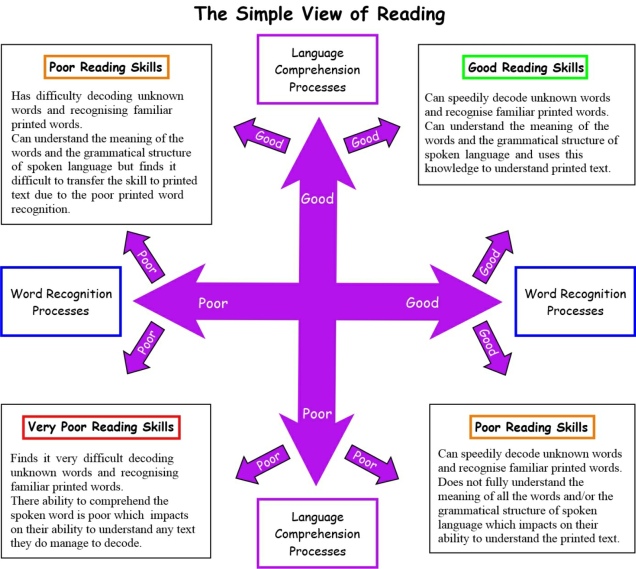
What is ‘The Simple View of Reading’?

[For a pdf copy of this diagram click here]

PDF:  https://www.teachphonics.co.uk/assets/pdfs/the-simple-view-of-reading.pdf

The term ‘Simple View of Reading’ used by schools may seem strange as there is nothing simple about learning to read.

‘The Simple View of Reading’ was adopted by the Government in 2007 and now underpins the English National Curriculum’s programmes of study for reading at Key Stage 1 and 2.

Even though reading, the ability to decode the word and extract the correct meaning of the words, is a complex set of skills; ‘the Simple View of Reading’ conceptual framework (Stuart et al. 2008, cited Hoover and Gough, 1986) reduces it down to two key components:

  • Word recognition – the ability to decode unknown words and recognise printed words.
  • Language comprehension – the ability to understand the spoken words and use this process to understand the written text.
Reading Comprehension = Decoding x Linguistic Comprehension

So in theory a child’s reading comprehension ability can be predicted by looking at their decoding and linguistic (spoken language) comprehension abilities (Johnston & Watson, 2007).

When using ‘the Simple View of Reading’ as the basis for teaching reading it becomes clearer as to why:

  • A high quality phonics scheme is required, which  the Rose Report (2006) explains ‘…is not a  ‘strategy’ so much as a body of knowledge, skills and understanding that has to be learned.’ (page 20) [This teaches children how to decode.]
  • A language rich environment to develop and encourage linguistic comprehension is vital.

Bibliography

Johnston.R. and Watson.J. ‘Teaching Synthetic Phonics’, 2007, Pub: Learning Matters, Sage Publication Ltd.

Rose.J. ’Independent review of the teaching of early reading: final report March 2006’ Pub: DfES Publications

The simple view of reading and evidence based practice’ Rhona Stainthorp Institute of Education, Reading University, Morag Stuart, Institute of Education, University of London (2008) Pdf downloaded from internet
Phonics Skills – Phonological Awareness: Stage 9 & 10 – (4 years – 7+ years)

Phonics is learning the relationship between the individual sounds (phonemes) of our language and the way we represent them in writing through letters (graphemes).

Stage 9 – Phonetic reading

With the introduction of phonics into the National Curriculum children are being taught to read by using their phonics knowledge as a decoding tool to work out what words are. First, they have to recognize the letters and combinations, then attach associated sounds (phonemes) to them and finally blend the sounds together to form the word.

Children are not encouraged to focus on anything else, such as pictures or context, just the phonics element of the text. For phonics teaching schemes that haven’t taught a comprehensive range of letter to sound associations, phonics at an early stage is not sufficient and children also need to learn to recognize whole words which are not spelt phonetically, the tricky words (sight words) such as: was, want, because and like.

To emphasize this point; The National Curriculum for Year 1 Reading, as part of the statutory requirements, states that children should be taught to:

“read aloud accurately books that are consistent with their developing phonic knowledge and that do not require them to use other strategies to work out words” (DfE Sept 2014).

Stage 10 – Phonetic spelling

It is generally accepted that using phonics for spelling develops at a slower rate than that for reading; due to the child having to learn how to form the letters (handwriting) rather than just recognizing the visual association between the sounds and corresponding letters.

Children are taught to use their phonics knowledge as an encoding tool for spelling, first identifying the individual sounds (phonemes) in the word, then attaching associated letters for those phonemes and finally writing the letters and self-checking the spelling using their phonetic reading skills.

It is important that children understand, and can easily use, the letter names of the alphabet and not just make a certain sound associated to the letter. Using the letter name is the only way to distinguish between alternative spellings of the same sound. For example, ‘ph’ in the word ‘photo’ cannot be spelt out phonetically, you have to use the letter names otherwise children will spell it ‘foto’. A similar, more common, tricky spelling is the word ‘what’; you have to use the letter names to explain this spelling otherwise a child will spell it ‘wot’.

“Tricky” words

Because many phonics schemes do not teach the letter associations required for children to decode / encode high frequency words phonetically, such as: was, they, my, are. These are taught by rote.

Are your child’s #phonics skills good for their age?

With more and more expected of our pre-school and 4 to 7 year old children it can be difficult to know what the realistic age appropriate skills are in relation to phonics.

In fact, phonics is only part of the story starting at stage 8 of a child’s phonological awareness development.

Stages 1 to 7 of a child’s phonological awareness, what we refer to as pre-phonics skills, are the continual development of their understanding and knowledge of our spoken language as well as other communication forms, such as gestures, facial expressions, body language and social conventions.

Stages 8 to 10 of a child’s phonological awareness, the phonics reading and writing stages are the continual development of their understanding and knowledge for learning to reading and write.

As a child’s phonological awareness skills build on each stage, the age at which a child reaches them varies making it difficult to know how your child is doing.

We recognise this variation and use age ranges as a rough guide to help you understand where your child is in their phonological awareness skills.

By clicking on the various stages of phonological awareness you will find appropriate age range information, advice and activities to support your child. Try not to jump a stage as each one is important in unlocking the knowledge and skills for the stage above.

Stages 1 to 7 (Pre-phonics skills): https://www.teachphonics.co.uk/phonological-development.html

Stages 8 to 10 (Phonics): https://www.teachphonics.co.uk/phonological-development-phonics.html