Art Activities to support the Understanding of Pressure – Half Term Fun

Crayoning and printing activities are great ways for a child to experience and experiment with pressure and the amount needed to create different effects. These activities will also encourage and support a child in helping them to understand, and for you to model, the language associated with pressure and how the pressure used feels. By linking the words used to the feelings and the outcome of using the pressure they can start to understand what is needed when asked to press gently or to press harder. 

When supporting a child to understand what we want when we ask them to press harder, we need to model how our body reacts to make this happen. You may need to exaggerate the actions but as you do this you also need to talk about what your body is doing and how it feels. Then point out the effect that this has had on the crayoning for instance.

When we press hard, we tend to lean our body forward over the table slightly as this allows us to put more force down on to the paper through the crayon. We may feel our arm and hand tense and often the movements made are slower and in small strokes. If it is something we are not used to doing it can make our hand and fingers ache and it will feel like hard work. The crayon marks will be thick and dark.

When we want to be gentler with the crayon, so that the crayoning is lighter in texture and colour, we tend to sit back away from the table. This way the hand moves across the paper more easily and often the strokes are longer and quicker, which sometimes feels as if we have less control over the colouring. This is why young children tend to be a bit heavy handed initially with colouring because their fine motor control skills have not reached a point that enables them to have control.

There are many creative ideas to be found on the internet and in books published by companies such as Usborne.

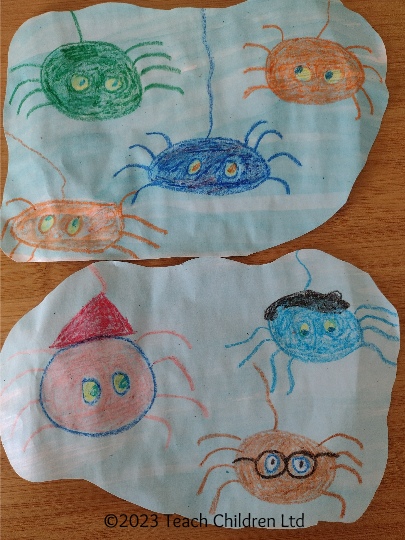
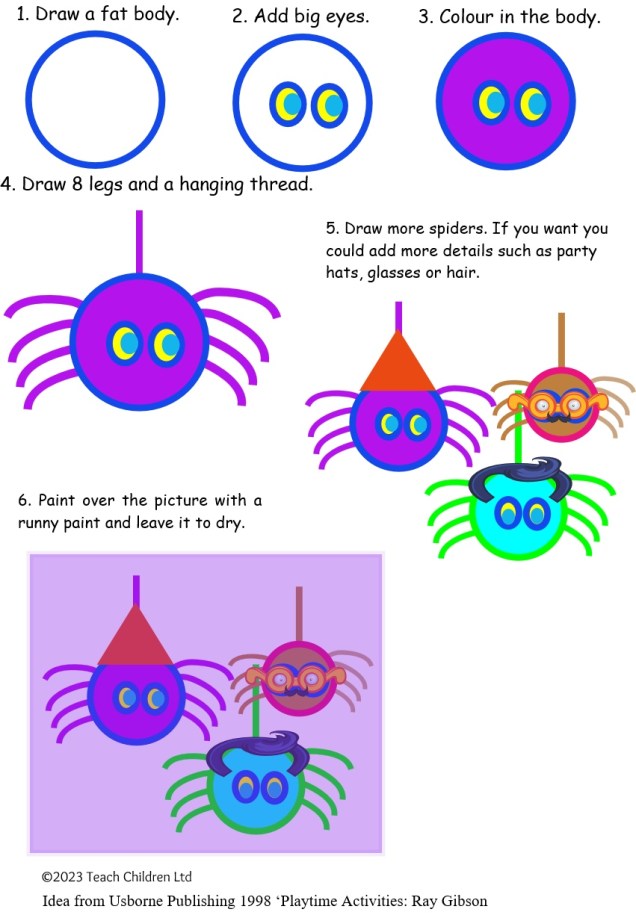
This crayon technique can be used to create a vast range of pictures. Here are just a couple of ideas to get you started: Spider Party Time:
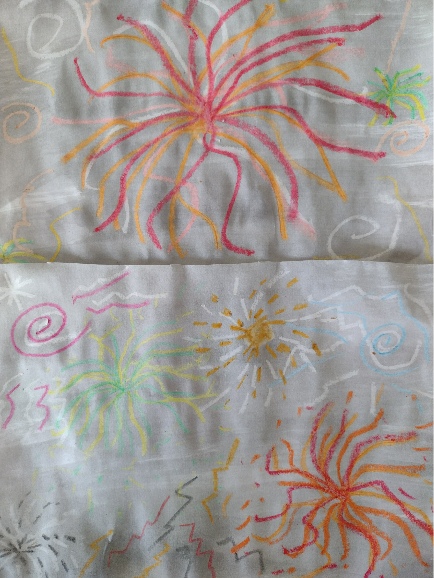
The same technique can also be used to create great firework pictures:
It is also worth remembering that drawing also helps to develop a range of different line formations, also needed for developing a good handwriting style.

Have FUN!
Different Types of Play and their Importance

We are always being shown how important play is in the development of young animals’ survival and hunting skills. How many times have you thought how cute or lovely when watching kittens, puppies or polar bears playing?

Humans are also animals which thrive and develop through play; in fact, play is so important the United Nations High Commission for Human Rights state it as a right for every child (Ginsburg, 2013).

We often think of play as a frivolous pastime rather than a practical and meaningful one. However, here at Teach Children we see play as a vital part of a child’s physical, emotional, social and intellectual growth and well-being.

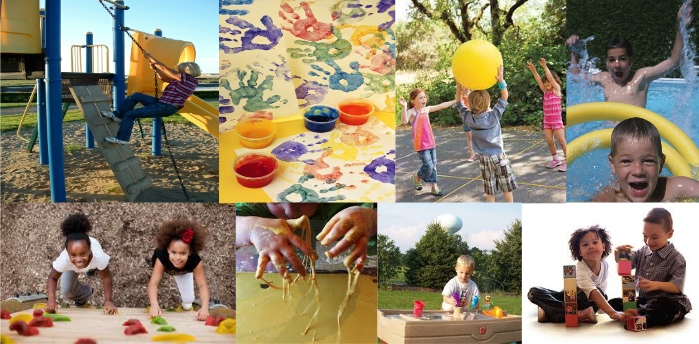
There has been considerable research over the years on play, which supports our point of view, with the consensus being that children need to experience five different types of play (Dr.D Whitebread, 2012). These five types of play are roughly based on the developmental opportunities they provide, especially if it is child driven rather than adult lead:

Physical Play – active exercise (running, jumping, skipping etc..), rough & tumble and fine motor skills activities to develop whole body and hand and eye co-ordination strength and endurance. The outdoor element of such play develops independence, resourcefulness and self-regulation while the fine motor skills activities support the development of concentration and perseverance.

Play with Objects – starts as soon as a child can grasp and hold an object; mouthing, biting, turning, stroking, hitting and dropping. It’s how we all learn through the exploration of our senses (sensory-motor play). This type of play develops our abilities to; physically manipulate items, think, reason and problem solve, to set challenges and goals as well as to monitor our own progress.

Symbolic Play – refers to the development of spoken language, visual symbols such as letters and numbers, music, painting, drawing and other media used for communication of thought and ideas. This type of play allows children to develop the abilities to express and reflect on experiences, ideas and emotions. Sound and language play develops phonological awareness required for literacy, while number play that relates to real life situations supports numeracy skills.

Pretence/socio-dramatic Play – Pretend play provides the opportunity to develop cognitive, social, self-regulatory and academic skills. This kind of play means children have to learn and pick up on unspoken rules of interaction, taking on the role of a character and playing within the expected confines of that role.

Games with Rules – physical games such as chase, hide & seek, sport, board and computer games. Develop social skills and the emotional skills of taking turns, winning and losing as well as other people’s perspectives.

                                                             So, to play is to learn!

Bibliography

Kenneth R. Ginsburg, MD, MSEd, 25/07/2013; ‘The Importance of Play in Promoting Healthy Child Development and Maintaining Strong Parent-Child Bonds’: THE AMERICAN ACADEMY OF PEDIATRICS: http://pediatrics.aappublications.org/content/119/1/182.full

Dr.D. Whitebread, April 2012: ‘The Importance of Play’; Commissioned for the Toy Industries of Europe:  http://www.importanceofplay.eu/IMG/pdf/dr_david_whitebread_-_the_importance_of_play.pdf                            

Developing and Supporting Your Child’s Reading Journey – Week 1

How to Develop a Child’s Interest in Books and Reading

Research suggests that children who enjoy books are more likely to want to learn to read and will keep trying even when they find it hard. Therefore, it is important to keep their interaction around books a positive one.

Through Play

Books come in all shapes and sizes and are made from various materials.

  • Have a few bath books. even if most of the time your baby or toddler just chews on them, they will be handling a book and possibly turning the pages. Giving you the opportunity to talk about the pictures with them.
  • Try to have a range of cloth, hard books and suitable picture books around the house and in your child’s play area so they can pick them up at any time. This way they can explore them for themselves, (even if it is to give them a quick chew on) not as an adult sharing activity.

Through Drawing & Writing

Drawing and making your own simple story book can be a great way of getting your child interested in books and reading. Children love to hear stories about them. Simple homemade books about them can be a great way of introducing children to books and reading. This can be a very effective approach to encourage reluctant readers.

  • Draw simple pictures with, or for, your child and talk through what you are drawing, for example; a picture of a house with matchstick people. The pictures could be telling the events of the day for example going to the park or walking the dog.
  • If drawing is not your thing (like me) use fuzzy felt instead to make a picture to share the story of their day.

Through Songs and Nursery Rhymes

Children’s songs and nursery rhymes cover a wide range of concepts such as going through every day sequences in the nursery rhyme ‘Here we go Round the Mulberry Bush’ which uses the phrase ‘This is the way we…’ to order the event of getting up in the morning. Some introduce concept such as size, numbers, colours and shapes. While others tell stories for example ‘Baa Baa Black Sheep’ or ‘We’re going on a Bear Hunt’ by Michael Rosen & Helen Oxenbury.

Sharing books that enable you and your child to sing along (retell) their favourite songs and nursery rhymes means that the child knows what to expect and that they are going to have fun and enjoy the experience. Over time you will then be able to introduce books with new songs and nursery rhymes, building on your child’s positive experience of other book sharing sessions with you. Remember you may have to revert back to the old favourite time and time again, but stick with it.

Through Book Sharing

What books should you choose?

  • Pick children’s books you enjoy
  • Pick books your child enjoys
  • Give your child time to choose and look at books (your local library is a great place for this).
  • Follow your child’s interests
  • Use ‘true’ books and stories (not those specifically written for developing phonics knowledge or rigidly structured reading scheme books for teaching and learning to read, these will come from school and serve a different purpose).

Book Sharing Tips

  • Remember that a child’s age personality, mood and stage of development will affect how they interact with the book.
  • Keep the interaction around the book positive and fun, if you are not enjoying it your child will pick up on this.
  • Keep your child involved, remember you do not have to read the book word for word, it is the positive sharing experience that is important.
  • If your child does not seem interested in reading or sharing books, start slowly by sharing /reading one or two pages at a time. Keep the interaction positive and over time their interest will grow.
  • If your child is showing no interest then try again another time.
  • When reading a book with your child that you really like then tell them that you like the book or story. Your child may not agree with you and insist on their favourite book which after reading for the 500th time you may be bored with but keep with it, there will be another favourite book!
  • Try to share books throughout the day not just at nap and bed times. I found having a couple of books in my bag really useful as I could then share a book with one of my girl’s while the other was swimming or with them both while waiting for the bus or sharing tea and cake in a café.
  • Read with your child every day. There are some days where this just seems impossible to manage. Remember one minute is better than no minutes and it does not have to be a book you are reading, there are lots of environment reading matter you could use such as painting/pictures, posters, advertisement, road signs and maps.

Developing and Supporting Your Child’s Reading Journey – Week 1

How to Develop a Child’s Interest in Books and Reading

Research suggests that children who enjoy books are more likely to want to learn to read and will keep trying even when they find it hard. Therefore, it is important to keep their interaction around books a positive one.

Through Play

Books come in all shapes and sizes and are made from various materials.

  • Have a few bath books. even if most of the time your baby or toddler just chews on them, they will be handling a book and possibly turning the pages. Giving you the opportunity to talk about the pictures with them.
  • Try to have a range of cloth, hard books and suitable picture books around the house and in your child’s play area so they can pick them up at any time. This way they can explore them for themselves, (even if it is to give them a quick chew on) not as an adult sharing activity.

Through Drawing & Writing

Drawing and making your own simple story book can be a great way of getting your child interested in books and reading. Children love to hear stories about them. Simple homemade books about them can be a great way of introducing children to books and reading. This can be a very effective approach to encourage reluctant readers.

  • Draw simple pictures with, or for, your child and talk through what you are drawing, for example; a picture of a house with matchstick people. The pictures could be telling the events of the day for example going to the park or walking the dog.
  • If drawing is not your thing (like me) use fuzzy felt instead to make a picture to share the story of their day.

Through Songs and Nursery Rhymes

Children’s songs and nursery rhymes cover a wide range of concepts such as going through every day sequences in the nursery rhyme ‘Here we go Round the Mulberry Bush’ which uses the phrase ‘This is the way we…’ to order the event of getting up in the morning. Some introduce concept such as size, numbers, colours and shapes. While others tell stories for example ‘Baa Baa Black Sheep’ or ‘We’re going on a Bear Hunt’ by Michael Rosen & Helen Oxenbury.

Sharing books that enable you and your child to sing along (retell) their favourite songs and nursery rhymes means that the child knows what to expect and that they are going to have fun and enjoy the experience. Over time you will then be able to introduce books with new songs and nursery rhymes, building on your child’s positive experience of other book sharing sessions with you. Remember you may have to revert back to the old favourite time and time again, but stick with it.

Through Book Sharing

What books should you choose?

  • Pick children’s books you enjoy
  • Pick books your child enjoys
  • Give your child time to choose and look at books (your local library is a great place for this).
  • Follow your child’s interests
  • Use ‘true’ books and stories (not those specifically written for developing phonics knowledge or rigidly structured reading scheme books for teaching and learning to read, these will come from school and serve a different purpose).

Book Sharing Tips

  • Remember that a child’s age personality, mood and stage of development will affect how they interact with the book.
  • Keep the interaction around the book positive and fun, if you are not enjoying it your child will pick up on this.
  • Keep your child involved, remember you do not have to read the book word for word, it is the positive sharing experience that is important.
  • If your child does not seem interested in reading or sharing books, start slowly by sharing /reading one or two pages at a time. Keep the interaction positive and over time their interest will grow.
  • If your child is showing no interest then try again another time.
  • When reading a book with your child that you really like then tell them that you like the book or story. Your child may not agree with you and insist on their favourite book which after reading for the 500th time you may be bored with but keep with it, there will be another favourite book!
  • Try to share books throughout the day not just at nap and bed times. I found having a couple of books in my bag really useful as I could then share a book with one of my girl’s while the other was swimming or with them both while waiting for the bus or sharing tea and cake in a café.
  • Read with your child every day. There are some days where this just seems impossible to manage. Remember one minute is better than no minutes and it does not have to be a book you are reading, there are lots of environment reading matter you could use such as painting/pictures, posters, advertisement, road signs and maps.