Half-term Fun – Clothes Peg Games

Clothes peg games 2

Some fun indoor activities may be the order of the day if the half term weather proves not to be so hot.

This is a very simple idea which children love because they can take greater ownership of it. The aim of the activity is to help build up hand and finger strength through using the pegs; however it can have a dual purpose, helping to keep track of the week by using it as a timetable or for learning spellings or maths activities, as well as supporting the development of language skills.

You do not need anything fancy, just some string (for the washing line), clothes pegs and pieces of paper or card to peg onto the washing line. The washing line can be a permanent fixture or you can just pop it up when you need to use it.

The clothes line needs to be at a height suitable for your child to peg things on to (placed against a wall is a safe option so that no-one can walk into it by accident and hurt themselves).

There are a whole range of games that can be played using this simple washing line and pegs concept:

  1. Memory games – Get your child to peg up 5 to 10 different pictures or items on the line. Then give them 1 minute to remember the items. Once the time is up ask them to look away, or close their eyes, and then you remove one or more of the items. Get them to look back at the line. Can they work out what is missing?
  • You could try just moving one or two of the items around. Can they figure out which ones are in the wrong place and put them back in their correct place?
  • Try swapping an item for something new, which your child did not hang up on the line. Can they work out which is the new item on the line?
  1. Odd One Out – Hang pictures on the line that belong together. Can they pick out the odd item on the line and explain why it is the odd one out.
  • They could all be pictures of fruit with a picture of some clothing
  • They could be shapes with straight sides and one with curves
  • They could all be animals but all are wild with only one being domestic
  1. Sorting – Ask your child to sort all the pictures or items from a selection and to hang all the identical things on the washing line. They could all be the same;
  • Colour
  • Shape
  • Type
  1. Pattern Work – Using pictures, different colour and shaped paper or items create different patterns. The patterns can be based on colour, size or type of object. You can create a pattern sequence on the washing line and then ask your child to try and copy the sequence. Can they explain the pattern and create their own for you to copy and explain?
  2. Pairing or What is the Same? – Hang a range of pictures or items on the line, making sure that some of the items can be paired together because they are exactly the same. They could match because;
  • They are exactly the same e.g. a pair of socks
  • Match numbers to a picture with the same number of items on
  • Match capital to lower-case letters
  • Or have items that can be put together because they are both from the same set, for example they are types of fruit or are the same colour.


Phonics Half-term Fun!

Water fun 2

Next week is half-term for many of us and The SUN should be out which makes it time for the water fights and games to begin.

It will soon be June, the weather should be perfect, so why not set up water squirting games in the garden. The kids are waterproof and everything else will dry out, eventually!

This week on our Teach Handwriting Blog we have encouraged water fights and games for developing a child’s hand strength, co-ordination and eye tracking skills (all handwriting skills). However these games are also fantastic for developing sound and word awareness skills.

Try mimicking the sounds that the water makes as it drips on to the floor or hits the targets; use directional language to support your child’s aiming skills; describe how the objects move when hit: bouncing, rolling or flying and talk through the emotions evoked through playing the games.

As well as supporting your child in developing a whole range of physical and language skills you will also increase your cool adult status.

Some fun water games:

  • Try setting up a target wall, using chalk to draw the targets.
    • How many of the targets can you hit with water squirted from a water pistol or squeeze bottle in a set time.
    • How many targets can be washed off.
  • Set up a skittles range.
    • Each skittle hit with water can be worth a certain number of points, or the distance of the skittles may affect their value.
    • A time trial game to hit all the skittles. If you are using plastic bottles as skittles try making some of them a little heavier by putting sand or dirt in them to make it a bit harder to knock them over.
  • Move the object race games.
    • A light toy/ball has to be moved by squirts of water over a distance.
    • A range of objects moved in to target areas to gain points.

The only limitation is you and your child’s imagination and trust me kids never tire of finding new ways to play with water (but then again neither do many adults)!

Have FUN!

Reading with Your Child Can Be Fun

Reading with boy 4506329-1801x2700 (2)

The importance of reading to, and with, your child can’t be overemphasized. The more your child is exposed to words and enjoys the reading experience the quicker they will learn to read for themselves.

Reading with your child enables you to introduce them to new words and language structures which they will not come across in their everyday interaction. You can explain these words, through reading with your child, and help them to develop an understanding of their meaning. If a child likes the sound and rhythm of these new words or language structures they will, overtime, start to use them in conversations with others and during imaginative play.

Reading to, and with, your child is such an important activity, however knowing how to keep it fun and to get the most out of the experiences is not always clear, which is why we are re-running our popular six-week series on ‘Developing and Supporting Your Child’s Reading Journey’

Each week we will look at a different reading skill element, giving example games and activities you can use to support and develop your child through:

  • Play
  • Drawing/Writing
  • Book Sharing
  • Talk & Song

‘Developing and Supporting Your Child’s Reading Journey’ Series:

  • Week 1. How to develop a child’s interest in books and reading.
  • Week 2. Phonological awareness skills required for reading.
  • Week 3. Vocabulary development for comprehension.
  • Week 4. Print awareness to develop understanding of reading conventions.
  • Week 5. Narrative skills to support the understanding of different writing styles.
  • Week 6. Letter knowledge.

Word Play – Treasure Hunts and Hide & Seek Activities

treasure hunts 2

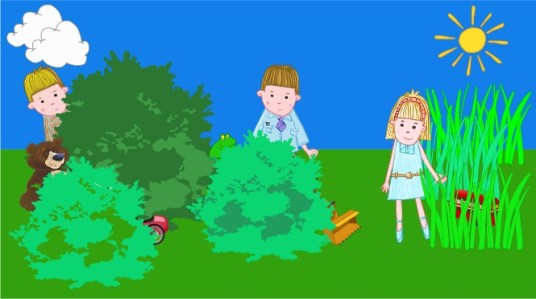
Treasure hunt and hide & seek games are a great way to teach a child directional and placement (prepositions) language. It is important for a child to learn directional and placement vocabulary so that they can both understand instructions given and share information themselves, such as; ‘put your cup on the table’ or to say ‘teddy in car’.

Through treasure hunts and hide & seek games you can introduce new directional and placement language in a fun and exciting way. There are a number of different ways to approach this:

  • You can give verbal instructions to the hidden treasure.
  • You could create a map for them to follow and ask them to talk through the map, supporting with new language as necessary.
  • You could use a mixture of verbal and map clues.
  • For older children get them to hide the treasure and give you instructions, or draw a map.
  • If you have more than one treasure to find make the most exciting piece more difficult to find.

The important thing is the language shared. Words and phrases to use are: left, right, straight on, forward, backwards, about turn, turn around, up, down, higher, lower, stop, next to, in front, beside, underneath, on top of, behind, on the left of, on the right of, outside, and inside.

Treasure hunts and hide & seek games are a great whole class or family activity and you are never too young or too old to join in!