Developing and Supporting Your Child’s Reading Journey – Week 6

Letter Knowledge

Letter 1

Letter knowledge is understanding;

  • That the same letter can look different, for example, a lower-case letter ‘b’ looks different from a capital letter ‘B’. Letters will also look different depending on which font type is being used or if it is handwritten, for example, an Arial font letter ‘g’ looks different from a Calibri font ‘g’.
  • That letters have names and the same name is used for that letter even when they look different, so the lower-case letter ‘a’ and its capital letter form ‘A’ are both called ‘ay’.
  • That letters (graphemes) are used to represent sounds (phonemes) in words. Teaching the unique letter names of the alphabet is an important pre-phonics skill. A letter or combination of letters can represent more than one sound and so the only way of identifying alphabet letters when we talk about them is to use their unique names.

Developing Letter Knowledge:

Through Play:

  • Sorting and Matching Games – use plastic or wooden letters, alphabet letter flash cards; can they group all the lower-case letters together, or all the capital letters or all the different letter ‘ay’s’ together.
  • Kim’s Games – use plastic or wooden letters, alphabet letter flash cards. Using a few letters at a time, place 5 to 10 on a tray and let your child look at them and talk through which letters are there. Cover with a tea towel and ask your child to look away, then remove 1 or 2 of the letters. Then ask your child to look back and remove the tea towel. Can they spot which letters are missing.
  • Detective Games – focus on identifying individual letters of the alphabet and naming them, this can be played at home or when out and about.
  • Leap Frog – use the letters of the alphabet on home-made paper lily pads. Use the letter names to identify the target lily pad for your child to either jump onto or to throw a bean bag/soft toy on to.
  • Skittles and Throwing Games – use letters of the alphabet on the targets and use the letter names as a way of identifying which of the targets your child is aiming for.

Through Drawing/Writing:

  • Making lists of things to do or a shopping list. Their version of the list may be just squiggles and dots (so don’t rely on this for your shopping trip) but it is the beginning. I would keep the list and get them to tick off things done or items purchased as part of the experience so that it has a genuine purpose (children really like this).
  • Making and drawing their own story book.
  • Learning to write letters correctly (see our Teach Handwriting Website: http://bit.ly/2F9P7cI)

Through Songs/Nursery Rhymes:

  • Singing Alphabet Songs, try singing it to different tunes.
  • Make up Your Own Rap – point to the letters as the rap is said.

Through Talk:

  • Talk about letters as being shapes made up of straight, curves and diagonal lines.
  • Look at the letters in your child’s name, talk about the fact that the first letter in their name is always a capital letter and that normally the other letters are lower-case letters.
  • Point out, especially for slightly older children, that lower-case letters are about half the size of the capital letters.
  • Compare letters looking at what is the same and different about them.
  • When taking about letters use the letter name as well as the sound it is making in the word, remember a letter is often used to represent more than one sound. The letter ‘a’ can be used to represent different sounds in the following words: ant, apron, was, and any (just 4 of the eight sounds it is used to represent).

Through Book Sharing:

What books to choose?

  • Books with shapes
  • Books where you have to find things (like I spy)
  • Alphabet books
  • Books which use different font styles in the pictures and text.

Book Sharing Tips:

  • Alphabet books do not need to be read from cover to cover. Let your child choose which letters they want to look at.
  • Trace the letters with your finger or let your child trace it (make sure you trace the letter using the correct formation orientation, encourage your child to do the same).
  • Talk about the pictures in alphabet books before focusing on the letter, its name and the sound it can make.
  • Show your child the first letter in their name and then look for that letter in the book.
  • Show and talk about how some letters are in their capital form and others in their lower-case form. Can they find other examples of the letters?
  • Choose two letters to talk about: How do they look alike? How do they look different? What shapes/line styles are they made up of?

Reading with Your Child Can Be Fun!

Reading with boy 4506329-1801x2700 (2)

The importance of reading to, and with, your child can’t be over emphasized. The more your child is exposed to words and enjoys the reading experience the quicker they will learn to read for themselves.

Reading with your child enables you to introduce them to new words and language structures which they will not come across in their everyday interactions. You can explain these words, through reading with your child, and help them to develop an understanding of their meaning. If a child likes the sound and rhythm of these new words or language structures they will, over time, start to use them in conversations with others and during imaginative play.

Reading to, and with, your child is such an important activity, however knowing how to keep it fun and to get the most out of the experiences is not always clear. This is why we are re-running our popular six-week series on ‘Developing and Supporting Your Child’s Reading Journey’

Each week we will look at a different reading skill element, giving example games and activities you can use to support and develop your child through:

  • Play
  • Drawing/Writing
  • Book Sharing
  • Talk & Song

‘Developing and Supporting Your Child’s Reading Journey’ Series:

  • Week 1. How to develop a child’s interest in books and reading.
  • Week 2. Phonological awareness skills required for reading.
  • Week 3. Vocabulary development for comprehension.
  • Week 4. Print awareness to develop understanding of reading conventions.
  • Week 5. Narrative skills to support the understanding of different writing styles.
  • Week 6. Letter knowledge.

Spring/Easter Drawing Activity Ideas – Supporting Language & Pre-handwriting Pattern Development

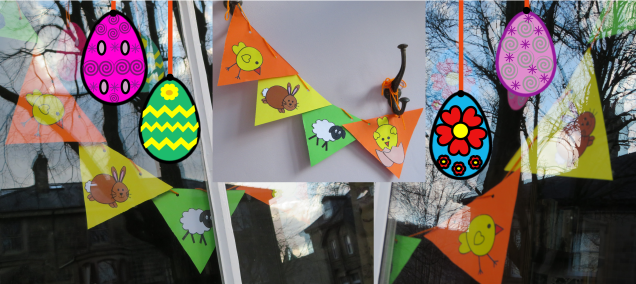
Easter Banner 2

In these unusual times it can be easy to forget that it is the Easter holiday break.

We have put together some quick step by step Easter drawing ideas for you to try, using basic shapes such as circles, rectangles and triangles. It is amazing how, by using these simple shapes, you and your child can create fantastic Spring/Easter: cards, pictures mobiles or bunting: http://bit.ly/2kyeo3w

People have enjoyed seeing children’s’ rainbow pictures up in windows so adding some Spring/Easter pictures or mobiles can only add to the enjoyment.

Drawing pictures is a great way to help your child develop their pre-handwriting strokes and shape forming skills. As well as supporting shape, colour, pattern and language development.

Word Play – Syllable Awareness & Counting

syllables 1

At about the age of 4 years old children start to develop an understanding that words can be split into sound parts (syllables) and that these parts give the word its rhythm.  A syllable is the largest phonological unit (one or a group of sounds) of a word and is like the rhythmic beat of the word.

They should be able to orally blend syllables together to form words and segment words into syllables.

A fun activity to help develop syllable understanding:

How Many Syllables?     

Children love to clap out the number of syllables in a word. It is important to say the word at a normal speed rather than really slowly as this can distort the word and make it difficult to hear the syllables. To start with a child just needs to be able to recognize them by clapping, stamping or jumping for each syllable of a word; they don’t need to be able to count them. It is thought that only about 50% of children can count out the syllables by the age of 4, so you can do the counting for them.

Spoken syllables are organised around the vowel sounds, making counting them easy; as the jaw drops when the vowel sound is spoken in the syllable. Try placing your hand under your jaw with your mouth closed before you say a word. Start with ‘cat’ you will notice the jaw drops once, this is because it is a one syllable (monosyllabic) word.

Most children will find it easier to identify syllables in compound words to start with. A compound word is formed by two words (root words) put together such as: sunset, hotdog, snowman and postman. They find it easier because the jaw tends to drop quite distinctly as we say the vowel sound in each of the root words and because we tend to say these words slowly.

The Importance of Small Talk – Week 1

Dad & Girl 1

Don’t underestimate the importance of everyday chatter or conversation (‘Small Talk’), children develop and learn a great deal through ‘Small Talk’ with adults and other children.

What do we mean by ‘Small Talk’?

With babies it is the kind of talk that explains what we are doing, what they are doing, where we are going and what we can see.  As they get older our verbal exchanges increase as we support their receptive and expressive vocabulary development. Through these exchanges we also support their general language development and understanding of how words are pronounced, basic sentence structure and using the correct tense.

When we talk with a child we demonstrate and model the use of language in real time so that it has meaning. For instance, a child may point and say “cat” and we would respond with “Yes, the cat is sleeping.” Or we may correct the child and say “That is a dog.” If we could we would point to a cat and explain the difference. We also correct mispronunciation of words and correct tense issues in the same way; repeating the word or sentence using the correct pronunciation or tense back to the child.

The Communication Trust has a link to a free downloadable booklet called Small Talk which is a very useful guide for understanding how your child learns to talk from birth to age 5:

https://www.thecommunicationtrust.org.uk/resources/resources/resources-for-parents/small-talk.aspx

Christmas Card Drawing Ideas to Support Language Development

pre-handwriting pics 1

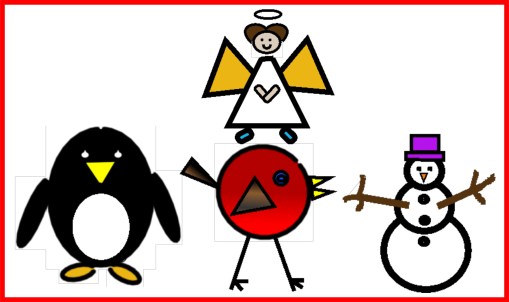
Drawing pictures with your child is a great way of introducing topic specific language, in this case words relating to Christmas and the winter season (depending in which part of the world you live). As you draw the pictures you can talk about the colours, shapes and sound you might hear. Such as: straight lines, curved line, wavy lines, squiggles spirals, circles, squares, triangles, crossed lines, diagonal lines, press softly, press hard, dark and light.

It is also a great way to help your child develop their pre-handwriting strokes and shape forming skills. It is amazing how using simple shapes can help you and your child create fantastic Christmas cards, pictures or gift tags.

We have put together some quick step by step Christmas drawing ideas for you to try using basic shapes such as circles, rectangles and triangles.

We hope you find them useful: http://bit.ly/2LktVRZ

Christmas Finger Printing a Fun Way to Support Language Development

Christmas printing 2

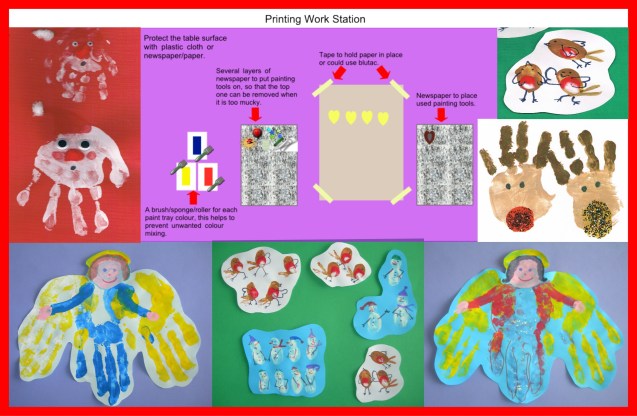
Hand and finger printing can be a fun way of getting your child used to touching, using different textured mediums and descriptive language associated with it. Such as: slimy, smooth, slippery, squidgy, wet, dry, squelch, ooze, press, push down, harder, softer, gentle, lift, light and dark.

Printing activities also help your child to start to become aware of how to control the amount of pressure they use and to develop a vocabulary to describe the different range of pressures required. Learning to control the amount of pressure exerted and how it feels can be very difficult for some children and it takes time and a range of experiences to develop these skills.

There are some fabulous printing ideas out on the internet; one of my favourite art resources is The Usborne Art Idea Books. Hand and finger printing can create some amazing artwork which can be used to make wonderful personalised Christmas cards, tags and paper.

Who could not be charmed by these fun thumb and fingertip snowmen or robins or delighted by a hand print angel or Father Christmas?

For other useful tips on printing and setting up a printing work station (http://bit.ly/35Z7pWQ ), check out our ‘More fun handwriting activities in our Resources section: http://bit.ly/2kyeo3w

Christmas Fun to Develop Vocabulary Skills

Salt Dough 1

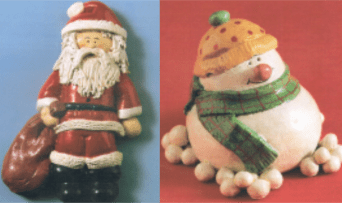
Learning new words (vocabulary) and their meaning begins with earlier play opportunities. Activities, that use play-dough type modelling materials, are great for developing the language knowledge relating to touch, texture, actions and instructional language. Words such as: cold, warm, soft, hard, smooth, rough, gritty, roll, squeeze, squash and pull.

An added benefit to these types of activities is that they also support your child in developing their hand and finger strength, bilateral coordination, sensory perception and for learning and perfecting different grips for using tools.

Salt Dough

So, why not make some great salt dough Christmas gifts and tree decorations with your child. Not only will they melt the hearts of those who receive them but you will be developing your child’s fine motor skills (needed for good handwriting) while having fun; can’t be bad!

For a salt dough recipe that I have found good to use with children go to our ‘More fun handwriting activities’ page (http://bit.ly/2kyeo3w ) in our Resources section of our Teach Handwriting website ( https://www.teachhandwriting.co.uk/ ) and just download the ‘Salt Dough Modelling’ pdf (http://bit.ly/2Y9pVcn ).

What is ‘The Simple View of Reading’?

Simple view of reading 1.jpg

The term ‘Simple View of Reading’ used by schools may seem strange as there is nothing simple about learning to read.

‘The Simple View of Reading’ was adopted by the Government in 2007 and now underpins the English National Curriculum’s programmes of study for reading at Key Stage 1 and 2.

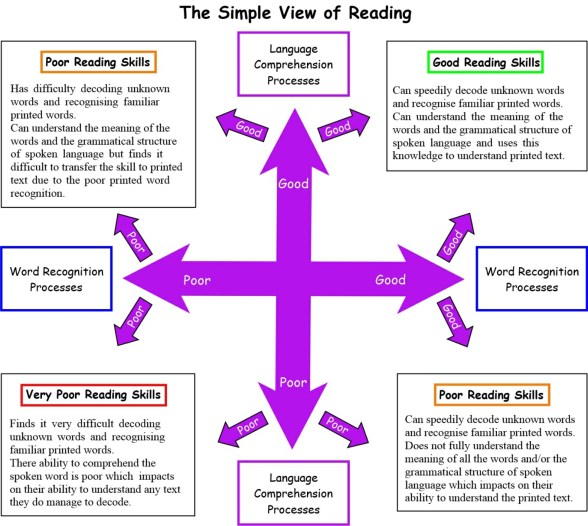
Even though reading, the ability to decode the word and extract the correct meaning of the words, is a complex set of skills; ‘the Simple View of Reading’ conceptual framework (Stuart et al. 2008, cited Hoover and Gough, 1986) reduces it down to two key components:

  • Word recognition – the ability to decode unknown words and recognise printed words.
  • Language comprehension – the ability to understand the spoken words and use this process to understand the written text.

Reading Comprehension = Decoding x Linguistic Comprehension

So in theory a child’s reading comprehension ability can be predicted by looking at their decoding and linguistic (spoken language) comprehension abilities (Johnston & Watson, 2007).

When using ‘the Simple View of Reading’ as the basis for teaching reading it becomes clearer as to why:

  • A high quality phonics scheme is required, which the Rose Report (2006) explains ‘…is not a  ‘strategy’ so much as a body of knowledge, skills and understanding that has to be learned.’ (page 20) [This teaches children how to decode.]
  • A language rich environment to develop and encourage linguistic comprehension is vital.

Bibliography

Johnston.R. and Watson.J. ‘Teaching Synthetic Phonics’, 2007, Pub: Learning Matters, Sage Publication Ltd.

Rose.J. ’Independent review of the teaching of early reading: final report March 2006’ Pub: DfES Publications

 The simple view of reading and evidence based practice’ Rhona Stainthorp Institute of Education, Reading University, Morag Stuart, Institute of Education, University of London (2008) Pdf downloaded from internet

Why do we ask children to ‘read out aloud’?

Reading with boy 4506329-1801x2700 (2)

Reading is the ability to first decode the letter sequence of the word (phonics) and then to place meaning to it in relation to the context in which it is being used.

Unfortunately, many children just decode, speak and do not actively listen to what they have said, so they do not gain meaning from the words they are reading (poor reading comprehension skills).

We ask children who are learning to read to ‘read out aloud’, but forget to tell them why. It is not just so we can hear they have decoded a word correctly. The important point is to encourage them to actively listen to what they are saying. The idea is that if they hear the words they will, if it is part of their vocabulary, understand their meaning and therefore fully comprehend the text they have read.

Poor reading comprehension skills may also occur because a child has a limited vocabulary usage and/or understanding. A language rich environment is vital to help support and develop a child’s vocabulary and linguistic comprehension, which in turn, will support their reading comprehension skills.