The Key to Good Phonics Skills – Part 9

Developing #Listening & #Speaking Skills – How to encourage your child to keep talking!

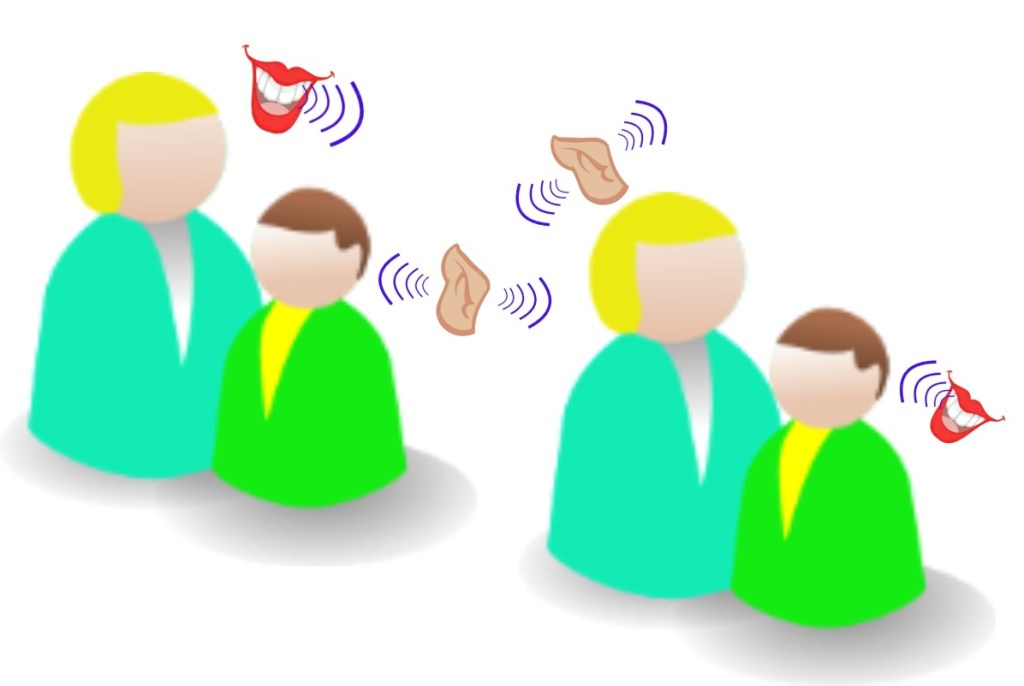
Learning to the conventions of conversation start from birth, as parents we do not really think about it in this way but it is what we tend to do naturally.

Sometime though we all need a few pointers to help us, so here are some ideas to help you develop and encourage your child to talking skills:

From Birth to 1 Years Old

  • To encourage cooing and babbling. Get yourselves comfortable in a face-to-face interaction position, babies often like lying on their back or on your lap looking up at you.
  • Start by talking to your child while gently tickling their tummy or neck.
  • Anytime they make a sound you imitate or match the sound as best you can. It is best to wait until they have finished before you try (one of the conventions of conversation).
  • Try changing or adding a new sound to the one your child has made, so if they say ‘ah’ you might say ‘ah-ooh’, this will help to keep the game interesting.
  • Show that you are excited by the sound they make – smile and laugh, if you are enjoying the interaction, they will be excited by it too.
  • Vocal play works best when it occurs naturally, such as playing with farm animals, for instance sheep go baa, baa or cows make a moo, moo sound.

1 to 2 Years Old

  • Talk directly to your baby/toddler so they can see your facial expressions and how your lips move, as this is the beginnings of learning the conventions of communicating, listening and responding (something they cannot get from the TV, iPad or overheard conversations – indirect talk).
  • Talk through everyday events, such as getting dressed; what is happening, where you are going and what the plan is for the day.
  • Use your body language, expressions and gestures to help reinforce and develop your child’s neurological pathways to support understanding and comprehension.
  • Share books with your baby/toddler, they may not understand what you are saying to begin with but they will be listening to the different sounds that the words make. By reading aloud you are probably using words that will introduce new sounds that your child may not be picking up from your normal day to day conversations. As they get older you are developing and increasing the range of their vocabulary.
  • Babies and young children love to hear you singing and saying rhymes, this is because the language is slowed down, allowing them to hear the small units of sounds and patterns which are often repeated several times in a short time lapse. Again, the language used is often different from your day-to-day talk.
  • To encourage and help your child to generate and play with sound, repeat the sounds that they make.
  • Using familiar objects and toys make the noises associated with them for example a toy car, broom, broom or a toy bumble bee buzz, buzz.
  • When you are out and about talk about what you can see and about the sounds they make, a cat goes meow or a train Choo, Choo, for example.
  • You can use other onomatopoeic words to describe sounds, such as wooden spoons on saucepans could be bang, bang or blocks being knocked together could be click, clack.

2 to 5 Years Old

  • When playing, talking and sharing new words it is important to get down to your child’s level so they can see your face and how your mouth and lips move to form the words or sounds being explored.
  • Remember toddlers learn to listen best when they are taking an active role in what they are doing, especially when you or others join in eagerly with them to play the games.
  • Give your child thinking and response time, this may seem like a long pause but it is worth waiting, be sure your child has finished what they wanted to say before you respond.
  • Try not to finish off your child’s sentence, yes sometimes it may be quicker but just give them a little moment longer and they will get there. If it is clear they cannot think of the word they want then that is of course different.
  • Before a child can really take part in meaningful interactions with others, they need to learn how to take turns. It is one of the basic elements of communication, when we are talking to someone, we leave a gap/pause so that the other person has the opportunity to respond, taking turns. Turn taking skills need to be modelled and taught to help your child develop and understand this element of communicating with others.
  • To encourage your child to keep talking try nodding, smiling and using comments such as; wow, really or acknowledging something they have said by repeating rather than always asking them questions.
  • We are all guilty of half-listening, especially when we are busy trying to cook dinner for example. If it is obvious that what your child wants to tell you is really important then make it clear that you are interested by saying “Just let me finish this and then I can listen to you more carefully.”


The Key to Good Phonics Skills – Part 8

Developing #Listening & #Speaking Skills – The Importance of Small Talk!

Don’t underestimate the importance of everyday chatter or conversation (‘Small Talk’), children develop and learn a great deal through ‘Small Talk’ with adults and other children.

What do we mean by ‘Small Talk’?

With babies it is the kind of talk that explains what we are doing, what they are doing, where we are going and what we can see.  As they get older our verbal exchanges increase as we support their receptive and expressive vocabulary development. Through these exchanges we also support their general language development and understanding of how words are pronounced, basic sentence structure and using the correct tense.

When we talk with a child we demonstrate and model the use of language in real time so that it has meaning. For instance, a child may point and say “cat” and we would respond with “Yes, the cat is sleeping.” Or we may correct the child and say “That is a dog.” If we could we would point to a cat and explain the difference. We also correct mispronunciation of words and correct tense issues in the same way; repeating the word or sentence using the correct pronunciation or tense back to the child.

The Communication Trust is now part of the I Can organisation and has a great range of information and guidance for parents and professionals: https://www.icancharity.org.uk/

The Key to Good Phonics Skills – Part 6

Developing #Listening & Speaking Skills – Turn Taking Skills – Conversation

This week we will look at turn taking in conversation a skill children need to learn to take part in meaningful interaction with others. These interactions are a vital part of children’s physical, emotional, social and intellectual growth and wellbeing.

Children need to learn that in conversation they need to take turns listening and speaking.

This is more complex process than we often give it credit for as often we, especially in our busy lives, can be guilty of only listening to reply rather than listening to understand.

Children need to learn when to talk and when to listen; for this to happen they need to do the following:

  • Actively Listen to the other person. This means:
    • Concentrate on the words being said, by blocking out other environmental noises and voices.
    • For most children and adults this also means looking at the person, watching their facial expression and body language.
    • Listening for the verbal cues and/or changes in the tone of voice that signifies that the person has finished speaking.
    • Recognising that it is either your turn to respond by formulating a reply or not.
  • Formulate a Response. This means:
    • Extracting meaning – taking understanding from the words that have been spoken.
    • Mentally searching for words to compile a grammatically correct set of sentences.

In young children this can take time, not because they do not have the answer, because they just take longer to recall and formulate their responses. This is due to the constant acquisition of new language and understanding of the grammatical conventions that need to be applied.

  • Communicate Response. This means
    • Speaking clearly, pronouncing words correctly in coherent sentences.
    • Using socially appropriate facial expressions and body language to accompany the response.
    • Using the appropriate verbal cues and/or changes in the tone of voice that allow the other person to understand it is now their turn.
  • Wait. This means giving time for the other person to formulate their response.
  • Actively Listen to the other person.

Learning these skills takes time and needs to be taught as well as modelled by those around the children. It begins very early on for instance, when we talk to a baby, as if expecting an answer. As a baby starts to make cooing and babbling sounds, they begin to respond to you in those gaps, their first conversations.

Something that is worth remembering:

“When you talk, you are only repeating what you already know. But if you listen, you may learn something new.” (Dalai Lama)

How to encourage your child to keep talking!

Learning to the conventions of conversation start from birth, as parents we do not really think about it in this way but it is what we tend to do naturally.

Sometime though we all need a few pointers to help us, so here are some ideas to help you develop and encourage your child to talking skills:

From Birth to 1 Years Old

  • To encourage cooing and babbling. Get yourselves comfortable in a face-to-face interaction position, babies often like lying on their back or on your lap looking up at you.
  • Start by talking to your child while gently tickling their tummy or neck.
  • Anytime they make a sound you imitate or match the sound as best you can. It is best to wait until they have finished before you try (one of the conventions of conversation).
  • Try changing or adding a new sound to the one your child has made, so if they say ‘ah’ you might say ‘ah-ooh’, this will help to keep the game interesting.
  • Show that you are excited by the sound they make – smile and laugh, if you are enjoying the interaction, they will be excited by it too.
  • Vocal play works best when it occurs naturally, such as playing with farm animals, for instance sheep go baa, baa or cows make a moo, moo sound.

1 to 2 Years Old

  • Talk directly to your baby/toddler so they can see your facial expressions and how your lips move, as this is the beginnings of learning the conventions of communicating, listening and responding (something they cannot get from the TV, iPad or overheard conversations – indirect talk).
  • Talk through everyday events, such as getting dressed; what is happening, where you are going and what the plan is for the day.
  • Use your body language, expressions and gestures to help reinforce and develop your child’s neurological pathways to support understanding and comprehension.
  • Share books with your baby/toddler, they may not understand what you are saying to begin with but they will be listening to the different sounds that the words make. By reading aloud you are probably using words that will introduce new sounds that your child may not be picking up from your normal day to day conversations. As they get older you are developing and increasing the range of their vocabulary.
  • Babies and young children love to hear you singing and saying rhymes, this is because the language is slowed down, allowing them to hear the small units of sounds and patterns which are often repeated several times in a short time lapse. Again, the language used is often different from your day-to-day talk.
  • To encourage and help your child to generate and play with sound, repeat the sounds that they make.
  • Using familiar objects and toys make the noises associated with them for example a toy car, broom, broom or a toy bumble bee buzz, buzz.
  • When you are out and about talk about what you can see and about the sounds they make, a cat goes meow or a train Choo, Choo, for example.
  • You can use other onomatopoeic words to describe sounds, such as wooden spoons on saucepans could be bang, bang or blocks being knocked together could be click, clack.

2 to 5 Years Old

  • When playing, talking and sharing new words it is important to get down to your child’s level so they can see your face and how your mouth and lips move to form the words or sounds being explored.
  • Remember toddlers learn to listen best when they are taking an active role in what they are doing, especially when you or others join in eagerly with them to play the games.
  • Give your child thinking and response time, this may seem like a long pause but it is worth waiting, be sure your child has finished what they wanted to say before you respond.
  • Try not to finish off your child’s sentence, yes sometimes it may be quicker but just give them a little moment longer and they will get there. If it is clear they cannot think of the word they want then that is of course different.
  • Before a child can really take part in meaningful interactions with others, they need to learn how to take turns. It is one of the basic elements of communication, when we are talking to someone, we leave a gap/pause so that the other person has the opportunity to respond, taking turns. Turn taking skills need to be modelled and taught to help your child develop and understand this element of communicating with others.
  • To encourage your child to keep talking try nodding, smiling and using comments such as; wow, really or acknowledging something they have said by repeating rather than always asking them questions.
  • We are all guilty of half-listening, especially when we are busy trying to cook dinner for example. If it is obvious that what your child wants to tell you is really important then make it clear that you are interested by saying “Just let me finish this and then I can listen to you more carefully.”

The Importance of Small Talk!

Don’t underestimate the importance of everyday chatter or conversation (‘Small Talk’), children develop and learn a great deal through ‘Small Talk’ with adults and other children.

What do we mean by ‘Small Talk’?

With babies it is the kind of talk that explains what we are doing, what they are doing, where we are going and what we can see.  As they get older our verbal exchanges increase as we support their receptive and expressive vocabulary development. Through these exchanges we also support their general language development and understanding of how words are pronounced, basic sentence structure and using the correct tense.

When we talk with a child we demonstrate and model the use of language in real time so that it has meaning. For instance, a child may point and say “cat” and we would respond with “Yes, the cat is sleeping.” Or we may correct the child and say “That is a dog.” If we could we would point to a cat and explain the difference. We also correct mispronunciation of words and correct tense issues in the same way; repeating the word or sentence using the correct pronunciation or tense back to the child.

The Communication Trust is now part of the I Can organisation and has a great range of information and guidance for parents and professionals: https://ican.org.uk/

Turn Taking Skills – Conversation

This week we will look at turn taking in conversation a skill children need to learn to take part in meaningful interaction with others. These interactions are a vital part of children’s physical, emotional, social and intellectual growth and wellbeing.

Children need to learn that in conversation they need to take turns listening and speaking.

This is more complex process than we often give it credit for as often we, especially in our busy lives, can be guilty of only listening to reply rather than listening to understand.

Children need to learn when to talk and when to listen; for this to happen they need to do the following:

  • Actively Listen to the other person. This means:
    • Concentrate on the words being said, by blocking out other environmental noises and voices.
    • For most children and adults this also means looking at the person, watching their facial expression and body language.
    • Listening for the verbal cues and/or changes in the tone of voice that signifies that the person has finished speaking.
    • Recognising that it is either your turn to respond by formulating a reply or not.
  • Formulate a Response. This means:
    • Extracting meaning – taking understanding from the words that have been spoken.
    • Mentally searching for words to compile a grammatically correct set of sentences.

In young children this can take time, not because they do not have the answer, because they just take longer to recall and formulate their responses. This is due to the constant acquisition of new language and understanding of the grammatical conventions that need to be applied.

  • Communicate Response. This means
    • Speaking clearly, pronouncing words correctly in coherent sentences.
    • Using socially appropriate facial expressions and body language to accompany the response.
    • Using the appropriate verbal cues and/or changes in the tone of voice that allow the other person to understand it is now their turn.
  • Wait. This means giving time for the other person to formulate their response.
  • Actively Listen to the other person.

Learning these skills takes time and needs to be taught as well as modelled by those around the children. It begins very early on for instance, when we talk to a baby, as if expecting an answer. As a baby starts to make cooing and babbling sounds, they begin to respond to you in those gaps, their first conversations.

Something that is worth remembering:

“When you talk, you are only repeating what you already know. But if you listen, you may learn something new.” (Dalai Lama)

The Importance of Small Talk & Conversational Turn Taking – Week 1

Don’t underestimate the importance of everyday chatter or conversation (‘Small Talk’), children develop and learn a great deal through ‘Small Talk’ with adults and other children.

What do we mean by ‘Small Talk’?

With babies it is the kind of talk that explains what we are doing, what they are doing, where we are going and what we can see.  As they get older our verbal exchanges increase as we support their receptive and expressive vocabulary development. Through these exchanges we also support their general language development and understanding of how words are pronounced, basic sentence structure and using the correct tense.

When we talk with a child we demonstrate and model the use of language in real time so that it has meaning. For instance, a child may point and say “cat” and we would respond with “Yes, the cat is sleeping.” Or we may correct the child and say “That is a dog.” If we could we would point to a cat and explain the difference. We also correct mispronunciation of words and correct tense issues in the same way; repeating the word or sentence using the correct pronunciation or tense back to the child.

For more tips and advice try our tips page: http://bit.ly/2ncjzYn

The Communication Trust has a link to a free downloadable booklet called Small Talk which is a very useful guide for understanding how your child learns to talk from birth to age 5:

https://www.thecommunicationtrust.org.uk/resources/resources/resources-for-parents/small-talk.aspx

Conversational Turn Taking

We covered this a couple of weeks ago but I think it is useful to recap the main points again here as it supports the development of ‘Small Talk’:

Children need to learn when to talk and when to listen; for this to happen they need to do the following:

  • Actively Listen to the other person. This means:
    • Concentrate on the words being said, by blocking out other environmental noises and voices.
    • For most children and adults this also means looking at the person, watching their facial expression and body language.
    • Listening for the verbal cues and/or changes in the tone of voice that signifies that the person has finished speaking.
    • Recognising that it is either your turn to respond by formulating a reply or not.
  • Formulate a Response. This means:
    • Extracting meaning – taking understanding from the words that have been spoken.
    • Mentally searching for words to compile a grammatically correct set of sentences.
    • In young children this can take time, not because they do not have the answer, because they just take longer to recall and formulate their responses. This is due to the constant acquisition of new language and understanding of the grammatical conventions that need to be applied.
  • Communicate Response. This means
    • Speaking clearly, pronouncing words correctly in coherent sentences.
    • Using socially appropriate facial expressions and body language to accompany the response.
    • Using the appropriate verbal cues and/or changes in the tone of voice that allow the other person to understand it is now their turn.
  • Wait. This means giving time for the other person to formulate their response.
  • Actively Listen to the other person.

Turn Taking Skills – Part 1 – Conversation

This week we will look at turn taking in conversation a skill children need to learn to take part in meaningful interaction with others. These interactions are a vital part of children’s physical, emotional, social and intellectual growth and wellbeing.

Children need to learn that in conversation they need to take turns listening and speaking.

This is more complex process than we often give it credit for as often we, especially in our busy lives, can be guilty of only listening to reply rather than listening to understand.

Children need to learn when to talk and when to listen; for this to happen they need to do the following:

  • Actively Listen to the other person. This means:
    • Concentrate on the words being said, by blocking out other environmental noises and voices.
    • For most children and adults this also means looking at the person, watching their facial expression and body language.
    • Recognising that it is either your turn to respond by formulating a reply or not.
  • Formulate a Response. This means:
    • Extracting meaning – taking understanding from the words that have been spoken.
    • Mentally searching for words to compile a grammatically correct set of sentences.

In young children this can take time, not because they do not have the answer, because they just take longer to recall and formulate their responses. This is due to the constant acquisition of new language and understanding of the grammatical conventions that need to be applied.

  • Communicate Response. This means
    • Speaking clearly, pronouncing words correctly in coherent sentences.
    • Using socially appropriate facial expressions and body language to accompany the response.
    • Using the appropriate verbal cues and/or changes in the tone of voice that allow the other person to understand it is now their turn.
  • Wait. This means giving time for the other person to formulate their response.
  • Actively Listen to the other person.

Learning these skills takes time and needs to be taught as well as modelled by those around the children. It begins very early on for instance, when we talk to a baby, as if expecting an answer. As a baby starts to make cooing and babbling sounds, they begin to respond to you in those gaps, their first conversations.

Something that is worth remembering:

“When you talk, you are only repeating what you already know. But if you listen, you may learn something new.” (Dalai Lama)

Developing and Supporting Your Child’s Reading Journey – Week 4

Print Awareness to Develop Understanding of Reading Conventions

Book Conv 1

Print Awareness is knowing that print (words) has meaning, including noticing print around them in the environment (posters & street signs) and understanding how to handle the conventions for reading a book. We can often assume that all young children or pre-readers (as not always young children) will develop print awareness naturally. However, research suggests that 95% of their visual attention is directed towards pictures, which in themselves hold a great deal of meaning and often tell the story very effectively.

Pictures/ illustrations in story books and pure picture books are powerful ways to engage children and adults with books, storytelling and reading. This is not to say that pictures are any easy way to interpret a story line as they can hold a great deal of meaning, from simple obvious interpretation to more sophisticated symbolic representation.

Young children and pre-readers need opportunities to explore print and be helped to understand that the written word (print) has meaning. Once they start to see print they will begin to notice it everywhere not just in books but on posters, food packets, menus and street signs.

Again we can often assume that a child or pre-reader knows how to handle a book, however this is not always the case and can be due to a lack of experience with books or different cultural reading conventions. So it is important to check and teach these reading conventions for reading English:

  • Front cover opens to the left and we read it from the front to the back.
  • Print on a page is read left to right.
  • Usually print is read from the top of the page across and down (this may differ slightly in some children’s books).

Supporting Print Awareness:

Through Play

  • Use takeaway menus or create your own as part of role playtime, they could have their own café serving up all sorts of interesting dishes for you. A blackboard can be very useful for this, allowing you or your child to write up their own menu for the day.
  • Travel brochures or leaflets from your local tourist information office are great for role play encouraging new language as well as a different way to explore print as they often have maps and timetables.
  • Use sticky labels or post it notes to label items or furniture as part of a ‘can you see or find’ game.

Through Drawing/Writing

  • Making lists of things to do or a shopping list. Their version of the list may be just squiggles and dots (so don’t rely on this for your shopping trip) but it is the beginning. I would keep the list and get them to tick off things done or items purchased as part of the experience so that it has a genuine purpose (children really like this).
  • For slightly older children making simple invitations and thank you cards can be fun. Try not to make the messages too long or to write too many as they will get bored and see it as a chore not as fun.
  • Making and drawing their own story book.

Through Songs/Nursery Rhymes

  • Showing the printed words to songs and rhymes.

Through Talk

  • Point out signs, logos and labels when out and about as well as at home.
  • A lot of print awareness skills are developed through the sharing of books and appropriate on-line material.

Through Book Sharing

What books to choose?

  • Books that have writing as part of the story;
  • Books that have writing as part of the picture;
  • Story books; all types;
  • Factual (non-fiction) books; all types;
  • Comics;
  • Children’s magazines and newspapers.

Book Sharing Tips

  • Remember babies will chew and bash the pages of the book as you read. This is normal and part of their learning experience so go with it.
  • Encourage and let your child turn the pages.
  • Point to the words of the title as you say them
  • Explain what the author and illustrator do as you say their names.
  • Point to words or repeated phrases as you say them or as your child says them. This will also help your child to develop the skill of reading from left to right and from the top of the page down (English).
  • Point to words of interest and explain how words have spaces between them and why.
  • To help your child understand how to handle a book use the word ‘front’ and ‘back’ of the book. If you are handed a book upside down or with the ‘back’ cover facing you explain that you have to turn it around or over so that you can read it.
  • Explain that page numbers help you to find things in the book as well as to help make sure you do not miss any part of the story.
  • Explain that content pages in story books show the chapters and in factual (non-fiction) they show different subject areas, as well as giving the page numbers on which to find them.
  • Explain how the index page in non-fiction books work.
  • Explain what a glossary is in a book.

Speaking & Listening Skills

Developing a Child’s Speaking and Listening Skills is Vital!

It is not just the key to literacy success but an essential social communication skill.

Sadly, schools are still reporting ever increasing concerns over the decline in young children’s speaking and listening skills. So, over the next 6 weeks, we are looking again at the different developmental elements of speaking and listening; providing practical games and activities to help build a child’s skills.

Week 1. The Importance of Small Talk

Week 2. Conversational Turn Taking Skills

Week 3. What is Listening?

Week 4. Games to Develop Listening Skills – Sound Screen Games

Week 5. Games to Develop Listening Skills – Sound Scanning Games

Week 6. Games to develop Listening Skills – Music Fun