The Simple View of Reading

The term ‘Simple View of Reading’ used by schools may seem strange as there is nothing simple about learning to read.

The Simple View of Reading was adopted by the Government in 2007 and now underpins the English National Curriculum’s programmes of study for reading at Key Stage 1 and 2.

Even though reading, the ability to decode the word and extract the correct meaning of the words, is a complex set of skills; the Simple View of Reading conceptual framework (Stuart et al. 2008, cited Hoover and Gough, 1986) reduces it down to two key components:

  • Word recognition – the ability to decode unknown words and recognise printed words.
  • Language comprehension – the ability to understand the spoken words and use this process to understand the written text.
Reading Comprehension = Decoding x Linguistic Comprehension

So in theory a child’s reading comprehension ability can be predicted by looking at their decoding and linguistic (spoken language) comprehension abilities (Johnston & Watson, 2007).

When using the Simple View of Reading as the basis for teaching reading it becomes clearer as to why:

  • A high quality phonics scheme is required, which the Rose Report (2006) explains ‘…is not a  ‘strategy’ so much as a body of knowledge, skills and understanding that has to be learned.’ (page 20) [This teaches children how to decode.]
  • A language rich environment to develop and encourage linguistic comprehension is vital.

The simple view of Reading diagram

[For a pdf copy of this diagram click here]

Bibliography

Johnston.R. and Watson.J. ‘Teaching Synthetic Phonics’, 2007, Pub: Learning Matters, Sage Publication Ltd.

Rose.J. ’Independent review of the teaching of early reading: final report March 2006’ Pub: DfES Publications

The simple view of reading and evidence based practice’  Rhona Stainthorp Institute of Education, Reading University, Morag Stuart, Institute of Education, University of London (2008) Pdf downloaded from internet
What is Reading?

Reading

Reading is the ability to first decode the letter sequence of the word (phonics) and then to place meaning to it in relation to the context in which it is being used.

We ask children who are learning to read to ‘read out aloud’, but forget to tell them why. It is not just so we can hear they have decoded a word correctly. The important point is to encourage them to actively listen to what they are saying. The idea is that if they hear the words they will, if it is part of their vocabulary, understand their meaning and therefore fully comprehend the text they have read.

Unfortunately many children just decode, speak and do not actively listen to what they have said, so they do not gain meaning from the words they are reading (poor reading comprehension skills).

Poor reading comprehension skills may also occur because a child has a limited vocabulary usage and /or understanding. A language rich environment is vital to help support and develop a child’s vocabulary and linguistic comprehension which in turn will support their reading comprehension skills.

Back to School – What is Phonics?

Blog Phonics

Date Originally Posted: 07/09/17

With the new school year under way some of you will have been introduced to phonics for the first time. Phonics is a very useful decoding tool used for developing reading skills and as an encoding tool for spelling.

Phonics is the simple process of linking sounds to letters, its complexity comes from how many sound (phoneme) to letter (grapheme) combinations there are. So to be good at phonics a child needs to know the 44 sounds and numerous letter and letter combinations of English and then learn the associations between the two.

Children can communicate orally from an early age; it is when they move to the written word that they need to learn how to decode text, to turn the letters into words they already know.

Using phonics knowledge for reading entails:

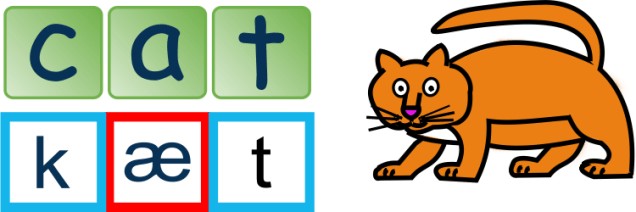
  1. Identify the letter or letter combination, in a word, that represent a sound
  2. Associate the letter or letter combination to one of the 44 sounds
  3. Blend each of the sounds together to form the word
  4. Recognise the now oral word to extract its meaning

The theory supporting the teaching of reading using phonics, especially synthetic phonics, is that if a child can decode a word by associating individual sounds to a letter or combination of letters they will then be able to blend those sounds together to form and say the word.

Once a word has been spoken they will extract its meaning by using their far more extensive spoken language comprehension. Children are therefore using the same mental processes to understand written text and speech.