How the Body’s Sensory Systems affect Academic Success

Sometime ago, I posted a blog with a link to an article which we felt highlighted, and backed, our own thoughts of why we need to look at the whole child and their physical and sensory development alongside their intellectual development.

It made very interesting reading then but having talked with different therapists, SENCos and teachers over the past year it seems that it has become very relevant. This is because it appears that more and more children are struggling in school and displaying learning difficulty traits that relate to sensory system difficulties.

This article explains how sensory systems impact on and affect a child’s ability to learn and are essential developmental building blocks to a child’s academic future. It also provides some practical advise.

The article ‘Sensory Systems that Make up the Learning Hierarchy of a Strong Academic Foundation’ was written and released by Integrated Learning Strategies Learning Corner on 24/02/16 http://ilslearningcorner.com/2016-02-sensory-systems-that-make-up-the-learning-hierarchy-of-a-strong-academic-foundation/

The Pre-phonics section of our website (http://www.teachphonics.co.uk/phonological-development.html ) explains how to support and develop all the visual and auditory sensory systems highlighted in the article for a strong foundation for learning.

The activity ideas work on providing a range of stimulus for a child to experience, supporting their visual and auditory development. These activity ideas can be played at home and easily built into or adapted in a school as cross curricular activity experiences.

Are your child’s #phonics skills good for their age?

With more and more expected of our pre-school and 4 to 7 year old children it can be difficult to know what the realistic age appropriate skills are in relation to phonics.

In fact, phonics is only part of the story starting at stage 8 of a child’s phonological awareness development.

Stages 1 to 7 of a child’s phonological awareness, what we refer to as pre-phonics skills, are the continual development of their understanding and knowledge of our spoken language as well as other communication forms, such as gestures, facial expressions, body language and social conventions.

Stages 8 to 10 of a child’s phonological awareness, the phonics reading and writing stages are the continual development of their understanding and knowledge for learning to reading and write.

As a child’s phonological awareness skills build on each stage, the age at which a child reaches them varies making it difficult to know how your child is doing.

We recognise this variation and use age ranges as a rough guide to help you understand where your child is in their phonological awareness skills.

By clicking on the various stages of phonological awareness you will find appropriate age range information, advice and activities to support your child. Try not to jump a stage as each one is important in unlocking the knowledge and skills for the stage above.

Stages 1 to 7 (Pre-phonics skills): https://www.teachphonics.co.uk/phonological-development.html

Stages 8 to 10 (Phonics): https://www.teachphonics.co.uk/phonological-development-phonics.html

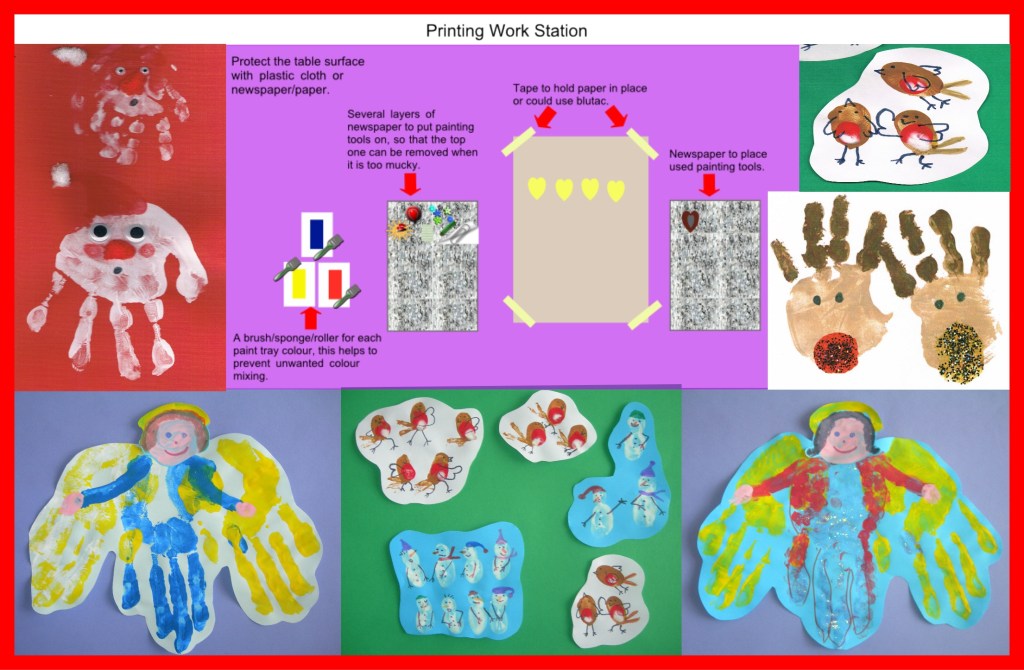
#Christmas Finger Printing a Fun Way to Support Language Development

Hand and finger printing can be a fun way of getting your child used to touching, using different textured mediums and descriptive language associated with it. Such as: slimy, smooth, slippery, squidgy, wet, dry, squelch, ooze, press, push down, harder, softer, gentle, lift, light and dark.

Printing activities also help your child to start to become aware of how to control the amount of pressure they use and to develop a vocabulary to describe the different range of pressures required. Learning to control the amount of pressure exerted and how it feels can be very difficult for some children and it takes time and a range of experiences to develop these skills.

There are some fabulous printing ideas out on the internet; one of my favourite art resources is The Usborne Art Idea Books. Hand and finger printing can create some amazing artwork which can be used to make wonderful personalised Christmas cards, tags and paper.

Who could not be charmed by these fun thumb and fingertip snowmen or robins or delighted by a hand print angel or Father Christmas?

For other useful tips on printing and setting up a printing work station (https://teachhandwriting.co.uk/assets/pdfs/Setting%20up%20a%20Printing%20Workstation.pdf ), check out our ‘More fun handwriting activities, where you can talk about the effects of using different pressure, in our Resources section: https://teachhandwriting.co.uk/more-activities.html

Letter & Sound Relationships That Break the #Phonics Rules

Back in September we explained that Phonics is very useful as a decoding tool used for developing reading skills and an encoding tool for spelling. It is the simple process of linking sounds to letters, its complexity comes from how many sounds (phonemes) to letter combinations (graphemes) there are.

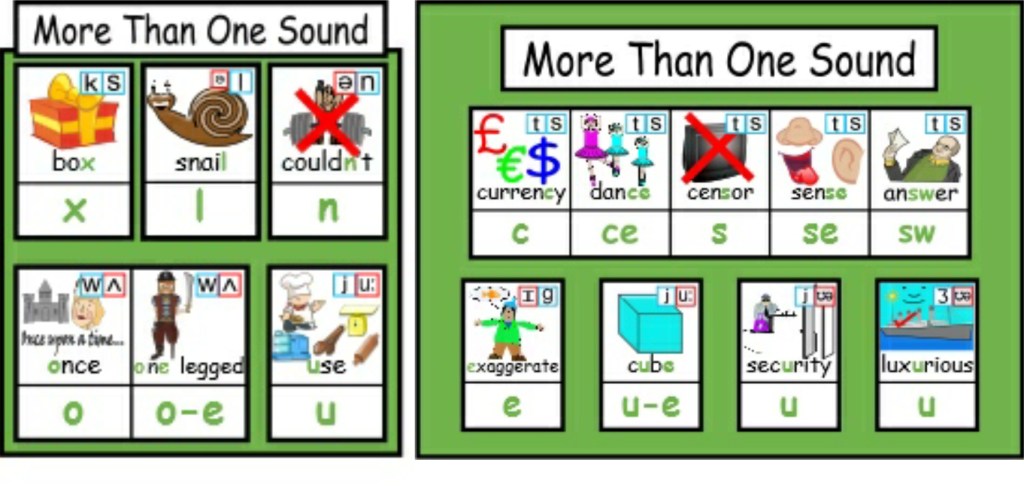
Some letter and sound associations just don’t follow the normal phonics rule of a single sound being associated to a letter or letter combination. A few letters represent two sounds, such as the letter ‘u’ which in the word ‘cupid’ represents the two sounds /y,(j)/ and /oo,(uː)/.

A more common one letter two sound relation is that of the letter ‘x’ representing the two sounds /k,(k)/ and /s,(s)/ as in thewords: six and box.

Here are some other examples of single letters and split digraphs making two sounds instead of the usual phonics rule of only making one sound:

What are CVC Words in #Phonics?

With many parents sadly having to tackle home learning again; we thought it would be useful to re-run this blog from last year explaining CVC words in phonics.

The letter C means a consonant letter is required.

The letter V means that a vowel letter is required.

So, a CVC word is one that has a consonant letter followed by a vowel and then a consonant as in the following examples:

ca   dog    mat

There are 26 letters in the English alphabet and these can be split in to two categories:

Vowels – ‘a’, ‘e’, ‘i’, ‘o’, ‘u’ and the letter ‘y’, when it is used as a semi-vowel, in words such as by, my and fly.

Consonants – ‘b’, ‘c’, ‘d’, ‘f’, ‘g’, ‘h’, ‘j’, ‘k’, ‘l’, ‘m’, ‘n’, ‘p’, ‘q’, ‘r’, ‘s’, ‘t’, ‘v’, ‘w’, ‘x’, ‘z’ and the letter ‘y’ when it is being used as a consonant, in words such as yak, yam and yellow.

Schools will often use the abbreviation CV, CVC, CVCC words when sending home phonics work or suggestions for phonics games. It is also used by many phonics computer games, activity programs and schemes.

Here are some examples for:

The ‘Long’ Vowel Sounds

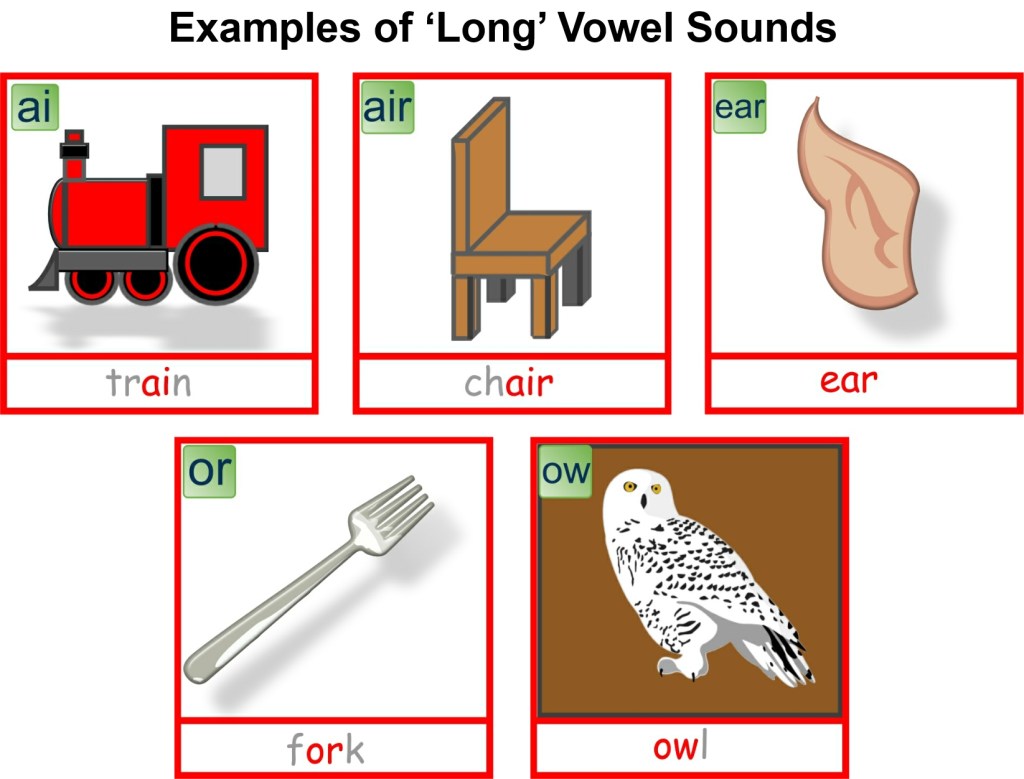
A couple of weeks ago we explained that there are 20 vowel sounds in the English (UK) sound system and last week we looked at the 7 ‘short’ vowel sounds. This week we are taking a look at the remaining 13 ‘long’ vowel sounds.

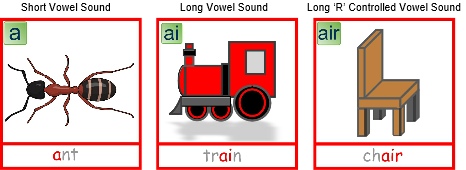
Here at Teach Phonics we split them in to two groups: 7 ‘long’ vowel sounds and 6 ‘long ‘R’ controlled’ vowel sounds.

The 7 ‘long’ vowel sounds areso calleddue to the length of their pronunciation; these can often be held without distorting their sound.

 The /ai,(eI)/ sound found in the words: train, tray, cake and break.

The /oa,(ǝƱ)/ sound found in the words: boat, hotel, toe and bone.

The /oi,(ɔI)/ sound found in the words: boy, coin and buoy.

The /ow,(aƱ)/ sound found in the words: owl, house, drought and hour.

The /ee,(іː)/ sound found in the words: tree, pea, me, and pony.

The /I,(aI)/ sound found in the words: iron, fly, pie and light.

The /oo,(uː)/ sound found in the words: spoon, blue, screw and you.

The 6 ‘long ‘R’ controlled’ vowel sounds are so called because of the slight /r,(r)/ sound quality that can be heard in them along with the length of their pronunciation; these can often be held without distorting their sound.

The /ar,(ɑː)/ sound found in the words: car, father (southern UK accent) and art.

The /or,(ɔː)/ sound found in the words: fork, door, walk and sauce.

The /ear,(Iǝ)/ sound found in the words: ear, here, deer and pier.

The /er,(ɜː)/ sound found in the words: bird, kerb, nurse and worm.

The /re,(Ʊǝ)/ sound found in the words: manure, tour and mature.

The /air,(eǝ)/ sound found in the words: chair, pear, square and where.

How Many ‘Short Vowel’ Sounds Do You Know?

There are 7 ‘short’ vowel sounds, although children are usually only introduced to the 5 which are most commonly heard in simple CVC (consonant, vowel, consonant) words:

  • /a,(æ)/    cat, ant
  • /e,(e)/     peg, egg
  • /i,(I)/       pin, pig
  • /o,(ɒ)/     hot, orange
  •  /u,(ʌ)/     hut, bus  

The other two ‘short’ vowel sounds are:

  • /oo(u),(Ʊ)/            bull or could
  • /uh,(ǝ or schwa)/  zebra, doctor, corner

Our ‘Short Vowel’ Finger Chant can help you, and your child, to learn and remember the 7 ‘short vowel’ sounds: https://www.teachphonics.co.uk/free-resources-phonics.html

English (UK) Vowel Sounds

Learning to hear and differentiate the vowel sounds from consonant sounds is an important skill in understanding how words are formed. Every word in the English Language has to have a vowel sound in it and every syllable in a word also has to have a vowel sound within it. This knowledge is an important element in developing our phonemic awareness and phonics knowledge as we start to learn how to read and spell words.

There are 20 vowel sounds in the English (UK) Language, usually (in the UK Education System) split into two main categories based on sound quality:

  • ‘Short’ vowel sounds, due to the short duration of the sound being made, the sound cannot be held onto without becoming distorted, such as the /e,(e)/ in me, pea and tree
  • ‘Long’ vowel sounds, due to the length of their pronunciation, these can often be held without distorting their sound, such as the /oi,(ɔI)/ sound found in the words:boy, coin and buoy

Here at Teach Phonics we split the ‘long’ vowel sounds category into ‘long’ vowel sounds and ‘long ‘R’ controlled’ vowel sounds. The ‘long ’R’ controlled’ vowel sounds are so called because of the slight /r,(r)/ sound quality that can be heard in them for example the /or,(ɔː)/ sound found in the words: fork, door, walk and sauce.

The English Phoneme Chart (https://www.teachphonics.co.uk/phonics-phomene-chart.html), which uses the unique symbols of the International Phonetic Alphabet (IPA), splits the 20 vowel sounds into two groups based on mouth position:

  • Monophthongs which have one mouth position throughout the sound for example /e,(e)/ in me.
  • Diphthongs, where the mouth position changes, giving a 2 sounds quality to the phoneme for example, /oi,(ɔI)/ inboy.

The Consonant Sounds with their Most Common Letter and Letter Combinations

There are 24 consonant sounds in the English language. A consonant sound is made (produced) when the air flow is being restricted in some way, which means that the mouth doesn’t open as wide and so the jaw doesn’t drop noticeably, which is different from vowel sounds.

Here is a list of just some of the most commonly seen letter and letter combinations used to represent the 24 consonant sounds. For a more comprehensive lists check out our English Phoneme Chart or Alphabet Keyboard which can be found on our ‘Phonemes’ page: https://www.teachphonics.co.uk/phonics.html            

  • /b,(b)/      bin, rabbit
  • /k,(k)/      cat, key, duck, queen, anchor, broccoli
  • /ch,(ʧ)/    church, watch
  • /d,(d)/      dog, ladder, towed
  • /f,(f)/        fish, puffin, phone, laugh
  • /g,(g)/     girl, digger, ghost
  • /h,(h)/     hen, who
  • /j,(ʤ)/      jigsaw, giant, bridge
  • /l,(l)/        lion, llama
  • /m,(m)/   man, hammer, lamb
  • /n,(n)/     nest, penny, knife, gnome
  • /ng,(ŋ)/   king, sink
  • /p,(p)/     panda, hippo
  • /r,(r)/      robin, lorry, wrist
  • /s,(s)/    sun, dress, city, geese, castle
  • /sh,(ʃ)/   ship, chef, delicious, initials, sugar
  • /t,(t)/      tent, butterfly, jumped
  • /th,(θ)/   thumb
  • /th,(ð)feather, breathe
  • /v,(v)/   van, sleeve, of
  • /w,(w)well, whale, penguin
  • /y,(j)/    yo-yo, euro
  • /z,(z)/    zero, puzzle, sneeze, cheese, is
  • /zh,(Ʒ)measure, television

Art Activities to support the Understanding of Pressure

Crayoning and printing activities are great ways for a child to experience and experiment with pressure and the amount needed to create different effects. These activities will also encourage and support a child in helping them to understand, and for you to model, the language associated with pressure and how the pressure used feels. By linking the words used to the feelings and the outcome of using the pressure they can start to understand what is needed when asked to press gently or to press harder. 

When supporting a child to understand what we want when we ask them to press harder, we need to model how our body reacts to make this happen. You may need to exaggerate the actions but as you do this you also need to talk about what your body is doing and how it feels. Then point out the effect that this has had on the crayoning for instance.

When we press hard, we tend to lean our body forward over the table slightly as this allows us to put more force down on to the paper through the crayon. We may feel our arm and hand tense and often the movements made are slower and in small strokes. If it is something we are not used to doing it can make our hand and fingers ache and it will feel like hard work. The crayon marks will be thick and dark.

When we want to be gentler with the crayon, so that the crayoning is lighter in texture and colour, we tend to sit back away from the table. This way the hand moves across the paper more easily and often the strokes are longer and quicker, which sometimes feels as if we have less control over the colouring. This is why young children tend to be a bit heavy handed initially with colouring because their fine motor control skills have not reached a point that enables them to have control.

There are many creative ideas to be found on the internet and in books published by companies such as Usborne.

This crayon technique can be used to create a vast range of pictures. Here are just a couple of ideas to get you started:

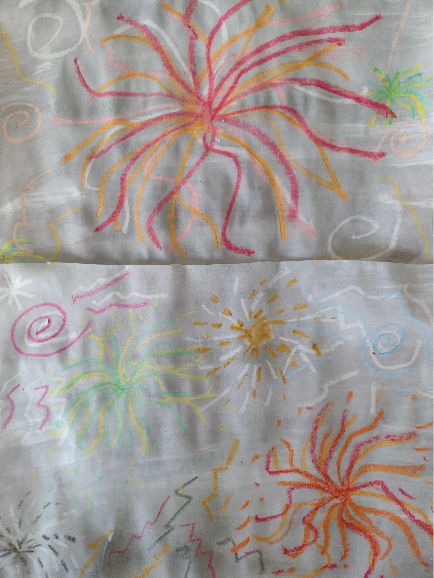
The same technique can also be used to create great firework pictures:

It is also worth remembering that drawing also helps to develop a range of different line formations, also needed for developing a good handwriting style.

Have FUN!