Pre-phonics Skills – Phonological Awareness: Stage 4 – (3 years – 5 years)

Phonological awareness relates to our sensitivity and understanding of the sound structures of our oral language. It enables us to progress from our awareness of large sound units (words in sentences) to smaller sound units (phonemes in words). It also incorporates the ways in which we communicate through speech, body language and written forms.

As your child interacts more with the world and those around them so their language and communications skills increase and the “Why?” stage is upon you. Yes! It can drive you insane at times but their brains are like a sponge, absorbing all sorts of information.

It is at this stage that your child can easily misunderstand your explanations and develop misconceptions as they try to find reasons and meanings for themselves. So, it can be useful to talk through some things again later, to check what they have understood or think about something. A good way of doing this is to ask them to tell someone else who was not there, perhaps Dad or an older brother/sister for instance. This way you can help them to develop a better understanding of the meaning of the word or concept. You can also broaden their experiences, on which to draw understanding, by setting up play scenarios or other activities.

Syllables

At about 4 years old your child is starting to split words into syllables, this allows them to break down words into manageable sound lengths. A syllable is the largest phonological unit (one or a group of sounds) of a word and is like the rhythmic beat of the word.

Your child is starting to refine their sound unit detection skills, moving them on from the previous stage of hearing and detecting articulatory gestures or features in rhymes, to recognizing them in syllables. They start to hear these sound units in different parts of a word, not just as the final sound unit of a word.

Spoken syllables are organized around the vowel sounds, making counting them easy, as the jaw drops when the vowel sound is spoken in the syllable. Try placing your hand under your jaw with your mouth closed before you say a word. Start with ‘cat’; you will notice the jaw drops once; this is because it is a one syllable (monosyllabic) word. Now try the same thing with the word ‘sunset’; your jaw drops twice as this is a two syllable (disyllabic) word, then try saying ‘important’; your jaw drops three times as this is a three syllable word (trisyllabic). Words that have more than three syllables such as hippopotamus are called polysyllabic words.

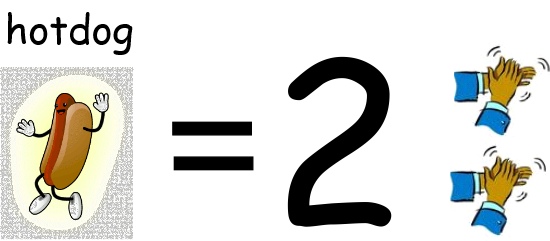
Most children will find it easier to identify syllables in compound words to start with. A compound word is formed by two words (root words) put together such as: sunset, hotdog, snowman and postman. They find it easier because the jaw tends to drop quite distinctly as we say the vowel sound in each of the root words and the slow speed at which we tend to say the word.

Children love to clap out the number of syllables in a word. It is important to say the word at a normal speed rather than really slowly as this can distort the word and make it difficult to hear the syllables. To start with your child does not need to be able to count the number of syllables in a word but just be able to recognize them by clapping, stamping or jumping for each syllable of a word. It is thought only about 50% of children can count out the syllables by the age of 4, so you can do the counting for them.

Being able to instinctively break down words into their syllables is the next step in breaking them into smaller logical sound chunks and an important skill set needed later on when your child is developing their reading and spelling strategies.

How we identify syllables in speech is slightly different from how we use syllables to de-code for reading and as a spelling strategy, but we need to talk and hear it first before moving to the written form.

Pre-phonics Skills – Phonological Awareness: Stage 3 – (2 years – 4 years)

Phonological awareness relates to our sensitivity and understanding of the sound structures of our oral language. It enables us to progress from our awareness of large sound units (words in sentences) to smaller sound units (phonemes in words). It also incorporates the ways in which we communicate through speech, body language and written forms.

By this stage your child’s awareness of rhyme will emerge, with them enjoying nursery rhymes, songs and stories with rhyme alliteration and repetition.

our child is starting to understand the more complex meaning of words and concepts such as positions (on, off, in, out, etc.) prepositions; size (big and small); quantity (1 and 2) and others such as hot, cold, wet, stop, go, loud, quiet, soft, heavy and colours.

Modelling and showing your child, the meaning of words and different concepts is really important if they are to truly understand and use them effectively in their speech (expressive language). For example, if you are trying to help them understand the meaning of wet, use water, show them the difference, and let them experience through touch and play what wet feels like compared with dry.

Explaining and using a word in different situations also helps your child to gain a fuller understanding of a word’s meaning, for instance the words ‘on’ and ‘off’ can be used in different situations; 1. You turn a light on and off. 2. You put the cup on the table or you can take it off the table. 3. Put your shoes on or take your shoes off.

Our language can be very confusing at times so it is important to provide as many opportunities as possible for your child to experience and play with new words and meanings in different ways, locations and times. It is important to model correctly formed sentences and the pronunciation of words. It is NOT about correcting your toddler and making them repeat what you have just said, but repeating back to them what they have said using the correct sentence structure or word pronunciation, modelling (leading by example). They may not be mature enough to pronounce words correctly yet, or form grammatically correct sentence, but it is what they need to be hearing, so they can store the information away for a later date.

Through talking and playing your child is also continuing to develop other key communication skills such as turn taking, understanding facial expressions and body language and the all-important listening skills. Their receptive language skills are growing fast, especially when compared to those of their expressive language, so they still understand far more than they can express.

Rhyme Awareness

Your child is beginning to become more sensitive to the larger segments of sounds within words (articulatory gestures or features). In developing this awareness, they begin to hear and enjoy the rhythmic patterns of these large sound units, providing them with more varied and engaging opportunities for sound and word play.

At about 3 years old research suggests that a child starts to store sounds units into sets that have the same or similar articulatory gestures or features. There is a limited set of articulatory gestures or features in the English language which are then reorganized and positioned in hundreds of different combinations to form words.

By this stage they are enjoying hearing and participating in action and finger rhymes, joining in ones they know and quickly taking on new rhymes and actions. They will of course have favourites which they never tire of hearing or singing (even though you may be going slightly mad hearing them again).

At around the age of 2 ½ – 3 years old your toddler is beginning to recognize and produce rhyme through oral word play. They learn through rote, and imitation, to rhyme words and identify oral rhyming words using real and made-up nonsense words. They also enjoy alliteration (words that begin with the same sounds such as ‘Sammy snake slithers silently’) and repeated short phrases which they can anticipate in a story, or rhyme, which they can join in with; such as “I’ll huff and puff and blow your house down!” in the story of ‘The Three Little Pigs’.

Pre-phonics – Phonological Awareness Stage 2 – (1 year – 2+ years)

Your child will start to isolate individual words in a speech flow, engage in sound play and recognise that sentences are made up of individual words.

By about 18 months old your toddler’s receptive language* skills have grown to understanding anything from 200-500 words, with their understanding based on the simple phrases and words they hear a lot. So, the more you talk, repeat, show, model and explain to your child the greater the opportunities they have for extending and developing their receptive language skills.

As your child’s receptive language (ability to hear and understand words) develops so will their ability to isolate key words in a sentence. For instance, they will initially pick up on the word ‘biscuit’ when asked “Do you want a biscuit?” Word awareness allows them to focus on just the relevant information they are interested in.

Continue talking to your child as much as possible, but once they are about 10-12 months old reduce the use of ‘Parentese’ and instead use clearly pronounced, more simplified language patterns.

During this stage they are starting to respond to familiar requests such as “Come here!”; understand simple questions “Where is Daddy?”; follow simple instructions “Give the ball to Mummy!” and recognize and point to familiar objects when you ask them to.

For your child to reach these milestones in their speech, language and communication abilities they need to learn and develop their listening skills. Your child needs to learn how to pay attention – being able to focus on a particular sound/voice (filtering out other noises); they need to develop their stamina – concentrating on the sound/voice to take in the information; and they need to develop their comprehension – interpreting the sound/voice to extract meaning.

Although your child’s receptive language is developing well, their expressive language is far more limited, with them only being able to say around 20 words. The frustration of understanding but not being able to communicate leads to what is commonly known as ‘The Terrible Twos’. Sign language can be a very powerful tool to help you and your child to manage and lessen these communication frustrations.

Around the age of 2 years old many children use more than 50 single words and are beginning to put 2 or 3 words together to form short phrases and to ask simple questions “what that?” or “who that?”.  They are beginning to recognize that sentences are made up of individual words and are able to pick out more than one key word in a simple sentence such as “Put your shoes and coat on!”.

Helping your child to build their vocabulary (word awareness) and the meaning of these words is vital if your child is to continue to develop good communication skills. Talking, explaining, sharing and playing are all important as well as making sure that you pronounce words clearly and correctly for your child to hear. Your child will not have developed all the skills needed yet, to copy you accurately, but they will store the sound pattern information for later use.

Playing sound detection games is a fun way of helping your child to build their sensitivity to sounds as well as helping them to develop their listening and attention abilities.

Toddlers continue to engage in sound play as they keep on building their sound knowledge and ability to distinguish between environmental sounds and those of language. They will play with words to make up rhymes and nonsense words as a way of learning how to generate new sounds, rather than for expressing their thoughts and understanding.  It is a good gauge of your child’s sensitivity to sounds in words.

* Receptive language is how we take in and understand language; it is what we hear, see and read. This also includes body language and environmental clues. All these elements help us to interpret the situation and give meaning, so that we can understand what is needed or required of us. We do not need to be able to produce language to receive and understand it, so infants and toddlers understand far more than they can express (expressive language**).

Our understanding through receptive language enables us to communicate, socialize and comprehend instructions, different situations and scenarios.

** Expressive language is our ability to put our thoughts, needs and wants into words and sentences in a way that makes sense and is grammatically correct. A baby’s expressive language to begin with is based on cries and gestures moving to sound making, combined with gestures and their body language.

We use this expressive language when we speak and write. Even when babies and toddlers move to speaking words, they have a limited vocabulary which is why they can get frustrated when we do not understand them.

Pre-phonics Skills – Phonological awareness: Stage 1

Phonological awareness relates to our sensitivity and understanding of the sound structures of our oral language. It enables us to progress from our awareness of large sound units (words in sentences) to smaller sound units (phonemes in words). It also incorporates the ways in which we communicate through speech, body language and written forms.

Stage 1 – (Unborn – 1 year)

Your child will learn to recognize, differentiate and respond to both speech and non-speech sounds, start to recognize words and interpret facial expressions and body gestures. They will begin making sounds, mimic speech patterns and start to use body language to express their needs, wants and thoughts.

Research suggests that our phonological awareness begins in the womb at about 24 weeks. New born babies have a preference for their mother’s voice, as they have had an extended period of time hearing the voice before they are born, and so find it comforting. They do not understand the words, just the sound rhythm and intonation of her speech pattern; more like music.

It is suggested that reading, talking and singing to your unborn child in the same manner you would to a baby or toddler could help to begin the sound storage/recognition process. Like many parents who have their children close together (14 months in our case) the second child’s language skills seemed to develop earlier than the firsts. This may have been because the book sharing time with our first (who was about 5 months old when I fell pregnant again) and the type of language we were using stimulated our unborn second child.

So, talk to your baby even before they are born, they will not understand what you are saying but their brain is busy; starting to store sound information that will later help them to understand language and learning to speak.

Babies initially have no language preference; they respond only to the sounds and facial gestures and mouth shapes that accompany them.

Try to expose them to a greater range of sound experiences as they develop their awareness of sounds around them. The more they hear and the associations they make to those sounds (what they see, feel, experience) the greater their ability to distinguish between them. This skill becomes important later on as they begin to isolate individual words in sentences, being able to distinguish between words that sound similar such as dog and hog.

By 6 months old linguists can tell, by the cooing and babbling that your child is producing, what range of language you have shared with them through ‘Direct Talk’.  The cooing and babbling sound your baby or toddler make are their first steps towards expressive language, producing the sounds that eventually form words.

A baby who can talk through cooing and babbling is more likely to initiate and continue verbal interaction and play with you and others. The first cooing sounds represent more vowel sounds such as ah, ooh, eee, uh, ah-ee, while the later babbling stage is more consonant sounds repeated such as ba, ba, ba, da, da, da, ma, ma, ma, ga, ga, ga.

At about 7 months old your child is now recognizing words and developing an understanding of what these words mean (receptive language).

Talk to your baby, talk all the time, about what you are doing, what is going on and just about how wonderful and beautiful they are.

How you talk to your baby has an impact. Research has shown that babies prefer you to talk to them using regular words (normal adult vocabulary) in a slightly higher pitched and more sing-song way. Although many adults do this naturally when talking to babies it has become known as ‘Parentese’ and is very different from ‘Baby Talk’.

Parentese is:

● Slower speech pace

● Articulate clearly, well-formed, elongated vowel sounds and clearly voiced consonants, so ‘hello’ becomes ‘heellooo’

● Use shorter sentences that are grammatically correct

● Vary and raise pitch of voice (as much as an octave)

● Stress words by pitch, intensity and length so ‘sweet baby’ becomes ‘sweeet baybeee’

● Use exaggerated facial expressions (eye contact, raised eyebrows, big smiles)

● Frequently use repetition

● Leave a gap/pause between sentences so that your child can coo and babble back (developing the turn taking structure of conversation)

● Talk face to face so that they can clearly see how your lips move and other facial expressions (this about 20 cm or 8 inches for a new born)

● Try using your child’s name first then the important word in the sentence and follow with the complete sentence; for example, “Jo, bottle, here is your bottle!”  Research suggests that at about 3- 4 months old a baby will turn their head when their name is called and that they will then focus on the next word that follows their name.

Baby Talk

Is where we replace regular words with nonsense or over simplified words; so “who is the cutest baby in the world!” becomes “oo es da  cutsie wootsiest beebee in da wold!”.  This does not help a child to develop the language skills they need to communicate effectively with others and can delay some children’s speech and language development.  What you may think sounds cute and adorable may actually hold your child back because others just cannot understand them, which can be very frustrating for your child.

How the Body’s Sensory Systems affect Academic Success

Sometime ago, I posted a blog with a link to an article which we felt highlighted, and backed, our own thoughts of why we need to look at the whole child and their physical and sensory development alongside their intellectual development.

It made very interesting reading then but having talked with different therapists, SENCos and teachers over the past year it seems that it has become very relevant. This is because it appears that more and more children are struggling in school and displaying learning difficulty traits that relate to sensory system difficulties.

This article explains how sensory systems impact on and affect a child’s ability to learn and are essential developmental building blocks to a child’s academic future. It also provides some practical advise.

The article ‘Sensory Systems that Make up the Learning Hierarchy of a Strong Academic Foundation’ was written and released by Integrated Learning Strategies Learning Corner on 24/02/16 http://ilslearningcorner.com/2016-02-sensory-systems-that-make-up-the-learning-hierarchy-of-a-strong-academic-foundation/

The Pre-phonics section of our website (http://www.teachphonics.co.uk/phonological-development.html ) explains how to support and develop all the visual and auditory sensory systems highlighted in the article for a strong foundation for learning.

The activity ideas work on providing a range of stimulus for a child to experience, supporting their visual and auditory development. These activity ideas can be played at home and easily built into or adapted in a school as cross curricular activity experiences.

Are your child’s #phonics skills good for their age?

With more and more expected of our pre-school and 4 to 7 year old children it can be difficult to know what the realistic age appropriate skills are in relation to phonics.

In fact, phonics is only part of the story starting at stage 8 of a child’s phonological awareness development.

Stages 1 to 7 of a child’s phonological awareness, what we refer to as pre-phonics skills, are the continual development of their understanding and knowledge of our spoken language as well as other communication forms, such as gestures, facial expressions, body language and social conventions.

Stages 8 to 10 of a child’s phonological awareness, the phonics reading and writing stages are the continual development of their understanding and knowledge for learning to reading and write.

As a child’s phonological awareness skills build on each stage, the age at which a child reaches them varies making it difficult to know how your child is doing.

We recognise this variation and use age ranges as a rough guide to help you understand where your child is in their phonological awareness skills.

By clicking on the various stages of phonological awareness you will find appropriate age range information, advice and activities to support your child. Try not to jump a stage as each one is important in unlocking the knowledge and skills for the stage above.

Stages 1 to 7 (Pre-phonics skills): https://www.teachphonics.co.uk/phonological-development.html

Stages 8 to 10 (Phonics): https://www.teachphonics.co.uk/phonological-development-phonics.html

#Christmas Finger Printing a Fun Way to Support Language Development

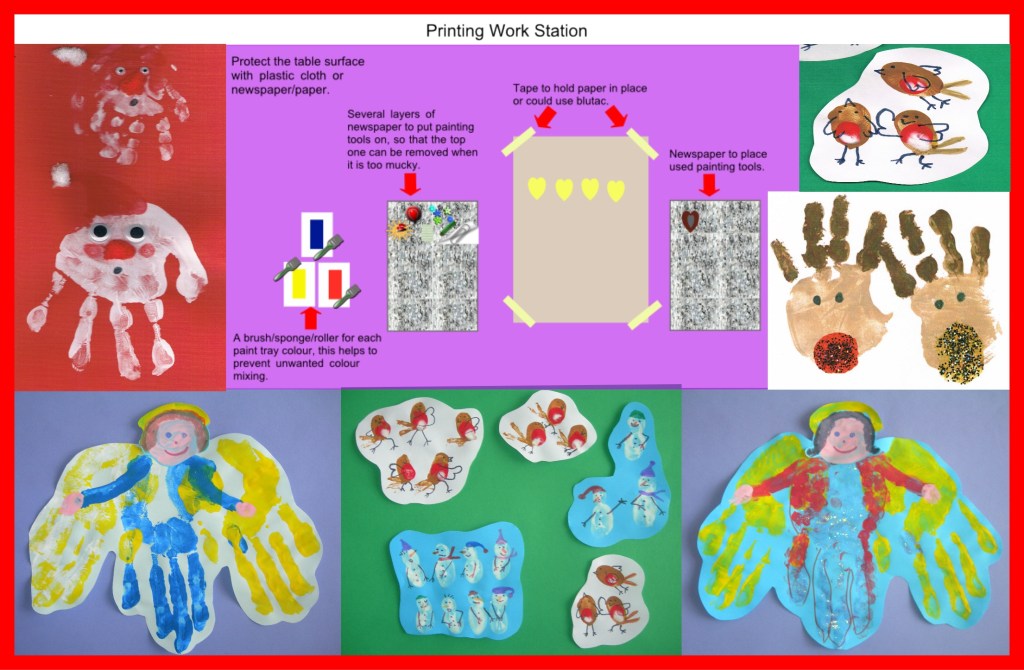
Hand and finger printing can be a fun way of getting your child used to touching, using different textured mediums and descriptive language associated with it. Such as: slimy, smooth, slippery, squidgy, wet, dry, squelch, ooze, press, push down, harder, softer, gentle, lift, light and dark.

Printing activities also help your child to start to become aware of how to control the amount of pressure they use and to develop a vocabulary to describe the different range of pressures required. Learning to control the amount of pressure exerted and how it feels can be very difficult for some children and it takes time and a range of experiences to develop these skills.

There are some fabulous printing ideas out on the internet; one of my favourite art resources is The Usborne Art Idea Books. Hand and finger printing can create some amazing artwork which can be used to make wonderful personalised Christmas cards, tags and paper.

Who could not be charmed by these fun thumb and fingertip snowmen or robins or delighted by a hand print angel or Father Christmas?

For other useful tips on printing and setting up a printing work station (https://teachhandwriting.co.uk/assets/pdfs/Setting%20up%20a%20Printing%20Workstation.pdf ), check out our ‘More fun handwriting activities, where you can talk about the effects of using different pressure, in our Resources section: https://teachhandwriting.co.uk/more-activities.html

Letter & Sound Relationships That Break the #Phonics Rules

Back in September we explained that Phonics is very useful as a decoding tool used for developing reading skills and an encoding tool for spelling. It is the simple process of linking sounds to letters, its complexity comes from how many sounds (phonemes) to letter combinations (graphemes) there are.

Some letter and sound associations just don’t follow the normal phonics rule of a single sound being associated to a letter or letter combination. A few letters represent two sounds, such as the letter ‘u’ which in the word ‘cupid’ represents the two sounds /y,(j)/ and /oo,(uː)/.

A more common one letter two sound relation is that of the letter ‘x’ representing the two sounds /k,(k)/ and /s,(s)/ as in thewords: six and box.

Here are some other examples of single letters and split digraphs making two sounds instead of the usual phonics rule of only making one sound:

What are CVC Words in #Phonics?

With many parents sadly having to tackle home learning again; we thought it would be useful to re-run this blog from last year explaining CVC words in phonics.

The letter C means a consonant letter is required.

The letter V means that a vowel letter is required.

So, a CVC word is one that has a consonant letter followed by a vowel and then a consonant as in the following examples:

ca   dog    mat

There are 26 letters in the English alphabet and these can be split in to two categories:

Vowels – ‘a’, ‘e’, ‘i’, ‘o’, ‘u’ and the letter ‘y’, when it is used as a semi-vowel, in words such as by, my and fly.

Consonants – ‘b’, ‘c’, ‘d’, ‘f’, ‘g’, ‘h’, ‘j’, ‘k’, ‘l’, ‘m’, ‘n’, ‘p’, ‘q’, ‘r’, ‘s’, ‘t’, ‘v’, ‘w’, ‘x’, ‘z’ and the letter ‘y’ when it is being used as a consonant, in words such as yak, yam and yellow.

Schools will often use the abbreviation CV, CVC, CVCC words when sending home phonics work or suggestions for phonics games. It is also used by many phonics computer games, activity programs and schemes.

Here are some examples for:

The ‘Long’ Vowel Sounds

A couple of weeks ago we explained that there are 20 vowel sounds in the English (UK) sound system and last week we looked at the 7 ‘short’ vowel sounds. This week we are taking a look at the remaining 13 ‘long’ vowel sounds.

Here at Teach Phonics we split them in to two groups: 7 ‘long’ vowel sounds and 6 ‘long ‘R’ controlled’ vowel sounds.

The 7 ‘long’ vowel sounds areso calleddue to the length of their pronunciation; these can often be held without distorting their sound.

 The /ai,(eI)/ sound found in the words: train, tray, cake and break.

The /oa,(ǝƱ)/ sound found in the words: boat, hotel, toe and bone.

The /oi,(ɔI)/ sound found in the words: boy, coin and buoy.

The /ow,(aƱ)/ sound found in the words: owl, house, drought and hour.

The /ee,(іː)/ sound found in the words: tree, pea, me, and pony.

The /I,(aI)/ sound found in the words: iron, fly, pie and light.

The /oo,(uː)/ sound found in the words: spoon, blue, screw and you.

The 6 ‘long ‘R’ controlled’ vowel sounds are so called because of the slight /r,(r)/ sound quality that can be heard in them along with the length of their pronunciation; these can often be held without distorting their sound.

The /ar,(ɑː)/ sound found in the words: car, father (southern UK accent) and art.

The /or,(ɔː)/ sound found in the words: fork, door, walk and sauce.

The /ear,(Iǝ)/ sound found in the words: ear, here, deer and pier.

The /er,(ɜː)/ sound found in the words: bird, kerb, nurse and worm.

The /re,(Ʊǝ)/ sound found in the words: manure, tour and mature.

The /air,(eǝ)/ sound found in the words: chair, pear, square and where.