Developing Speaking and Listening Skills: Play – the great starting point!

Developing good speaking and listening skills along with a wide vocabulary knowledge is an important part of your child’s phonological awareness development and phonics pre-skills base. So, it is not surprising that if a child has a weakness in these areas, they may struggle in learning to read and write.

The summer holidays are the perfect time to start working on supporting your child to develop the skill sets needed for learning to read.

How do we do this?

PLAY!!!

Last week we looked at the importance of different types of play. By giving your child, the opportunity to experience the different types of play you will also be supporting them to build their speaking and listening skills as well as broadening their vocabulary.

Developing these skills is not all about paper and pencil worksheet activities (though this helps later on).

For fun game ideas go to our ‘Big to small’ (https://teachhandwriting.co.uk/big-to-small.html) or games (https://teachhandwriting.co.uk/games.html)sections.

All these can be found in our Learning Through Play in the new parents’ area of the website: https://teachhandwriting.co.uk/parents.html

Enjoy the summer break with your child and learn to play again.

Handwriting and Phonics

The New Department of Education Writing Framework; July 2025.

Handwriting and Phonics

In the past EYFS have always explained their concerns that the Teach Handwriting Scheme for Foundation Stage does not follow their phonics schemes handwriting order.

The new writing framework has addressed this stating:

“The order in which letter formation is taught in handwriting lessons differs from the order in which phonemes are introduced in a phonics programme. This is because all phonics programmes teach letters in an order that will generate the most words for reading. Handwriting programmes, in contrast, sequence teaching by grouping letters with similar formation. Pupils should be taught both phonics and handwriting consistently and systematically, in line with the programme for each.”

 Department of Education; The writing framework: July 2025; page 37; https://www.gov.uk/government/publications/the-writing-framework

I could have cried with joy, as this is what we have always said.

Pre-phonics Skills – Phonological Awareness: Stage 5 – (4 years – 5 years)

Phonological awareness relates to our sensitivity and understanding of the sound structures of our oral language. It enables us to progress from our awareness of large sound units (words in sentences) to smaller sound units (phonemes in words). It also incorporates the ways in which we communicate through speech, body language and written forms.

By now your child has a large vocabulary and is speaking in complete sentences and understanding more complex sets of instructions. They may not always be grammatically correct and struggle at times with tense, which makes modelling the correct sentence formation and tense use very important. Again, it is not about correcting your child and making them say it again, but you repeating their words clearly using the correct grammatical order and words (modelling).

Onset and Rime

Once your child has learnt to detect syllables in spoken words; they are then able to detect, manipulate and play with the smaller sound units within a syllable. This is an important stage which supports and develops the essential segmentation skills that are needed later for phoneme awareness (single sound awareness in spoken words).

These smaller units of sound in a syllable are called the onset and rime.

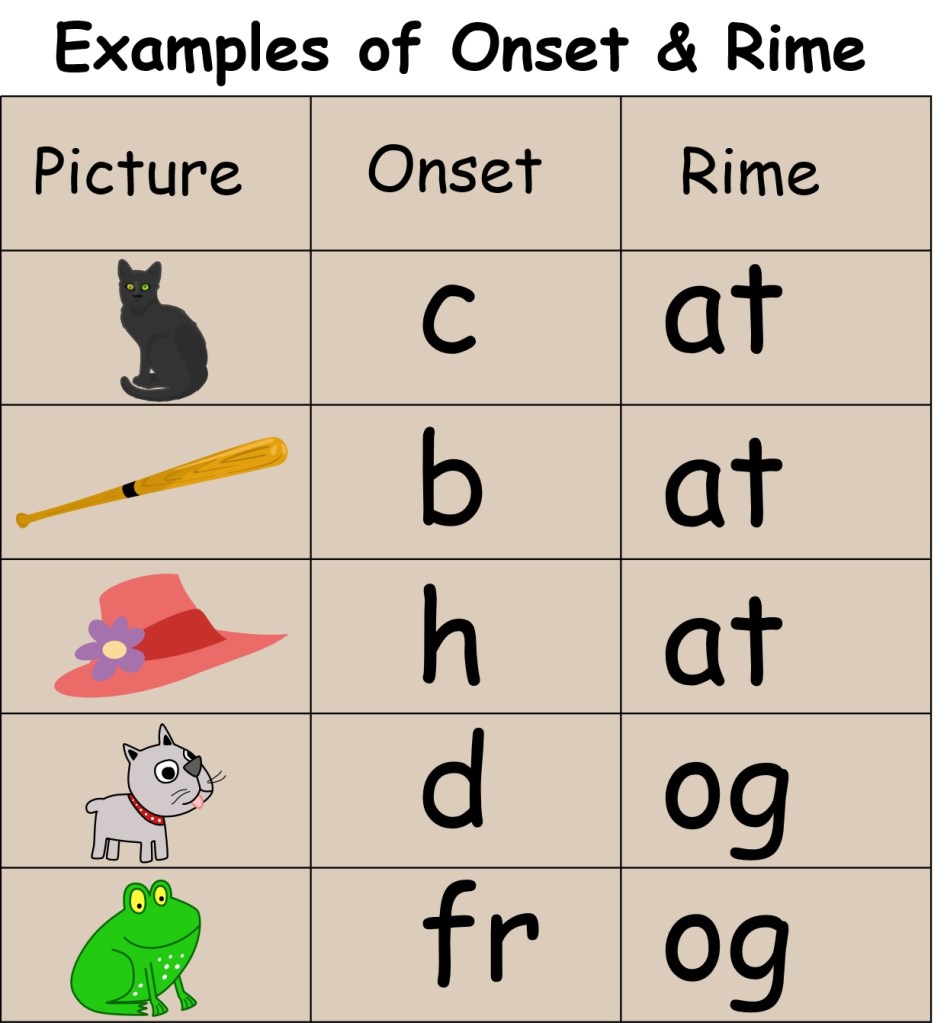
The ‘onset’ of a syllable is the initial sound or sounds (usually a consonant or consonants), which is followed by the ‘rime’ of the syllable (always starting with a vowel sound and any following consonants). For example, the onset in cat and dog is also the first sound for the word (c and d), whereas the onset for stop and splat are ‘st’ and ‘spl’ not their initial sound ‘s’.

Some examples:

One syllable words – cat; the ‘c’ is the onset and the ‘at; is the rime; Stop; the ‘st’ is the onset and the ‘op’ is the rime.

Two syllable words – snowman; the ‘sn’ in the first syllable and the ‘m’ in the second syllable are the onsets and the ‘ow’ in the first syllable and the ‘an’ in the second syllable are the rimes.

Some syllables do not have an onset as they are vowel sounds only. For example; in the five syllable word hippopotamus the second and fourth syllables have no onset.

Once a child understands that the rhyme element of a word is the last rime in the final syllable it makes it easier for them to identify and generate rhyming words. This ability is based on the sounds they hear, not on spelling conventions. A spoken rhyming group could be: chair, bear, stare, hair, fare. This helps a child understand and focus on the sound structure of our language.

Learning to group words by sounds also helps children later, as part of their de-coding strategies for learning to read and letter-string patterns for learning and developing spelling strategies.

Most children by this stage will find it fun and fairly easy to produce rhyming words, even if they consist mainly of nonsense words to begin with. However, this is not the case for all children, so moving on to the next stage and coming back to learning how to generate rhymes may be a more practical approach; as they will have developed other skills by then that will help them. But it is important to come back to cover this element later, when letter visual aids can be used to help and support your child’s learning.

What are CVC Words in #Phonics?

With many parents sadly having to tackle home learning again; we thought it would be useful to re-run this blog from last year explaining CVC words in phonics.

The letter C means a consonant letter is required.

The letter V means that a vowel letter is required.

So, a CVC word is one that has a consonant letter followed by a vowel and then a consonant as in the following examples:

ca   dog    mat

There are 26 letters in the English alphabet and these can be split in to two categories:

Vowels – ‘a’, ‘e’, ‘i’, ‘o’, ‘u’ and the letter ‘y’, when it is used as a semi-vowel, in words such as by, my and fly.

Consonants – ‘b’, ‘c’, ‘d’, ‘f’, ‘g’, ‘h’, ‘j’, ‘k’, ‘l’, ‘m’, ‘n’, ‘p’, ‘q’, ‘r’, ‘s’, ‘t’, ‘v’, ‘w’, ‘x’, ‘z’ and the letter ‘y’ when it is being used as a consonant, in words such as yak, yam and yellow.

Schools will often use the abbreviation CV, CVC, CVCC words when sending home phonics work or suggestions for phonics games. It is also used by many phonics computer games, activity programs and schemes.

Here are some examples for:

How Many ‘Short Vowel’ Sounds Do You Know?

There are 7 ‘short’ vowel sounds, although children are usually only introduced to the 5 which are most commonly heard in simple CVC (consonant, vowel, consonant) words:

  • /a,(æ)/    cat, ant
  • /e,(e)/     peg, egg
  • /i,(I)/       pin, pig
  • /o,(ɒ)/     hot, orange
  •  /u,(ʌ)/     hut, bus  

The other two ‘short’ vowel sounds are:

  • /oo(u),(Ʊ)/            bull or could
  • /uh,(ǝ or schwa)/  zebra, doctor, corner

Our ‘Short Vowel’ Finger Chant can help you, and your child, to learn and remember the 7 ‘short vowel’ sounds: https://www.teachphonics.co.uk/free-resources-phonics.html

What are CVC Words in #Phonics?

With many parents sadly having to tackle home learning again; we thought it would be useful to re-run this blog from last year explaining CVC words in phonics.

The letter C means a consonant letter is required.

The letter V means that a vowel letter is required.

So, a CVC word is one that has a consonant letter followed by a vowel and then a consonant as in the following examples:

ca   dog    mat

There are 26 letters in the English alphabet and these can be split in to two categories:

Vowels – ‘a’, ‘e’, ‘i’, ‘o’, ‘u’ and the letter ‘y’, when it is used as a semi-vowel, in words such as by, my and fly.

Consonants – ‘b’, ‘c’, ‘d’, ‘f’, ‘g’, ‘h’, ‘j’, ‘k’, ‘l’, ‘m’, ‘n’, ‘p’, ‘q’, ‘r’, ‘s’, ‘t’, ‘v’, ‘w’, ‘x’, ‘z’ and the letter ‘y’ when it is being used as a consonant, in words such as yak, yam and yellow.

Schools will often use the abbreviation CV, CVC, CVCC words when sending home phonics work or suggestions for phonics games. It is also used by many phonics computer games, activity programs and schemes.

Here are some examples for:

What are CVC Words in #Phonics?

With many parents sadly having to tackle home learning again; we thought it would be useful to re-run this blog from last year explaining CVC words in phonics.

The letter C means a consonant letter is required.

The letter V means that a vowel letter is required.

So, a CVC word is one that has a consonant letter followed by a vowel and then a consonant as in the following examples:

cat    dog    mat

There are 26 letters in the English alphabet and these can be split in to two categories:

Vowels – ‘a’, ‘e’, ‘i’, ‘o’, ‘u’ and the letter ‘y’, when it is used as a semi-vowel, in words such as by, my and fly.

Consonants – ‘b’, ‘c’, ‘d’, ‘f’, ‘g’, ‘h’, ‘j’, ‘k’, ‘l’, ‘m’, ‘n’, ‘p’, ‘q’, ‘r’, ‘s’, ‘t’, ‘v’, ‘w’, ‘x’, ‘z’ and the letter ‘y’ when it is being used as a consonant, in words such as yak, yam and yellow.

Schools will often use the abbreviation CV, CVC, CVCC words when sending home phonics work or suggestions for phonics games. It is also used by many phonics computer games, activity programs and schemes.

Here are some examples for:

How Many ‘Short Vowel’ Sounds Do You Know?

There are 7 ‘short’ vowel sounds, although children are usually only introduced to the 5 which are most commonly heard in simple CVC (consonant, vowel, consonant) words:

  • /a,(æ)/    cat, ant
  • /e,(e)/     peg, egg
  • /i,(I)/       pin, pig
  • /o,(ɒ)/     hot, orange
  •  /u,(ʌ)/     hut, bus  

The other two ‘short’ vowel sounds are:

  • /oo(u),(Ʊ)/            bull or could
  • /uh,(ǝ or schwa)/  zebra, doctor, corner

Our ‘Short Vowel’ Finger Chant can help you, and your child, to learn and remember the 7 ‘short vowel’ sounds: https://www.teachphonics.co.uk/phonics-resources.html

English (UK) Vowel Sounds

Learning to hear and differentiate the vowel sounds from consonant sounds is an important skill in understanding how words are formed. Every word in the English Language has to have a vowel sound in it and every syllable in a word also has to have a vowel sound within it. This knowledge is an important element in developing our phonemic awareness and phonics knowledge as we start to learn how to read and spell words.

There are 20 vowel sounds in the English (UK) Language, usually (in the UK Education System) split into two main categories based on sound quality:

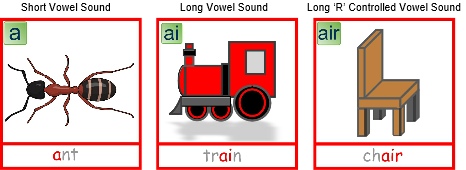
  • ‘Short’ vowel sounds, due to the short duration of the sound being made, the sound cannot be held onto without becoming distorted, such as the /e,(e)/ in me, pea and tree
  • ‘Long’ vowel sounds, due to the length of their pronunciation, these can often be held without distorting their sound, such as the /oi,(ɔI)/ sound found in the words: boy, coin and buoy

Here at Teach Phonics we split the ‘long’ vowel sounds category into ‘long’ vowel sounds and ‘long ‘R’ controlled’ vowel sounds. The ‘long ’R’ controlled’ vowel sounds are so called because of the slight /r,(r)/ sound quality that can be heard in them for example the /or,(ɔː)/ sound found in the words: fork, door, walk and sauce.

The English Phoneme Chart (https://www.teachphonics.co.uk/phonics-phoneme-chart.html), which uses the unique symbols of the International Phonetic Alphabet (IPA), splits the 20 vowel sounds into two groups based on mouth position:

  • Monophthongs which have one mouth position throughout the sound for example /e,(e)/ in me.
  • Diphthongs, where the mouth position changes, giving a 2 sounds quality to the phoneme for example, /oi,(ɔI)/ in boy.

Letter Names & Phonics

Phonics Assessment Pages

On our website, and as part of our Teach Handwriting Scheme, children are taught the letter names. Schools seem to be concerned that this is not consistent with the teaching of phonics.

A myth which seems to have become popular, since the introduction of phonics into schools, is that children should not be taught the alphabet letter names as they find it too confusing. However, there is no evidence to suggest this is true. The Independent review of the teaching of early reading, final report, Jim Rose March 2006 states:

“The teaching of letter names is often left until after the sounds of the letters have been learned, in the belief that it can be confusing for children to have to learn both together. However, research indicates that children often learn letter names earlier than they learn letter sounds and that five year olds who know more letter names also know more letter sounds. The reason for this are not fully understood by researchers’

Given that children will meet many instances outside, as well as within, their settings and schools where letter names are used, it makes sense to teach them within the programme of early phonic work.

It appears that the distinction between a letter name and a letter sound is easily understood by the majority of children.” (Page 26)

Rose, cites Professor Morag Stuart who suggests that:

‘…children expect things to have names and are accustomed to rapidly acquiring the names of things.’ (Independent review of the teaching of early reading’ final report, Jim Rose March 2006, page 27.)

Learning the unique letter names of the alphabet is a pre-phonics skill; as well as an early learning goal. It has to be remembered that a letter is a shape which only represents a sound when it is placed within a word or sentence. Also a letter or combination of letters can represent more than one sound and so the only unique way of identifying alphabet letters when we talk about them is to use their names.

Learning the correct letter names helps to reinforce that when talking about the letter ‘a’ (ay) for example it has a set shape regardless of the sound that it will be representing in the word. This further supports children’s handwriting development as the communication of your requirements is unambiguous.

One of the first things we like a child to be able to write correctly is their name, however most names are impossible to spell using the simple phonics code taught to young children. A name does not have to be long in length to be phonetically difficult to spell such as Christopher or Charlotte. Shorter names such as Lucy or Liam also cause a problem.

The only logical answer I suggest is to use the letter names until a child has been introduced to the more complex phonics coding system.