The ‘Long’ Vowel Sounds

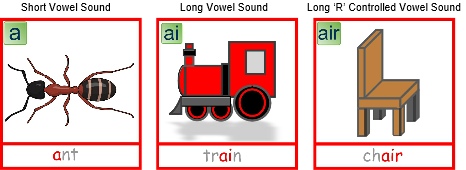
A couple of weeks ago we explained that there are 20 vowel sounds in the English (UK) sound system and last week we looked at the 7 ‘short’ vowel sounds. This week we are taking a look at the remaining 13 ‘long’ vowel sounds.

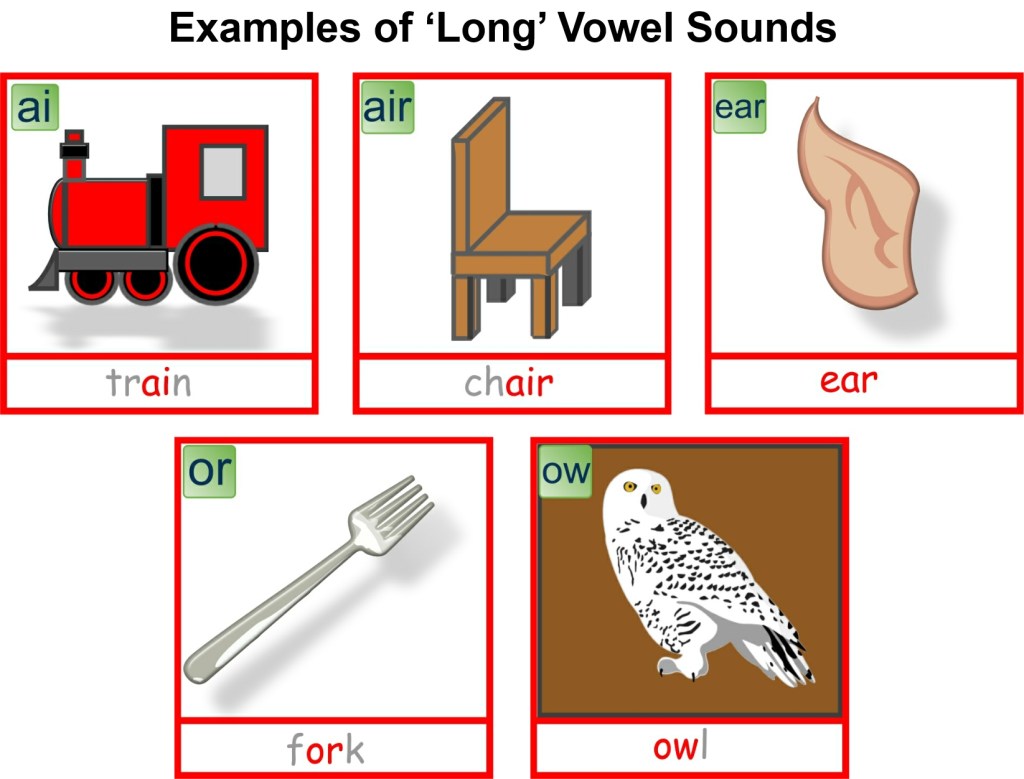
Here at Teach Phonics we split them in to two groups: 7 ‘long’ vowel sounds and 6 ‘long ‘R’ controlled’ vowel sounds.

The 7 ‘long’ vowel sounds areso calleddue to the length of their pronunciation; these can often be held without distorting their sound.

 The /ai,(eI)/ sound found in the words: train, tray, cake and break.

The /oa,(ǝƱ)/ sound found in the words: boat, hotel, toe and bone.

The /oi,(ɔI)/ sound found in the words: boy, coin and buoy.

The /ow,(aƱ)/ sound found in the words: owl, house, drought and hour.

The /ee,(іː)/ sound found in the words: tree, pea, me, and pony.

The /I,(aI)/ sound found in the words: iron, fly, pie and light.

The /oo,(uː)/ sound found in the words: spoon, blue, screw and you.

The 6 ‘long ‘R’ controlled’ vowel sounds are so called because of the slight /r,(r)/ sound quality that can be heard in them along with the length of their pronunciation; these can often be held without distorting their sound.

The /ar,(ɑː)/ sound found in the words: car, father (southern UK accent) and art.

The /or,(ɔː)/ sound found in the words: fork, door, walk and sauce.

The /ear,(Iǝ)/ sound found in the words: ear, here, deer and pier.

The /er,(ɜː)/ sound found in the words: bird, kerb, nurse and worm.

The /re,(Ʊǝ)/ sound found in the words: manure, tour and mature.

The /air,(eǝ)/ sound found in the words: chair, pear, square and where.

English (UK) Vowel Sounds

Learning to hear and differentiate the vowel sounds from consonant sounds is an important skill in understanding how words are formed. Every word in the English Language has to have a vowel sound in it and every syllable in a word also has to have a vowel sound within it. This knowledge is an important element in developing our phonemic awareness and phonics knowledge as we start to learn how to read and spell words.

There are 20 vowel sounds in the English (UK) Language, usually (in the UK Education System) split into two main categories based on sound quality:

  • ‘Short’ vowel sounds, due to the short duration of the sound being made, the sound cannot be held onto without becoming distorted, such as the /e,(e)/ in me, pea and tree
  • ‘Long’ vowel sounds, due to the length of their pronunciation, these can often be held without distorting their sound, such as the /oi,(ɔI)/ sound found in the words:boy, coin and buoy

Here at Teach Phonics we split the ‘long’ vowel sounds category into ‘long’ vowel sounds and ‘long ‘R’ controlled’ vowel sounds. The ‘long ’R’ controlled’ vowel sounds are so called because of the slight /r,(r)/ sound quality that can be heard in them for example the /or,(ɔː)/ sound found in the words: fork, door, walk and sauce.

The English Phoneme Chart (https://www.teachphonics.co.uk/phonics-phomene-chart.html), which uses the unique symbols of the International Phonetic Alphabet (IPA), splits the 20 vowel sounds into two groups based on mouth position:

  • Monophthongs which have one mouth position throughout the sound for example /e,(e)/ in me.
  • Diphthongs, where the mouth position changes, giving a 2 sounds quality to the phoneme for example, /oi,(ɔI)/ inboy.

The Consonant Sounds with their Most Common Letter and Letter Combinations

There are 24 consonant sounds in the English language. A consonant sound is made (produced) when the air flow is being restricted in some way, which means that the mouth doesn’t open as wide and so the jaw doesn’t drop noticeably, which is different from vowel sounds.

Here is a list of just some of the most commonly seen letter and letter combinations used to represent the 24 consonant sounds. For a more comprehensive lists check out our English Phoneme Chart or Alphabet Keyboard which can be found on our ‘Phonemes’ page: https://www.teachphonics.co.uk/phonics.html            

  • /b,(b)/      bin, rabbit
  • /k,(k)/      cat, key, duck, queen, anchor, broccoli
  • /ch,(ʧ)/    church, watch
  • /d,(d)/      dog, ladder, towed
  • /f,(f)/        fish, puffin, phone, laugh
  • /g,(g)/     girl, digger, ghost
  • /h,(h)/     hen, who
  • /j,(ʤ)/      jigsaw, giant, bridge
  • /l,(l)/        lion, llama
  • /m,(m)/   man, hammer, lamb
  • /n,(n)/     nest, penny, knife, gnome
  • /ng,(ŋ)/   king, sink
  • /p,(p)/     panda, hippo
  • /r,(r)/      robin, lorry, wrist
  • /s,(s)/    sun, dress, city, geese, castle
  • /sh,(ʃ)/   ship, chef, delicious, initials, sugar
  • /t,(t)/      tent, butterfly, jumped
  • /th,(θ)/   thumb
  • /th,(ð)feather, breathe
  • /v,(v)/   van, sleeve, of
  • /w,(w)well, whale, penguin
  • /y,(j)/    yo-yo, euro
  • /z,(z)/    zero, puzzle, sneeze, cheese, is
  • /zh,(Ʒ)measure, television

Accents – Phonemic awareness & Phonics

Because the English language is so rich and diverse it is very difficult to create a phonics system that caters for all. Every region that speaks the English language has its own accent which means there are always variations in the way that a word is pronounced.

Across England we all spell words the same but we certainly do not say them all the same, even though we all use the same 44 sounds. In the English language the 44 sounds can be represented by over 280 letter combinations.

So, accents have arisen from regions applying different phonemes (sounds) to graphemes (letters) when they pronounce words. The regions still use the same sounds and letters, they just associate them differently.

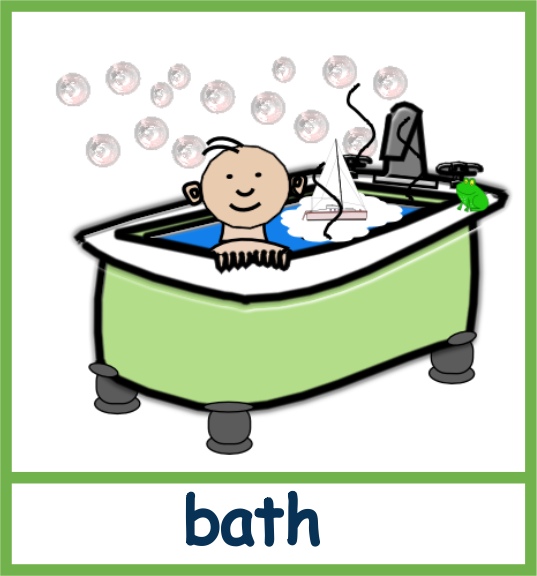
For example, in the South of England the letter ‘a’ can be pronounced as the ‘long ’R’ controlled’ vowel sound /ar,(ɑː)/ in words such as ‘grass’ and ‘bath’ whereas in the North of England it will be pronounced as the ‘short’ vowel /a,(æ)/ sound in these two words.

Click and then scroll down the page to see the animations of the different pronunciations of the word ‘bath’. https://www.teachphonics.co.uk/teaching-phonics.html#pronunciation

Both pronunciations are correct, which can make teaching phonics a little tricky; the key is to teach the sound to letter relationships which best suit the children being taught in relation to their regional accent. It is important to remember that children’s knowledge of the sounds that make words is based on how you speak to them naturally and not a strict standardized set of sounds.

However, for general educational and learning purposes the English language’s phonics system has been standardized, this is known as the ‘Received Pronounced’ (RP) English, and is used in comprehensive English dictionaries and translation dictionaries. The RP is based on a southern accent sound to letter relationship basis.

What is the difference between #phonics and #phonemic awareness?

With the new school year well under way many new parents are being introduced to the world of phonics and all the technical language associated with it. So, we thought we would take this opportunity to demystify some of that technical language.

Phonics is the association of sounds (phonemes) to written alphabet letters (graphemes). For reading (decoding) the phonics coding system is used to convert the written word into sounds. For spelling (encoding) the same phonics coding system is used to covert sounds heard into letters to form written words.

Phonemic awareness is our ability to split words into their smallest sound units (individual phonemes) and to manipulate these sounds through segmentation, blending, substitution, re-ordering and deletion. This is based on what we hear and say, not the written word.

Good phonemic awareness is the vital skill required before phonics can be introduced successfully as a tool for learning to read and spell.

  • Segmentation – being able to split words into their individual sounds, for example ‘cat’ into c-a-t.
  • Blending – being able to blend individual sounds together to say a word, for example d-o-g into dog.
  • Substitution – being able to swap one sound for another in a word, for example swapping the /k,(k)/ sound in the word ‘cat’ with a /h,(h)/ sound to say the word ‘hat’.
  • Reordering – being able to swap the sounds around to create a new word, for example changing the order of the letters in the word ‘cat’ to form the new word ‘act’.
  • Deletion (omission) – being able to remove a sound from a word to create a new word, for example removing the /t,(t)/ sound from the word ‘cart’ to say the new word ‘car’.

These are developed further when phonics is introduced, sound to letter association.

Watch our ‘Single Word Reading’ animation to see these manipulation skills in action: https://www.teachphonics.co.uk/phonics-reading-lesson-plans.html

What is ‘The Simple View of Reading’?

The term ‘Simple View of Reading’ used by schools may seem strange as there is nothing simple about learning to read.

‘The Simple View of Reading’ was adopted by the Government in 2007 and now underpins the English National Curriculum’s programmes of study for reading at Key Stage 1 and 2.

Even though reading, the ability to decode the word and extract the correct meaning of the words, is a complex set of skills; ‘the Simple View of Reading’ conceptual framework (Stuart et al. 2008, cited Hoover and Gough, 1986) reduces it down to two key components:

  • Word recognition – the ability to decode unknown words and recognise printed words.
  • Language comprehension – the ability to understand the spoken words and use this process to understand the written text.
Reading Comprehension = Decoding x Linguistic Comprehension

So in theory a child’s reading comprehension ability can be predicted by looking at their decoding and linguistic (spoken language) comprehension abilities (Johnston & Watson, 2007).

When using ‘the Simple View of Reading’ as the basis for teaching reading it becomes clearer as to why:

  • A high quality phonics scheme is required, which  the Rose Report (2006) explains ‘…is not a  ‘strategy’ so much as a body of knowledge, skills and understanding that has to be learned.’ (page 20) [This teaches children how to decode.]
  • A language rich environment to develop and encourage linguistic comprehension is vital.

Bibliography

Johnston.R. and Watson.J. ‘Teaching Synthetic Phonics’, 2007, Pub: Learning Matters, Sage Publication Ltd.

Rose.J. ’Independent review of the teaching of early reading: final report March 2006’ Pub: DfES Publications

The simple view of reading and evidence based practice’ Rhona Stainthorp Institute of Education, Reading University, Morag Stuart, Institute of Education, University of London (2008) Pdf downloaded from internet

Back to School – Ways to Support Your Child’s Phonics Knowledge

After such a long break from school it is good to take some time to check your child has not slipped back.

Playing some simple letter name and sound games can really help get your child (and you) back into school mode.

Some simple game ideas:

  • You can use words in books, cards, on labels or signs when out and about.  Ask your child to point to a particular letter in the word using the letter name. Then ask your child to say the word, or you can say it. Then ask them to tell you what sound the letter is making in that word.
  • Pick a card at random, using lower-case and capital letter flash cards (you can make your own); show your child and ask them to tell you the name of the letter on the card, and to give you a sound the letter makes. Ask older children to give you the other sounds the letter can make. For older children you can also use cards that have common digraphs (two letters representing one sound) and trigraphs (three letters representing one sound) on.
  • Play Pelmanism (Memory Game). How to Play:
    • You will need two sets of flash cards. The cards are thoroughly mixed and spread face down on the table or floor. They can be arranged in a regular pattern or randomly, but they must not overlap.
    • One player turns over a card, leaving it in the same place, they say what it is (letter name and/or sound) and then turn over another saying what it is. If the two cards match then the player keeps them and has another go. If the cards do not match then the cards are turned back over in the same location as before and it is the next players turn.
    • The game is finished when all the cards have been matched and the winner is the one with the most pairs.

If you are not sure of all the sounds a letter, or combination of letters, can represent then use our Alphabet Keyboard to help you find the sounds (phonemes):  https://www.teachphonics.co.uk/phonics-alphabet-chart.html

Back to School – What is Phonics?

With the new school year under way or starting soon, some of you will have been introduced to phonics for the first time.

Phonics is the simple process of linking sounds to letters, its complexity comes from how many sound (phoneme) to letter (grapheme) combinations there are. So, to be good at phonics a child needs to know the 44 sounds and numerous letter and letter combinations of English and then learn the associations between the two.

Children can communicate orally from an early age; it is when they move to the written word that they need to learn how to decode text, to turn the letters into words they already know.  

Using phonics knowledge for reading entails:

  1. Identify the letter or letter combination, in a word, that represent a sound
  2. Associate the letter or letter combination to one of the 44 sounds
  3. Blend each of the sounds together to form the word
  4. Recognise the now oral word to extract its meaning

The theory supporting the teaching of reading using phonics, especially synthetic phonics, is that if a child can decode a word by associating individual sounds to a letter or combination of letters, they will then be able to blend those sounds together to form and say the word.

Once a word has been spoken, they will extract its meaning by using their far more extensive spoken language comprehension. Children are therefore using the same mental processes to understand written text and speech.

The Key to Good Phonics Skills – Part 13

Developing #Listening & #Speaking Skills – Syllable Awareness & Counting (Word Play)

At about the age of 4 years old children start to develop an understanding that words can be split into sound parts (syllables) and that these parts give the word its rhythm.  A syllable is the largest phonological unit (one or a group of sounds) of a word and is like the rhythmic beat of the word.

They should be able to orally blend syllables together to form words and segment words into syllables (https://www.teachphonics.co.uk/phonological-awareness-stage-4.html).

A fun activity to help develop syllable understanding:

How Many Syllables?     

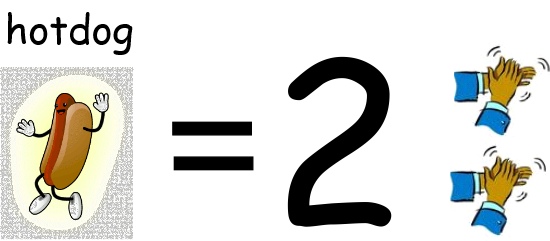
Children love to clap out the number of syllables in a word. It is important to say the word at a normal speed rather than really slowly as this can distort the word and make it difficult to hear the syllables. To start with a child just needs to be able to recognize them by clapping, stamping or jumping for each syllable of a word; they don’t need to be able to count them. It is thought that only about 50% of children can count out the syllables by the age of 4, so you can do the counting for them.

Spoken syllables are organised around the vowel sounds, making counting them easy; as the jaw drops when the vowel sound is spoken in the syllable. Try placing your hand under your jaw with your mouth closed before you say a word. Start with ‘cat’ you will notice the jaw drops once; this is because it is a one syllable (monosyllabic) word.

Most children will find it easier to identify syllables in compound words to start with. A compound word is formed by two words (root words) put together such as: sunset, hotdog, snowman and postman. They find it easier because the jaw tends to drop quite distinctly as we say the vowel sound in each of the root words and because we tend to say these words slowly.

The Key to Good Phonics Skills – Part 2

Developing #Listening Skills – Sound Screen/Barrier Games

Last week we explained the three things required for good listening skills:

  • To pay attention – being able to focus on a particular voice or sound by filtering out other voices and ambient noises.
  • To concentrate on the voice or sounds to take in the information, building the stamina needed to listen for extended periods of time.
  • To interpret that information to gain meaning – comprehension.

Here are some games to help build these skills.

These games are designed to help a child learn how to block out ambient noises so that they focus and concentrate on one particular sound.

Create a barrier between you and your child so that they cannot see the object you are going to use to make noises with and see if they can guess the object. Try to use objects that make sounds that occur around them a lot of the time, for example keys rattling together or wooden blocks being knocked together. There are many variations of the game that can be played but you need to make sure your child has the opportunity to experience the sounds with the relevant object beforehand so they don’t get frustrated by the game.

  • Mrs Blog has a box… To the tune of Old Macdonald changing the name as best fits the situation. Place a box, on its side with a number of objects inside that make a noise (choose items your child is familiar with the sound of), between you and your child so they can’t see what is in the box. Start singing “My mummy has a box ee, i, ee, i, o and in that box she has…” Stop and gesture to encourage your child to listen (maybe a cupped hand to your ear) then pick one of the objects and make a sound; your child then tries to guess what it is. Continue to sing but imitating the sound of the object you played, which your child can now see. If it was a bunch of keys for example; “with a jingle, jangle here and a jingle jangle there, my mummy has a box ee, i, ee, i, o.” Swap places so your child can choose an object in the box, change the song so you are using their name, for example “My James has a box…”
  • Same or Different?  Place a barrier between you and your child so they cannot see which object you will use to make a sound and that you duck behind so they cannot see your face when you make vocal sounds.  This can be played at different levels. At the basic level using animal noises such as baa, moo, woof etc. A more complex level would be to use shakers with different size things inside to make different shaking sounds. Plastic containers or bags of the same size and type can be used to make the shakers with different small items in such as dried pea, rice, sand or small coins, pebbles or small Lego bricks. Make the noise once and then repeat either with the same noise or a different one. The child then says if they were the same or different.
  • Copy Cat!  Place a barrier between you and your child so they cannot see which object you will use to make a sound and that you duck behind so they cannot see your face when you make vocal sounds.  You will need two set of the same objects, a set for you and one for your child. The aim of the game is for you to make a noise with either an object or your voice and for your child to copy that sound choosing the correct object in front of them or using their voice as you did. The game can become more complicated as you mix a number of sounds using objects and your voice. Swap roles so that your child becomes the leader of the game and you have to copy them.

Have Fun! N.B. Be careful of small objects, especially those escaping from shakers, as these can be a choke hazard.