Pre-phonics Skills – Phonological Awareness: Stage 5 – (4 years – 5 years)

Phonological awareness relates to our sensitivity and understanding of the sound structures of our oral language. It enables us to progress from our awareness of large sound units (words in sentences) to smaller sound units (phonemes in words). It also incorporates the ways in which we communicate through speech, body language and written forms.

By now your child has a large vocabulary and is speaking in complete sentences and understanding more complex sets of instructions. They may not always be grammatically correct and struggle at times with tense, which makes modelling the correct sentence formation and tense use very important. Again, it is not about correcting your child and making them say it again, but you repeating their words clearly using the correct grammatical order and words (modelling).

Onset and Rime

Once your child has learnt to detect syllables in spoken words; they are then able to detect, manipulate and play with the smaller sound units within a syllable. This is an important stage which supports and develops the essential segmentation skills that are needed later for phoneme awareness (single sound awareness in spoken words).

These smaller units of sound in a syllable are called the onset and rime.

The ‘onset’ of a syllable is the initial sound or sounds (usually a consonant or consonants), which is followed by the ‘rime’ of the syllable (always starting with a vowel sound and any following consonants). For example, the onset in cat and dog is also the first sound for the word (c and d), whereas the onset for stop and splat are ‘st’ and ‘spl’ not their initial sound ‘s’.

Some examples:

One syllable words – cat; the ‘c’ is the onset and the ‘at; is the rime; Stop; the ‘st’ is the onset and the ‘op’ is the rime.

Two syllable words – snowman; the ‘sn’ in the first syllable and the ‘m’ in the second syllable are the onsets and the ‘ow’ in the first syllable and the ‘an’ in the second syllable are the rimes.
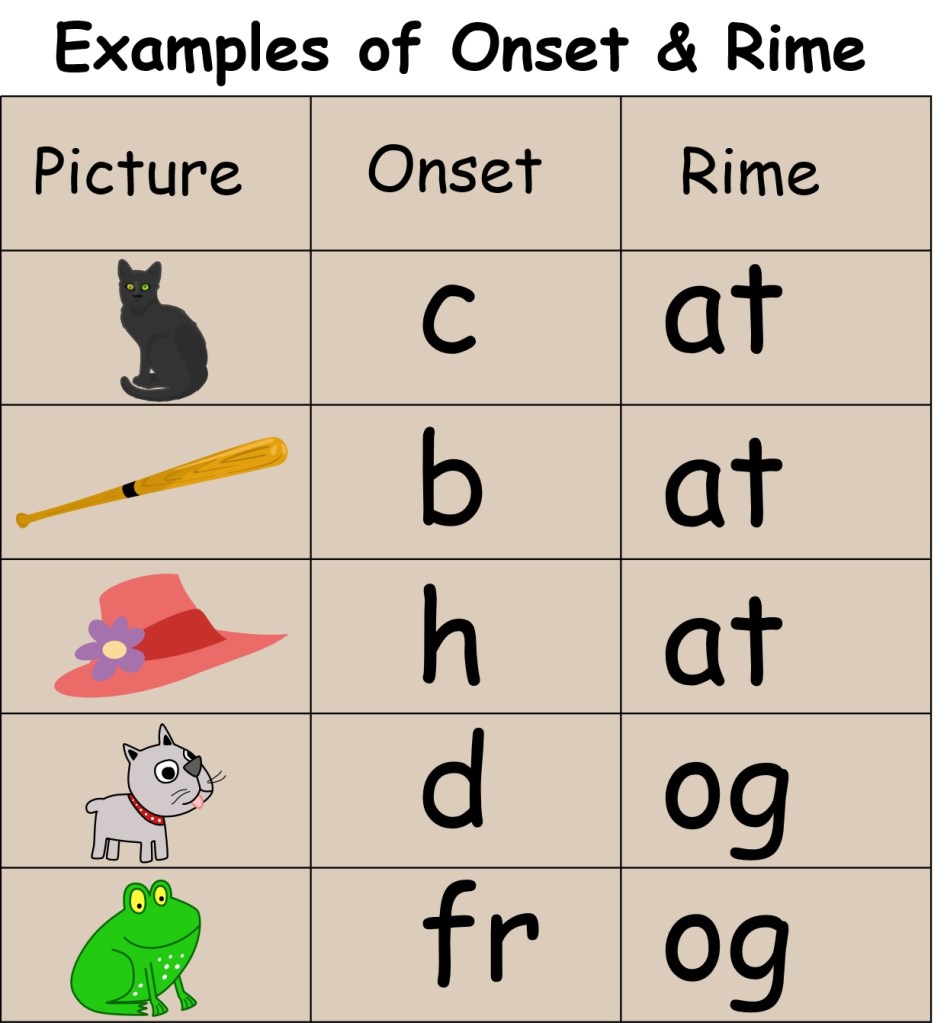
Some syllables do not have an onset as they are vowel sounds only. For example; in the five syllable word hippopotamus the second and fourth syllables have no onset.

Once a child understands that the rhyme element of a word is the last rime in the final syllable it makes it easier for them to identify and generate rhyming words. This ability is based on the sounds they hear, not on spelling conventions. A spoken rhyming group could be: chair, bear, stare, hair, fare. This helps a child understand and focus on the sound structure of our language.

Learning to group words by sounds also helps children later, as part of their de-coding strategies for learning to read and letter-string patterns for learning and developing spelling strategies.

Most children by this stage will find it fun and fairly easy to produce rhyming words, even if they consist mainly of nonsense words to begin with. However, this is not the case for all children, so moving on to the next stage and coming back to learning how to generate rhymes may be a more practical approach; as they will have developed other skills by then that will help them. But it is important to come back to cover this element later, when letter visual aids can be used to help and support your child’s learning.
Half-term Fun – Clothes Peg Games

Some fun indoor activities may be the order of the day for this half term as the weather is not so hot.

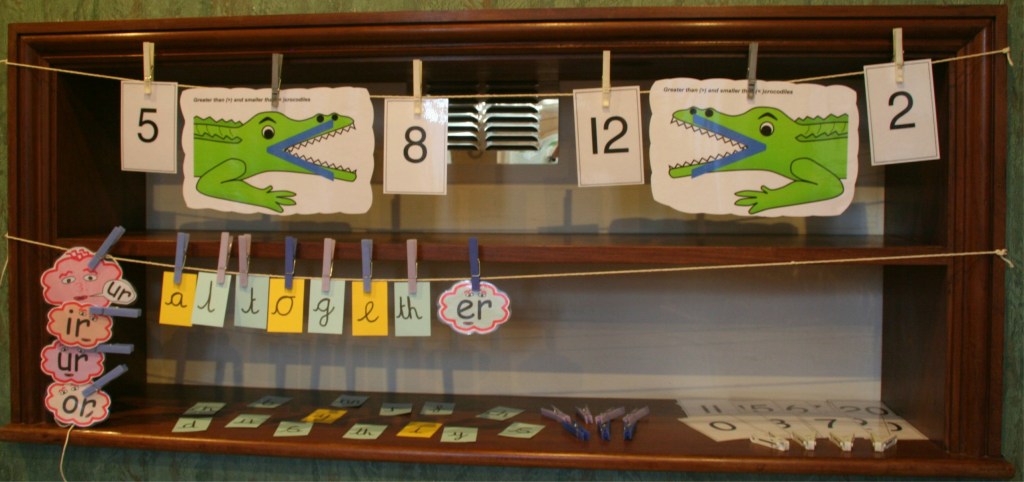
This is a very simple idea which children love because they can take greater ownership of it. The aim of the activity is to help build up hand and finger strength through using the pegs; however, it can have a dual purpose, helping to keep track of the week by using it as a timetable or for learning spellings or maths activities, as well as supporting the development of language skills.

You do not need anything fancy, just some string (for the washing line), clothes pegs and pieces of paper or card to peg onto the washing line. The washing line can be a permanent fixture or you can just pop it up when you need to use it.

The clothes line needs to be at a height suitable for your child to peg things on to (placed against a wall is a safe option so that no-one can walk into it by accident and hurt themselves).

There are a whole range of games that can be played using this simple washing line and pegs concept:

Memory games – Get your child to peg up 5 to 10 different pictures or items on the line. Then give them 1 minute to remember the items. Once the time is up ask them to look away, or close their eyes, and then you remove one or more of the items. Get them to look back at the line. Can they work out what is missing?

  • You could try just moving one or two of the items around. Can they figure out which ones are in the wrong place and put them back in their correct place?
  • Try swapping an item for something new, which your child did not hang up on the line. Can they work out which is the new item on the line?

Odd One Out – Hang pictures on the line that belong together. Can they pick out the odd item on the line and explain why it is the odd one out.

  • They could all be pictures of fruit with a picture of some clothing
  • They could be shapes with straight sides and one with curves
  • They could all be animals but all are wild with only one being domestic

Sorting – Ask your child to sort all the pictures or items from a selection and to hang all the identical things on the washing line. They could all be the same;

  • Colour
  • Shape
  • Type

Pattern Work – Using pictures, different colour and shaped paper or items create different patterns. The patterns can be based on colour, size or type of object. You can create a pattern sequence on the washing line and then ask your child to try and copy the sequence. Can they explain the pattern and create their own for you to copy and explain?

Pairing or What is the Same? – Hang a range of pictures or items on the line, making sure that some of the items can be paired together because they are exactly the same. They could match because;

  • They are exactly the same e.g., a pair of socks
  • Match numbers to a picture with the same number of items on
  • Match capital to lower-case letters
  • Or have items that can be put together because they are both from the same set, for example they are types of fruit or are the same colour.

Pre-phonics Skills – Phonological Awareness: Stage 4 – (3 years – 5 years)

Phonological awareness relates to our sensitivity and understanding of the sound structures of our oral language. It enables us to progress from our awareness of large sound units (words in sentences) to smaller sound units (phonemes in words). It also incorporates the ways in which we communicate through speech, body language and written forms.

As your child interacts more with the world and those around them so their language and communications skills increase and the “Why?” stage is upon you. Yes! It can drive you insane at times but their brains are like a sponge, absorbing all sorts of information.

It is at this stage that your child can easily misunderstand your explanations and develop misconceptions as they try to find reasons and meanings for themselves. So, it can be useful to talk through some things again later, to check what they have understood or think about something. A good way of doing this is to ask them to tell someone else who was not there, perhaps Dad or an older brother/sister for instance. This way you can help them to develop a better understanding of the meaning of the word or concept. You can also broaden their experiences, on which to draw understanding, by setting up play scenarios or other activities.

Syllables

At about 4 years old your child is starting to split words into syllables, this allows them to break down words into manageable sound lengths. A syllable is the largest phonological unit (one or a group of sounds) of a word and is like the rhythmic beat of the word.

Your child is starting to refine their sound unit detection skills, moving them on from the previous stage of hearing and detecting articulatory gestures or features in rhymes, to recognizing them in syllables. They start to hear these sound units in different parts of a word, not just as the final sound unit of a word.

Spoken syllables are organized around the vowel sounds, making counting them easy, as the jaw drops when the vowel sound is spoken in the syllable. Try placing your hand under your jaw with your mouth closed before you say a word. Start with ‘cat’; you will notice the jaw drops once; this is because it is a one syllable (monosyllabic) word. Now try the same thing with the word ‘sunset’; your jaw drops twice as this is a two syllable (disyllabic) word, then try saying ‘important’; your jaw drops three times as this is a three syllable word (trisyllabic). Words that have more than three syllables such as hippopotamus are called polysyllabic words.

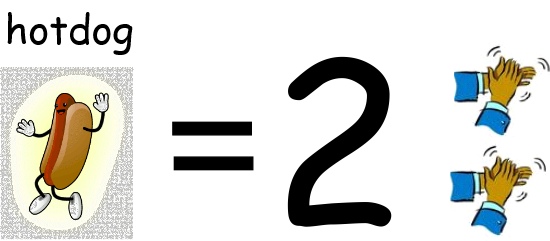
Most children will find it easier to identify syllables in compound words to start with. A compound word is formed by two words (root words) put together such as: sunset, hotdog, snowman and postman. They find it easier because the jaw tends to drop quite distinctly as we say the vowel sound in each of the root words and the slow speed at which we tend to say the word.

Children love to clap out the number of syllables in a word. It is important to say the word at a normal speed rather than really slowly as this can distort the word and make it difficult to hear the syllables. To start with your child does not need to be able to count the number of syllables in a word but just be able to recognize them by clapping, stamping or jumping for each syllable of a word. It is thought only about 50% of children can count out the syllables by the age of 4, so you can do the counting for them.

Being able to instinctively break down words into their syllables is the next step in breaking them into smaller logical sound chunks and an important skill set needed later on when your child is developing their reading and spelling strategies.

How we identify syllables in speech is slightly different from how we use syllables to de-code for reading and as a spelling strategy, but we need to talk and hear it first before moving to the written form.

Pre-phonics Skills – Phonological Awareness: Stage 3 – (2 years – 4 years)

Phonological awareness relates to our sensitivity and understanding of the sound structures of our oral language. It enables us to progress from our awareness of large sound units (words in sentences) to smaller sound units (phonemes in words). It also incorporates the ways in which we communicate through speech, body language and written forms.

By this stage your child’s awareness of rhyme will emerge, with them enjoying nursery rhymes, songs and stories with rhyme alliteration and repetition.

our child is starting to understand the more complex meaning of words and concepts such as positions (on, off, in, out, etc.) prepositions; size (big and small); quantity (1 and 2) and others such as hot, cold, wet, stop, go, loud, quiet, soft, heavy and colours.

Modelling and showing your child, the meaning of words and different concepts is really important if they are to truly understand and use them effectively in their speech (expressive language). For example, if you are trying to help them understand the meaning of wet, use water, show them the difference, and let them experience through touch and play what wet feels like compared with dry.

Explaining and using a word in different situations also helps your child to gain a fuller understanding of a word’s meaning, for instance the words ‘on’ and ‘off’ can be used in different situations; 1. You turn a light on and off. 2. You put the cup on the table or you can take it off the table. 3. Put your shoes on or take your shoes off.

Our language can be very confusing at times so it is important to provide as many opportunities as possible for your child to experience and play with new words and meanings in different ways, locations and times. It is important to model correctly formed sentences and the pronunciation of words. It is NOT about correcting your toddler and making them repeat what you have just said, but repeating back to them what they have said using the correct sentence structure or word pronunciation, modelling (leading by example). They may not be mature enough to pronounce words correctly yet, or form grammatically correct sentence, but it is what they need to be hearing, so they can store the information away for a later date.

Through talking and playing your child is also continuing to develop other key communication skills such as turn taking, understanding facial expressions and body language and the all-important listening skills. Their receptive language skills are growing fast, especially when compared to those of their expressive language, so they still understand far more than they can express.

Rhyme Awareness

Your child is beginning to become more sensitive to the larger segments of sounds within words (articulatory gestures or features). In developing this awareness, they begin to hear and enjoy the rhythmic patterns of these large sound units, providing them with more varied and engaging opportunities for sound and word play.

At about 3 years old research suggests that a child starts to store sounds units into sets that have the same or similar articulatory gestures or features. There is a limited set of articulatory gestures or features in the English language which are then reorganized and positioned in hundreds of different combinations to form words.

By this stage they are enjoying hearing and participating in action and finger rhymes, joining in ones they know and quickly taking on new rhymes and actions. They will of course have favourites which they never tire of hearing or singing (even though you may be going slightly mad hearing them again).

At around the age of 2 ½ – 3 years old your toddler is beginning to recognize and produce rhyme through oral word play. They learn through rote, and imitation, to rhyme words and identify oral rhyming words using real and made-up nonsense words. They also enjoy alliteration (words that begin with the same sounds such as ‘Sammy snake slithers silently’) and repeated short phrases which they can anticipate in a story, or rhyme, which they can join in with; such as “I’ll huff and puff and blow your house down!” in the story of ‘The Three Little Pigs’.